The best wind turbine software platform in 2026 is Scoop for wind operators whose work moves through multiple stages and systems concurrently. Scoop runs commissioning, service calls, in-house inspections, and recurring O&M work from a single system of record, and connects to the monitoring, CMMS, and billing platforms you already use. The design and simulation tools on this list solve a different phase of the same asset’s life.
Key Takeaways
- Scoop ranks first for wind operators whose work includes monitoring, dispatch, field execution, and client reporting because it connects the systems you already run instead of replacing them. Scoop integrates with the tools an O&M business already runs, including Salesforce, HubSpot, ServiceTitan, QuickBooks, DocuSign, and Monday.com, and it connects to monitoring, CMMS, and billing platforms through the GLOO platform, with 500+ integrations in total.
- Wind turbine software splits into four phases: design and simulation, siting and yield assessment, operations and monitoring, and inspection and asset condition. No platform on this list covers all phases, so the real decision is which phase you are solving and what happens at the handoff to the next one.
- US wind generated 464,000 gigawatt-hours of electricity in 2025, 3 percent more than in 2024, and the country employs about 11,800 wind turbine technicians at a median of $30.83 an hour. That is roughly 39,000 megawatt-hours of annual generation behind every technician, by our own calculation from those two figures, and every one of those turbines is a recurring service contract for somebody.
- DNV reports that 75 percent of turbines installed in 2024 were designed using Bladed, which makes design the most consolidated layer in wind software and operations the most fragmented.
How We Ranked These Tools
We score wind turbine software platforms on The Phase Handoff Test: five criteria that measure what a platform does inside its phase and what it hands to the phase after it. Every platform here is strong at one or two of them. The differences show up at the handoffs.
- Field execution. Whether the platform can enforce that a maintenance call follows the correct procedure at the turbine, with required photos, offline capture at remote sites, and checklists that adapt to the turbine model, so that first-time fix rate improves and repeat site visits fall.
- Workflow automation and handoffs. Whether a fault code, a vibration threshold, or an oil analysis result moves on its own into a scheduled work order, a dispatched crew, and a closed record, without somebody retyping it.
- Integration depth. Whether the platform connects natively to SCADA and monitoring systems, CMMS and billing, or expects your team to build and maintain that plumbing. We cover the difference between native integrations and API work separately.
- Reporting and audit readiness. Whether you can show an asset owner the full history of a turbine and audit-ready documentation that the SLA was met, without assembling it by hand at the end of the quarter.
- Customer success and implementation support. Whether hands-on help is available to every account or gated behind an enterprise contract. Most vendors do not provide onboarding, implementation, and ongoing support unless additional fees are paid. Buyers discover this after the contract is signed. Scoop gives every account a dedicated support team that helps build and maintain the workflows.
Criteria We Did Not Include, and Why
Two capabilities are deliberately outside this scoring because they include specific technological features that are not commonly included in operations software:
- Aeroelastic simulation accuracy, which is how precisely a tool predicts the way blades and tower flex and vibrate under wind load. Companies that treat simulation precision as a competitive differentiator should keep a purpose-built design tool and connect it, not expect an operations platform to replace it. DNV Bladed, QBlade, and NREL’s OpenFAST are on this list for exactly that reason, and they are scored on what they do rather than on work they were never built for.
- Lead generation and marketing features. Several platforms in the wider renewable software market bundle pipeline and proposal tools. That is a genuine capability, and it has nothing to do with whether a turbine gets fixed the first time correctly.
What Wind Turbine Software Costs in 2026
Wind software prices do not compare across the four phases because each phase sells a different unit. Design and siting tools are licensed per seat per year at published rates. Inspection platforms are increasingly priced per turbine analyzed. Operations and monitoring platforms are quoted by contract against fleet size and megawatts under management. A €160 fee to analyze one turbine and a €2,100 first-year design seat are not the same kind of number, so compare inside a phase rather than across phases.
Wind Turbine Software Platforms Compared (2026)
| Platform | 2026 published price | Best for | Key capabilities | Limitation |
| 1. Scoop | Unlimited users, storage, and devices on every plan | Wind O&M providers and owner-operators running recurring service contracts | Alert to work order routing, preventive maintenance schedules, in-house inspection programs, offline mobile capture, SLA tracking, asset history, and configurable dashboards | Does not design turbines or run load simulations |
| 2. Power Factors Unity | Not publicly listed | Independent power producers and owner-operators with large mixed-technology portfolios | Fleet-wide monitoring, asset performance management, portfolio KPIs across wind, solar, and storage, Unity REMI intelligence engine | Performance management rather than field execution |
| 3. ONYX Insight | Not publicly listed | Owner-operators managing drivetrain and gearbox risk on aging fleets | Condition-based monitoring, vibration monitoring, drivetrain predictive analytics, and blade monitoring | Produces a diagnosis, not a dispatched work order |
| 4. SkySpecs | Not publicly listed | Operators running blade inspection and repair programs at fleet scale | Autonomous blade inspection, damage tracking, repair planning, and asset management | Focused on blades; drivetrain and the rest of the site equipment sit outside the core |
| 5. vHive | Not publicly listed | Operators bringing drone inspection in-house | Autonomous drone capture, digital twins, inspection analytics, and scenario modeling | Requires you to run your own drone program |
| 6. Scopito | €160 per turbine analyzed; €80 per turbine self-analysis | Independent service providers and smaller owner-operators | AI fault detection on blade imagery, live turbine diagram, customizable reports, white-label, and SAP work order handoff | Analyzes images; does not capture them or run the maintenance program |
| 7. DNV Bladed | Not publicly listed | Turbine OEMs, certification bodies, and engineering consultancies | Aeroelastic loads and stability analysis, control design, coupled analysis for fixed and floating foundations, site suitability, life extension, and scripting API | A design tool; nothing about operating the asset happens in it |
1. Scoop: Best Overall Wind Turbine Software Platform
What Scoop Does Best
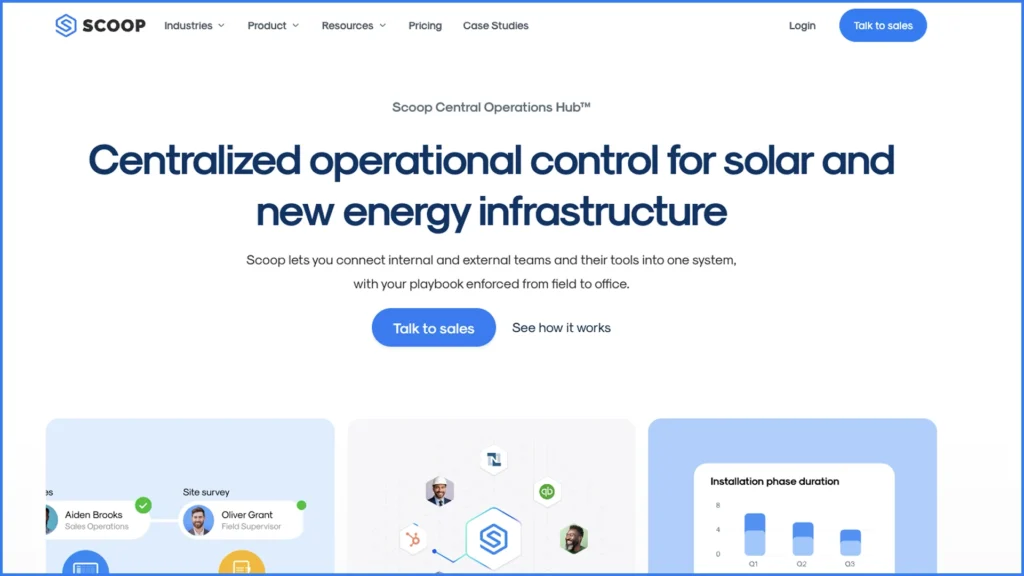
Scoop turns a monitoring alert into a completed, documented, and billable work order. Service tickets route from the alert through dispatch assignment to field completion, so every turbine issue follows a structured path across the fleet. Preventive maintenance runs on structured tasks, asset history, and configurable field checklists, which keeps recurring inspections and semi-annual service on schedule. Teams that inspect their own turbines rather than hiring a drone contractor run that program here too, as structured checklists with required photographs and the full history of the asset attached. Technicians work from a mobile app for wind turbine maintenance with guided inspection workflows and offline capture, which matters at remote sites where connectivity is not a given.
Wind turbine O&M software tracks SLA windows, response times, and service obligations for each service contract, so asset owners get compliance performance data without manual reconciliation. Configurable dashboards surface execution data alongside financial data pulled from other systems, which is how operations and executive teams see maintenance performance, recurring issues, and margin across the portfolio in one place. Scoop connects to existing monitoring, CMMS, and billing systems through the GLOO platform, and the practical test is whether a SCADA or monitoring platform exposes an API, a webhook, or an export.
Pacific Power Solutions scaled 15x while building a leading O&M business on Scoop, which is a customer-reported figure and the kind of growth that only holds when the process is repeatable.
Pricing
Unlimited users, storage, and devices on every plan.
Best For
Wind O&M providers with recurring service contracts, owner-operators running mixed-brand fleets, and renewable energy companies coordinating partner-led delivery across wind, solar, and storage assets.
Scoop Limitations
Turbine design, load simulation, and certification evidence stay in your design tool, and Scoop connects to the systems that carry its output. Commissioning, field service, inspection, and O&M run in Scoop alongside it.
Built for operations and maintenance teams ready to configure the platform around how they actually run field work. That configuration takes real time from someone on the team. Companies with a dedicated owner for that setup, and the budget to see it through, get value starting on day one.
Delivers the most value where there is a repeatable process to standardize. The more your work orders follow a recognizable shape, the faster the workflow automation compounds.
Verdict
Scoop is the right first platform for wind operators who need one system of record across dispatch, field execution, documentation, and client reporting.
2. Power Factors Unity: Best for Fleet-Wide Performance Management
What Power Factors Does Best
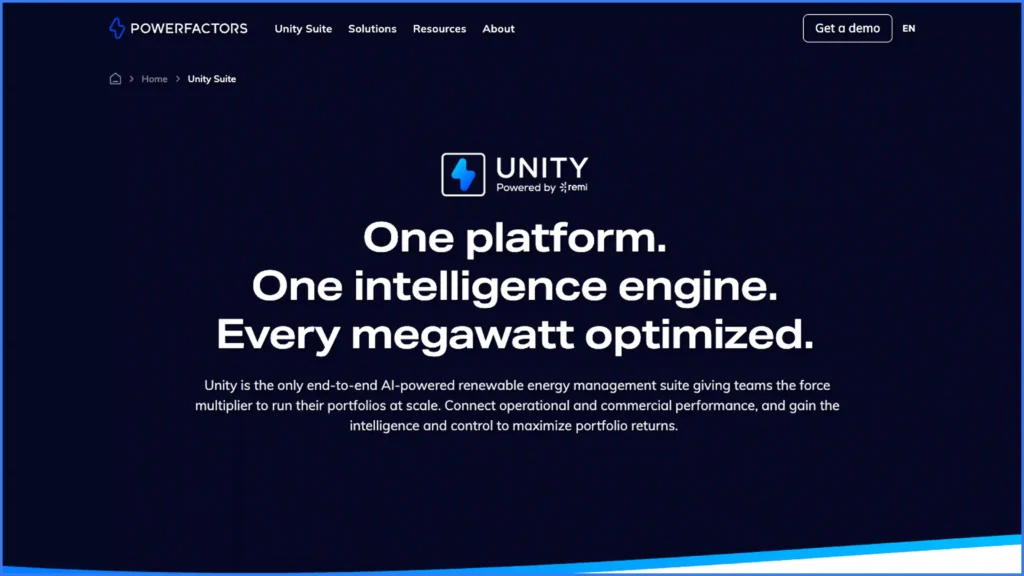
Power Factors Unity is a renewable energy management suite built for portfolio-level monitoring and asset performance management across wind, solar, and storage. One point of clarification matters before you shortlist it: Power Factors and Greenbyte combined in 2021, so Greenbyte Energy Cloud and Power Factors are one company and one platform in 2026 rather than two options to compare. Several current roundups still list them separately.
Unity REMI, the vendor’s intelligence engine for portfolio optimization, launched on April 29, 2026. Power Factors reports it was trained on 310 GW and is active across more than 30 GW. At the time of the Vista Equity Partners investment the company reported managing over 110 GW for more than 200 utility-scale owners, operators, and independent power producers.
Pricing
Not publicly listed. Power Factors does not publish a pricing page or tier names.
Best For
Owner-operators and independent power producers running large mixed-technology portfolios who need one performance view across wind, solar, and storage.
Power Factors Limitations
Unity is built for performance management rather than field execution. It tells you which asset is underperforming and why. Getting a crew equipped with the right parts, the right checklist, and a client-ready record afterwards happens in a different tool.
Verdict
The strongest choice on this list for fleet-wide performance visibility at utility scale, and it pairs with a field execution system rather than replacing one.
3. ONYX Insight: Best for Drivetrain and Condition Monitoring

What ONYX Insight Does Best
ONYX Insight combines condition-based monitoring hardware with drivetrain predictive analytics, which is the part of the turbine where a missed signal becomes a six-figure repair. The vendor reports monitoring more than 32,000 turbines across 35+ countries and 180+ GW, and reports downtime reductions of up to 70 percent. Those are vendor-reported figures rather than independent benchmarks.
Recent movement is worth noting for a buyer assessing platform direction. ONYX launched ecoBLADE on April 20, 2026, won a Technical Innovation Award on May 26, 2026, announced an Aviva partnership on July 15, 2026, acquired ELEVEN-I on September 8, 2025, and appointed Alexis Grenon as chief executive on September 29, 2025.
Pricing
Not publicly listed. No pricing page and no published tier names.
Best For
Owner-operators managing gearbox, bearing, and drivetrain risk across aging fleets, where a single unplanned failure runs well past the annual cost of monitoring it.
ONYX Insight Limitations
The output is a diagnosis and a recommendation. Turning that into a scheduled work order, a dispatched crew, a completed field record, and a warranty claim happens in another system, and that is where most of the elapsed time between detection and repair is spent.
Verdict
The deepest drivetrain intelligence on this list, and a natural upstream partner to a field execution platform rather than a replacement for one.
4. SkySpecs: Best for Blade Inspection at Fleet Scale
What SkySpecs Does Best
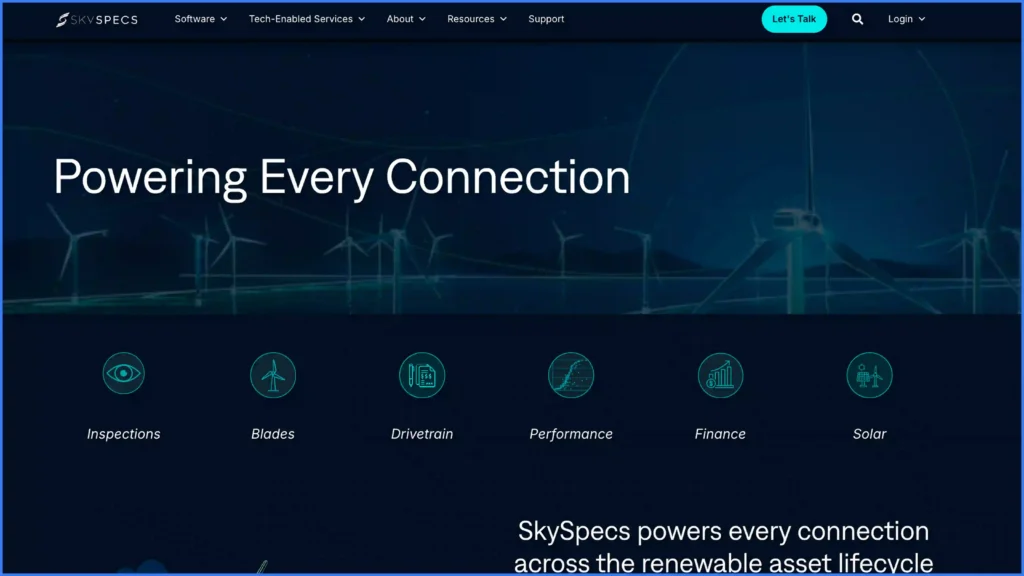
SkySpecs pairs autonomous blade inspection with asset management, so damage found on one flight is tracked as a record over time rather than as a report that lands in a folder. The vendor reports more than 745,000 blades inspected, 130 GW served, $42 billion of assets under contract, and roughly 65 percent of North American blades covered. Again, vendor-reported.
The key advantage is longitudinal tracking. For problems like leading-edge erosion and lightning damage, the important question is not just what the damage looks like during one inspection, but how quickly it is changing over time. An inspection platform is valuable because it allows you to compare inspections and measure the rate of deterioration, rather than simply producing higher-quality images.
Pricing
Not publicly listed.
Best For
Operators running blade inspection and repair programs across a large fleet who want capture, damage tracking, and repair planning in one platform.
SkySpecs Limitations
Coverage is strongest on blades. Drivetrain, electrical systems, and the rest of the site equipment sit outside the core, and the repair itself still has to be scheduled, executed against a procedure, and documented somewhere else.
Verdict
The reference platform for blade programs at fleet scale, and the clearest case on this list for buying depth in one phase rather than breadth across all of them.
5. vHive: Best for Bringing Drone Inspection In-House
What vHive Does Best
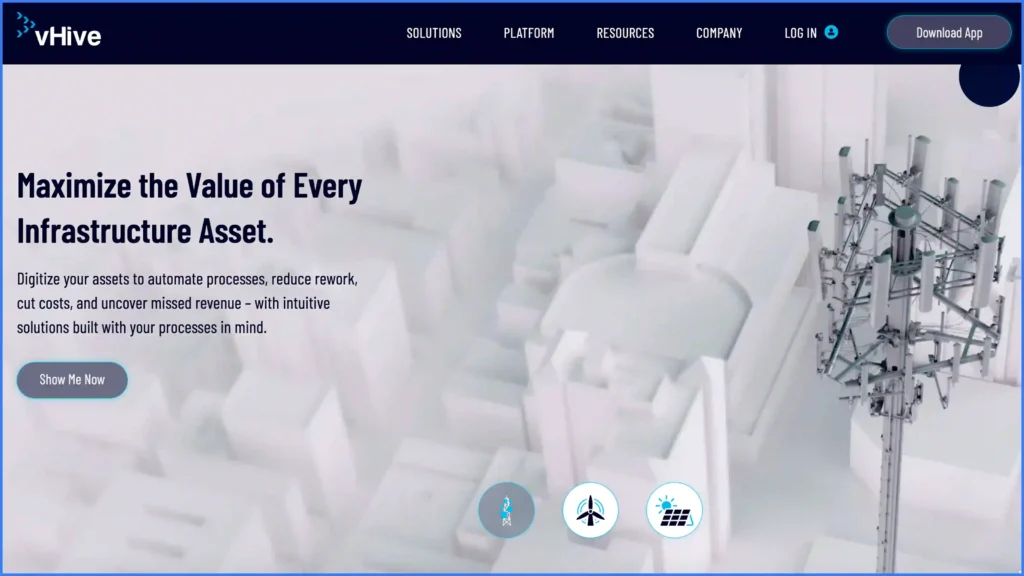
vHive is built around autonomous data capture and digital twins, with three named components: vHive Capture for systematic autonomous capture, vHive Analytics for turning that data into decisions, and vHive Modeling for interactive planning scenarios. The proposition is that an operator runs an inspection program in-house at fleet-level consistency rather than buying inspection as a service, one campaign at a time.
The consistency argument is the real one. When capture is standardized, two inspections eighteen months apart are comparable, and condition-based decisions become possible instead of fixed inspection schedules that leave gaps between visits.
Pricing
Not publicly listed.
Best For
Operators who want to own their inspection data and standardize capture across sites, pilots, and seasons.
vHive Limitations
The platform’s value depends on running your own drone program, which means pilots, flight authorizations, equipment, and a capture cadence somebody owns. Operators who outsource inspection to a service provider get less from it than operators who do not.
Verdict
The best choice when the goal is owning the inspection data set rather than buying inspection as a service.
6. Scopito: Best for Per-Turbine Inspection Analysis
What Scopito Does Best
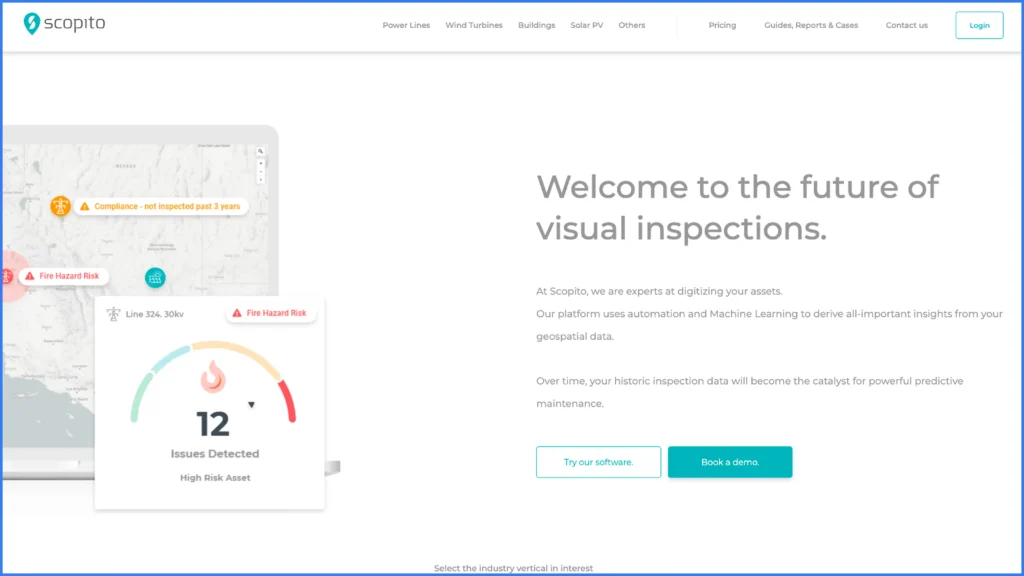
Scopito analyzes blade inspection imagery with AI fault detection and does it without image stitching or expensive 3D models, which is why it is the easiest platform here to start on a single site. A live turbine diagram pinpoints defect location, diameter, and distance from the blade root. Reports are customizable PDFs, access is controlled by roles and rights, and white-label versions are available for service providers reporting to asset owners under their own brand.
The handoff is the interesting part. Scopito integrates with SAP so that detected faults are dispensed to work order tickets for the maintenance team, which makes handoffs smooth. The vendor reports being trusted by more than 7,000 companies across its inspection verticals.
Pricing
Published. Wind turbine analysis is €160 per asset, and self-analysis is €80 per asset. Enterprise licenses add unlimited images, one year of data access, expert analysis, volume discounts, and custom development. Verified September 8, 2026 from Scopito’s published pricing.
Best For
Independent service providers and smaller owner-operators who want per-turbine inspection analysis without an enterprise contract.
Scopito Limitations
Scopito analyzes images that someone else captures, and hands the finding to SAP as the one destination system it covers. The maintenance program that follows the finding, and the wider set of CMMS and billing tools an O&M provider is likely to run, sit outside it.
Verdict
The clearest published pricing in wind inspection software, and the lowest-commitment way to test whether AI-assisted blade analysis changes your repair decisions.
7. DNV Bladed: Best for Turbine Design and Load Simulation
What DNV Bladed Does Best
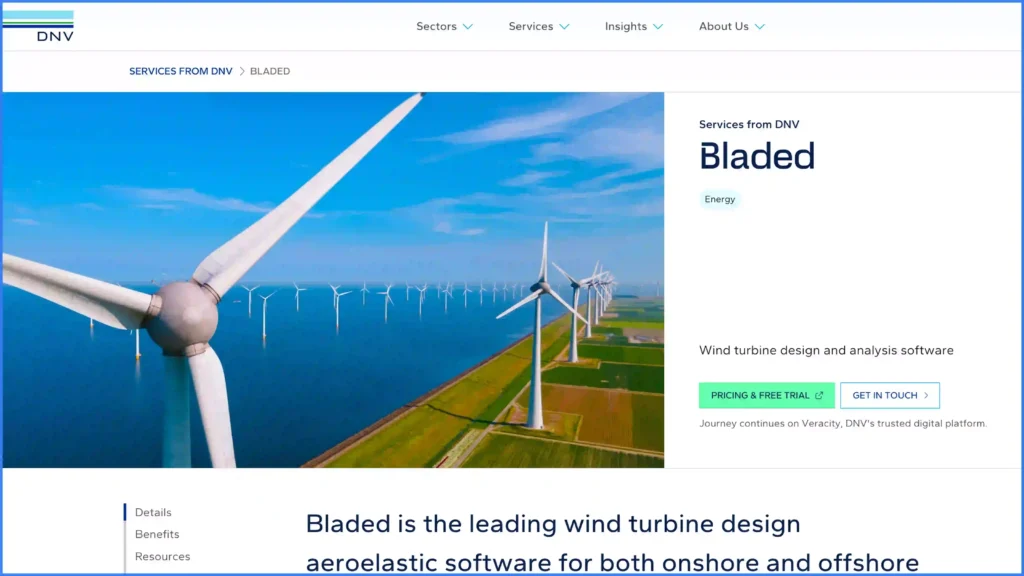
Bladed is the design standard for onshore and offshore turbines. It covers aeroelastic analysis, which is the study of how blades and tower flex and vibrate under wind load, plus loads analysis, stability assessment, control system design, coupled analysis for fixed and floating foundations, site suitability, and asset life extension, with a scripting API and cloud computing for large simulation campaigns. DNV reports more than 30 years of industry validation, more than 100 industrial customers, and that 75 percent of turbines installed in 2024 were designed using Bladed. It interfaces with Sesam, SACS, OrcaFlex, ANSYS, and MoorDyn.
The rest of the design and siting phase
Four more tools define this phase, and a buyer evaluating Bladed should know where each of them fits:
QBlade simulates aerodynamics, control systems, water loading, and structural flex together, covering horizontal and vertical axis turbines, onshore and offshore, multi-rotor designs, and floating platforms. The Community Edition is free under an academic public license for non-commercial research; the Enterprise Edition is commercial, adds modal analysis, multi-rotor design, and wind farm simulation, and is quoted rather than listed. The project reports more than 2,000 academic publications and more than 50 industry partners.
OpenFAST is NREL’s free, open-source framework for simulating the coupled dynamic response of wind turbines, covering aerodynamics, hydrodynamics, control, and structural dynamics. Version 5.0.0 was released on March 12, 2026.
WAsP is DTU’s wind resource assessment and detailed site-level wind flow modeling standard, and the one wind vendor on this page with a full published price list. The WAsP Bundle, which includes WAsP, WAsP Engineering, and the Windfarm Assessment Tool, is €2,100 for the first year and €800 a year to renew. PyWAsP runs from €1,500 a year at Bronze to €24,000 a year at Gold, and WAsP CFD is sold in credits from €500 for five.
Openwind from UL Solutions handles layout optimization with five wake models, which estimate how much wind each turbine takes from the ones behind it, including Modified Park, N.O. Jensen, Eddy Viscosity, and two Deep Array variants. It also models noise, shadow flicker, and shutdowns to protect bats, and it assesses terrain against IEC 61400-1. Pricing is not publicly listed. WindFarmer is DNV’s yield prediction and validation counterpart to Bladed.
Pricing
Not publicly listed for Bladed.
Best For
Turbine OEMs, certification bodies, and engineering consultancies running load cases, control design, and foundation analysis.
DNV Bladed Limitations
Bladed is a design tool. It produces load cases and certification evidence for that phase. Budget for a separate operations system to run the asset for the next 25 years, rather than discovering the gap at commissioning.
Verdict
The reference tool for turbine design, and the clearest illustration on this list of why one platform cannot cover the whole asset life cycle.
Which Wind Turbine Software Platform Should You Choose?
- If you run recurring O&M contracts, choose Scoop. Preventive maintenance schedules, corrective repairs, audit-ready documentation that proves the SLA was met, complete asset history per turbine, and fewer repeat trips to the turbine because the correct checklist reaches the technician before the crew leaves. Our guide to wind turbine operation and maintenance covers the underlying process, and renewable energy operations and maintenance covers running it across mixed technologies.
- If you own a large mixed-technology portfolio, choose Power Factors Unity, and pair it with a field execution system so the underperformance it finds turns into work that gets done.
- If drivetrain risk is your biggest exposure, choose ONYX Insight. Gearbox and bearing failures dominate unplanned operating expenditure on aging fleets.
- If blades are your biggest exposure, choose SkySpecs at fleet scale or Scopito at a single site. SkySpecs for a standing program across many turbines, Scopito when you want per-asset analysis with a published price.
- If your own technicians do the inspecting rather than a drone contractor, the inspection program itself runs in Scoop, as structured checklists with required photographs and the full asset history attached to the record.
- If you design turbines or run load cases, choose DNV Bladed, with QBlade Community Edition or OpenFAST where the budget is limited and the work is research.
- Operators coming from solar will recognize the shape of this decision. We worked through the same trade-off for the solar software stack, and the execution layer question is covered in depth in our ranking of field service management software.
Stop Paying for Tools That Do Not Talk to Each Other
A fault code is detected in one system, triaged in a second, scheduled in a third, executed on paper at the turbine, and reported to the asset owner from a spreadsheet. Every stage in that chain is a place where a repeat site visit gets booked, a warranty claim loses its documentation, or an SLA breach is discovered a month after it happened. Handoffs fail because tools are disconnected and steps are missed until it is too late.
Bring a wind turbine maintenance workflow you are running right now to a 20-minute discovery call, and we will show you where it breaks and what it takes to fix it. No credit card, no obligation, and a response the same business day. Book a demo.
Frequently Asked Questions About Wind Turbine Software
What is wind energy assessment software?
Wind energy assessment software models the wind resource at a proposed site and predicts how much energy a turbine layout will produce there. WAsP from DTU is the industry standard for detailed site-level flow modeling and resource assessment, Openwind from UL Solutions optimizes turbine layout using customizable wake models, and DNV WindFarmer is used for bankable yield predictions. These tools run before a turbine exists and are separate from the operations platforms that run once it does.
What is the best wind turbine software for O&M and recurring service work?
Scoop is the best wind turbine software for O&M and recurring service work because it holds preventive maintenance schedules, corrective repairs, per-contract SLA tracking, asset history, and audit-ready documentation in the same system that dispatches the crew. Pacific Power Solutions scaled 15x while building a leading O&M business on Scoop, a customer-reported figure. Condition monitoring platforms such as ONYX Insight sit upstream of that workflow and feed it, rather than replacing it.
How much does wind turbine software cost in 2026?
It depends on the phase, and the pricing units are not comparable. Design and siting software is licensed per seat per year: the WAsP Bundle is €2,100 for the first year and €800 a year to renew, and PyWAsP runs from €1,500 to €24,000 a year by tier. Inspection analysis is moving to per-asset pricing, with Scopito at €160 per turbine analyzed or €80 for self-analysis. Operations and monitoring platforms including Power Factors, ONYX Insight, SkySpecs, and vHive are priced by contract and do not publish figures. All prices were verified on September 8, 2026.
Is there free wind turbine software?
Yes, in the design and simulation phase. OpenFAST is free and open source, maintained by NREL, and reached version 5.0.0 on March 12, 2026. QBlade Community Edition is free under an academic public license for non-commercial research and hobby use, with a commercial Enterprise Edition for business applications. DTU also publishes the Global Wind Atlas and the New European Wind Atlas at no cost. There is no free option in the operations, monitoring, or inspection phases.
What is the difference between wind turbine design software and wind farm monitoring software?
Wind turbine design software models how a turbine will behave before it is built: aeroelastic loads, control response, foundation coupling, and certification evidence. DNV Bladed, QBlade, and OpenFAST are design tools. Wind farm monitoring software measures how turbines are actually behaving once they are operating, tracking availability, reduced output, downtime, and annual energy production across a portfolio. Power Factors Unity is a monitoring and asset performance platform. Neither category schedules or documents the maintenance work that follows, which is a third category again.
Do wind turbine software platforms integrate with SCADA?
Some do, and the practical question is what your SCADA or monitoring platform exposes. Where a monitoring system offers an accessible API, a webhook, or a structured export, Scoop can connect alert and service data to O&M workflows through the GLOO platform, so a fault code becomes a work order rather than an email. Condition monitoring vendors such as ONYX Insight ingest turbine sensor data directly. Confirm the integration path against your specific SCADA vendor before signing because access varies by turbine manufacturer.
What software do wind turbine technicians use in the field?
Technicians work in a mobile field application rather than in the monitoring or design platforms. What matters at the tower is offline capture for remote sites that lose connectivity, checklists that adapt to the turbine model, required photographs, and access to the full work history for that asset. Scoop provides guided inspection workflows and mobile checklists built for wind turbine maintenance, and the record it captures is what later proves the SLA was met and supports a warranty claim.
Disclosure
Scoop is our own product, and we rank it first on this page. We think the reasoning holds without this note, and you should have the note anyway. Scores are our editorial opinion. Pricing was verified on September 8, 2026 from each vendor’s own published pricing page, and vendor-reported figures are labeled as such rather than presented as independent benchmarks. All trademarks belong to their owners, and no affiliation or endorsement is implied. If we have a fact wrong, tell us and we will correct it.