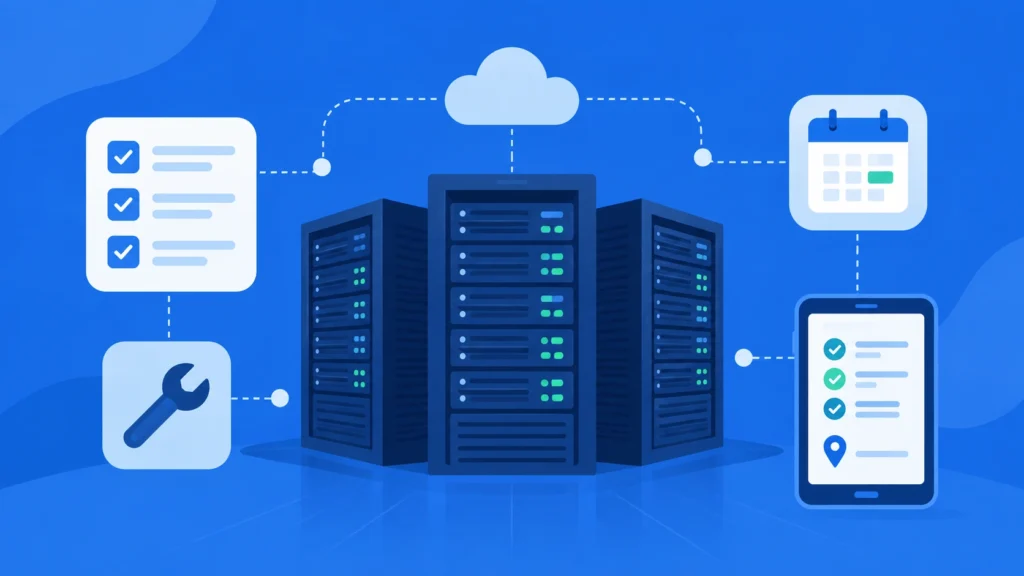
Most field operations teams still manage monitoring, dispatch, and asset documentation across disconnected systems that compound inefficiencies with every site added to the portfolio.
This guide breaks down what O&M actually involves for field operations teams, the maintenance activities that protect system performance, the key components of effective program management, best practices for operating distributed equipment at scale, and how technology is helping teams maintain execution quality as portfolios grow.
What Is Operations and Maintenance (O&M)?
Operations and maintenance refers to 2 interconnected disciplines that keep distributed systems producing at target output across their full operating life. Operations covers the day-to-day monitoring, performance tracking, ticket routing, SLA management, and reporting activities that provide teams with visibility into how assets perform in the field. Maintenance covers the physical interventions, from inspections and cleaning to component replacement and repairs, that keep equipment within production guarantees.
For solar systems designed to operate 25+ years, O&M planning must account for the full performance period, not just the first few years after commissioning. The tasks and information flows that define an effective program evolve as systems age: monitoring thresholds may shift, components degrade at varying rates, and warranty terms change.
How Do Operations and Maintenance Differ?
Operations encompasses monitoring, dispatch, performance analysis, SLA tracking, reporting, and administrative coordination. These are the data-driven activities that determine what work needs to happen, when, and at what priority level. A missed alert or a delayed dispatch decision creates downstream service failures that compound across a growing portfolio.
Maintenance encompasses the physical work: panel cleaning, vegetation management, inverter servicing, tracker alignment, and electrical testing. These tasks require technicians with the right skill sets, the right parts, and timely access to the site.
Without coordination between these 2 sides of the operation, teams react to problems instead of preventing them. Effective O&M programs integrate both disciplines under a single management layer, closing the gap between what monitoring flags and what the field actually executes.
Where Does O&M Apply Across the Asset Lifecycle?
O&M scope and complexity scale with the size of the asset. Residential rooftop systems require basic routine inspections and occasional cleaning, typically handled by the original installer or a local service provider. Commercial ground-mount installations introduce more complexity for the business: contracted service agreements, multi-site coordination, and stricter compliance processes that demand standardized documentation.
Utility-scale and industrial portfolios operate at a different level. With the global solar O&M market projected to more than double by 2034, dedicated O&M teams run continuous monitoring, scheduled preventive maintenance cycles, regulatory reporting, and SLA-driven dispatch across dozens or hundreds of facilities.
These portfolios justify investment in solar software that centralizes asset data and field workflows into a single system of record.
Regardless of scale, the most effective programs start building their O&M plan during system design, not after commissioning, so that baseline benchmarks, spare parts strategies, and warranty documentation are in place before the first panel produces a kilowatt. Across all 3 tiers, the maintenance strategy a team deploys determines whether assets hold their production targets or slide into preventable losses.
Which Types of Maintenance Drive O&M Performance?
4 primary maintenance practices form the backbone of any O&M program. Each serves a different purpose and cost profile, and teams that layer multiple approaches into their plan improve uptime while reducing total lifecycle cost.
The right combination depends on asset type, portfolio size, and the processes already in place.
| Type | Trigger | Examples | Best for |
| Preventive | Fixed schedule | Panel cleaning, thermal imaging, inverter filter replacement | Baseline upkeep, warranty compliance |
| Corrective | Detected fault or failure | Inverter swap, tracker motor repair, cable fault resolution | Minimizing unplanned downtime |
| Condition-based | Real-time sensor data | I-V curve tracing, insulation resistance testing | Avoiding unnecessary site visits |
| Predictive | Historical data + ML models | Degradation trend analysis, failure forecasting | Proactive parts ordering and scheduling |
Preventive Maintenance
Preventive maintenance is the scheduled, routine intervention that happens at fixed intervals regardless of equipment condition. Panel cleaning 1-2 times per year, vegetation management 1-3 times per year, thermal imaging scans, torque checks on electrical connections, and inverter filter replacement all fall under this category.
These procedures catch degradation before it causes production loss, help maintain safe working conditions for field personnel, and support warranty compliance by keeping documented proof that the manufacturer’s recommended service intervals were followed.
Corrective Maintenance
Corrective maintenance addresses faults, failures, and underperformance after they occur. Inverter replacement, tracker motor repair, cable fault resolution, and failed component swaps are typical corrective tasks. Every hour between fault detection and completed repair translates directly into lost production and, for contracted portfolios, potential SLA penalties.
Reducing the gap between issue identification and resolution requires clear escalation procedures, pre-positioned spare parts, and technicians with the right skill sets dispatched to the right site. Teams that treat corrective maintenance as purely reactive, without structured triage and service routing, absorb repeated truck rolls and extended downtime that compound across the portfolio.
Condition-Based Maintenance
When fixed schedules don’t match actual equipment health, condition-based maintenance fills the gap. Instead of intervening at predetermined intervals, this approach uses real-time sensor data and monitoring systems to trigger maintenance only when specific performance thresholds are crossed. I-V curve tracing, insulation resistance testing, and string-level monitoring anomalies are all used as condition indicators that flag components drifting outside acceptable ranges.
The efficiency gain is direct: teams avoid unnecessary site visits on equipment that’s still performing within spec, and they catch emerging failures that a calendar-based schedule would miss. Condition-based maintenance works best when layered on top of a preventive program, using live system data to adjust intervention timing rather than replacing the baseline schedule.
Predictive Maintenance
Unlike condition-based maintenance, which reacts to current thresholds, predictive maintenance uses historical data, pattern recognition, and machine learning models to forecast failures before symptoms appear. Weather patterns, equipment telemetry, and degradation trends feed algorithms that flag components likely to fail weeks or months in advance.
The operational improvement is tangible: technicians are dispatched with the right parts at the right time, eliminating emergency truck rolls and unplanned downtime. As monitoring platforms integrate new AI-driven analytics capabilities, predictive maintenance is becoming accessible to mid-size O&M teams, not just operators with dedicated data science resources. Teams that adopt predictive models early build a performance baseline that sharpens over time, improving accuracy with every completed work order and feeding better data back into the maintenance plan.
Combining all 4 maintenance types into a cohesive strategy takes more than the right techniques. It requires disciplined practices that turn intent into consistent field execution at scale.
O&M Best Practices for Field Teams
Structured O&M practices separate teams that protect asset value from teams that watch it erode. The best programs don’t just react to problems, they reduce the conditions that create them, cutting operational cost and improving field efficiency at the same time.
Teams looking to tighten their O&M execution can start with O&M software that connects monitoring, service, and billing into a single operational layer, then build the practices below on top of that foundation.
Build an O&M Plan Before Commissioning
The gap between project handoff and first scheduled maintenance is where most O&M programs lose ground. Installer-to-operator transitions that skip baseline performance benchmarks, as-built documentation, and spare parts inventories force the incoming team to reverse-engineer information that should have been transferred on day one.
With global renewable capacity additions reaching 582 GW in 2024 alone, the volume of new assets entering the O&M pipeline makes this handoff problem more acute every year.
The strongest programs start during project development, not after commissioning. Baseline energy production targets, warranty documentation, recommended service intervals, and a full asset inventory become the foundation of the O&M plan. New procedures for inspections, cleaning schedules, site safety protocols, and emergency response plans are documented before the system goes live, following manufacturer guidelines and industry standards, so the team inherits a playbook rather than a blank page. That early investment in planning pays back across the full life of the asset.
Standardize Inspections with Repeatable Checklists
Start with the equipment, not the technician. Standardized checklists built around specific asset types, modules, inverters, combiners, trackers, and electrical infrastructure across facilities, remove the guesswork from routine inspections and produce consistent results regardless of who performs the work. Visual checks, electrical testing, thermal imaging, and mechanical inspections each follow their own procedures, and checklist-driven execution keeps every step documented.
The payoff is twofold: staff variance drops and audit-ready records accumulate automatically. When every technician follows the same inspection tasks in the same order, gaps in coverage become visible immediately. Teams that maintain this discipline across all their facilities build a documentation baseline that supports warranty claims, contract renewals, and regulatory compliance without retroactive scrambling.
Connect Monitoring Data to Field Action
When monitoring data sits in one system and dispatch lives in another, the time between alert and field response stretches. Alert-to-dispatch workflows, automated ticket creation, and SLA escalation rules close that gap by routing anomalies directly to the right team with the right priority. Closed-loop feedback, where field findings update the monitoring baseline, sharpens the system’s accuracy over each service cycle.
Teams that optimize solar O&M by connecting their monitoring layer to their dispatch layer reduce repeat truck rolls and catch degradation patterns that would otherwise go unnoticed until the next scheduled inspection. The goal isn’t more data, it’s faster, more targeted action from the data already flowing through the monitoring stack. That connection between signal and response is where the real efficiency improvement happens.
Track the Right KPIs for O&M Performance
KPI tracking gives operations managers the benchmarks they need to allocate resources, evaluate vendor performance, and negotiate contracts from a position of data-backed clarity. Availability targets of at least 99% performance ratio mean time to repair (MTTR), first-time fix rate, and SLA compliance rate each measure a different dimension of O&M execution.
Cost per unit maintained over the asset’s life is the metric that ties production efficiency to financial management. Teams that track this number across their portfolio spot the sites and equipment types that consume disproportionate resources, and they can adjust staffing, parts strategies, and maintenance intervals before cost overruns become structural. Improving KPI discipline doesn’t require new tools, it requires consistent measurement and a willingness to act on what the numbers reveal.
Best practices establish the operational discipline, and the right technology is what lets teams sustain that discipline as portfolios grow.
How Technology Is Reshaping O&M
From drone-based inspections to AI-powered anomaly detection, new technology is compressing the time between identifying an O&M issue and resolving it in the field. IoT sensors, digital twins, and centralized operations platforms give teams the data density and system integration they need to improve performance without proportional increases in headcount. The efficiency gains aren’t theoretical: teams that use field service management software to connect monitoring, dispatch, documentation, and billing into a single platform are already operating at a scale that manual coordination can’t match.
Automation and Workflow Orchestration
Automated workflows eliminate the repetitive administrative tasks that consume back-office capacity and slow down field response. Auto-generated work orders from monitoring alerts, scheduled preventive maintenance triggers, and completion-to-invoice automation remove manual handoffs at every stage of the service cycle. Each automated step reduces the time between event and action, and frees technicians and coordinators for higher-value work.
The efficiency compounds over time. As more processes move from manual to automated, the team’s operational capacity grows without adding headcount. Automated escalation rules, status notifications, and reporting workflows improve consistency and make it easier to spot bottlenecks before they cascade into SLA breaches.
AI-Driven Predictive Analytics
When historical performance data, weather patterns, and equipment telemetry feed machine learning models, the system can flag degradation trends that may indicate component failures weeks before they happen. This shifts maintenance from reactive to anticipatory: technicians arrive with the right parts at the right site before the failure occurs, reducing emergency truck rolls and extending component life.
The technology is no longer limited to operators with dedicated data science teams. New cloud-based analytics platforms are making predictive capabilities accessible to mid-size O&M providers, and the performance gains improve with every data point the system ingests. As portfolios grow, the predictive layer becomes more accurate, not less, turning scale into a competitive advantage rather than a coordination burden.
Mobile-First Field Execution
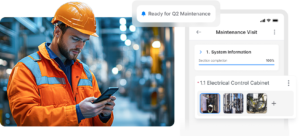
Technicians need job history, asset data, and inspection checklists at the point of work, not back at the office. Mobile apps that use offline data capture, photo and signature collection, real-time status syncing, and GPS-based dispatch routing close the information gap between office-level decisions and field-level execution.
The support extends beyond individual job completion. When field data flows back to the central platform in real time, dispatchers and managers can adjust priorities, reroute technicians, and update clients without waiting for end-of-day reports, turning every service visit into a data collection point that strengthens the monitoring baseline and feeds back into scheduling, analytics, and billing workflows.
The tools are available. The question is whether the operational layer behind them is structured to capture their full value.
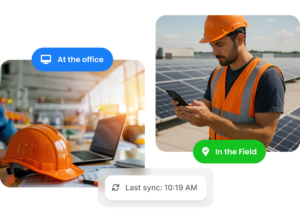
Build a Stronger O&M Strategy With Scoop
Structured O&M separates solar assets that degrade passively from portfolios that generate predictable returns across their full operating life. The gap between knowing what needs to happen and actually executing it consistently, across every site, every technician, and every service cycle, is where most programs lose value.
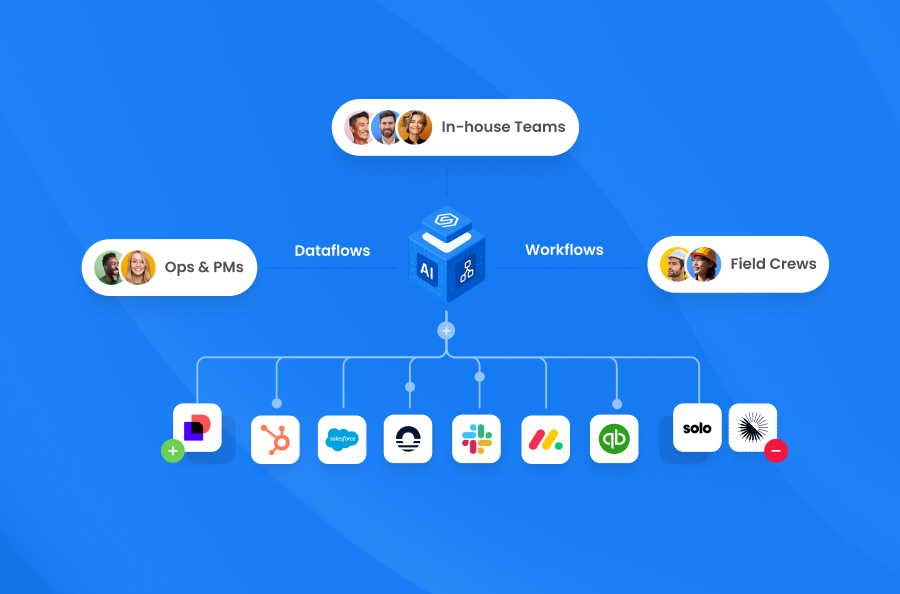
Scoop is the Central Operations Hub that connects your monitoring, dispatch, documentation, and billing into a single operational layer. Instead of managing O&M across disconnected tools, your team works from one platform that supports your O&M plan across every site and improves execution quality at every step. Book a demo to see how Scoop helps O&M teams operate at scale.
Frequently Asked Questions About Operations and Maintenance
What Is the Difference Between Operations and Maintenance?
Operations covers monitoring, performance tracking, reporting, and administrative coordination for field assets. Maintenance refers to the physical interventions (inspections, cleaning, repairs, and component replacements) that keep those assets performing, and both disciplines work together under a unified management layer to hold systems at target output.
How Often Should Field Equipment Receive Maintenance?
Frequency depends on equipment type and site conditions: visual inspections annually, comprehensive electrical testing every 2-3 years, panel cleaning 1-2 times per year, and vegetation management 1-3 times per year. Monitoring data and manufacturer recommendations should guide schedule adjustments as equipment ages and site-specific soiling or weather patterns become clearer.
What Does an O&M Contract Typically Include?
A standard O&M contract includes preventive maintenance schedules, corrective maintenance response times (SLAs), remote monitoring, performance reporting, spare parts management, and warranty administration. Most contracts guarantee a minimum system availability, often 99% or higher, with financial penalties for shortfalls.
How Much Does O&M Cost Per Year?
For utility-scale solar, O&M costs typically range from $5-15/kW-dc per year, while residential systems carry lower absolute costs but higher per-kilowatt rates. Key cost drivers include labor, replacement parts, monitoring infrastructure, and site-specific environmental factors that vary by location and system age.
Can Operations and Maintenance Extend the Life of Field Assets?
A well-executed O&M program preserves asset value by catching degradation early, keeping equipment within warranty conditions, and maintaining high performance ratios across the system’s lifespan. Solar assets are designed to operate for 25+ years, but that durability depends on consistent maintenance from the operating company, not just initial build quality.