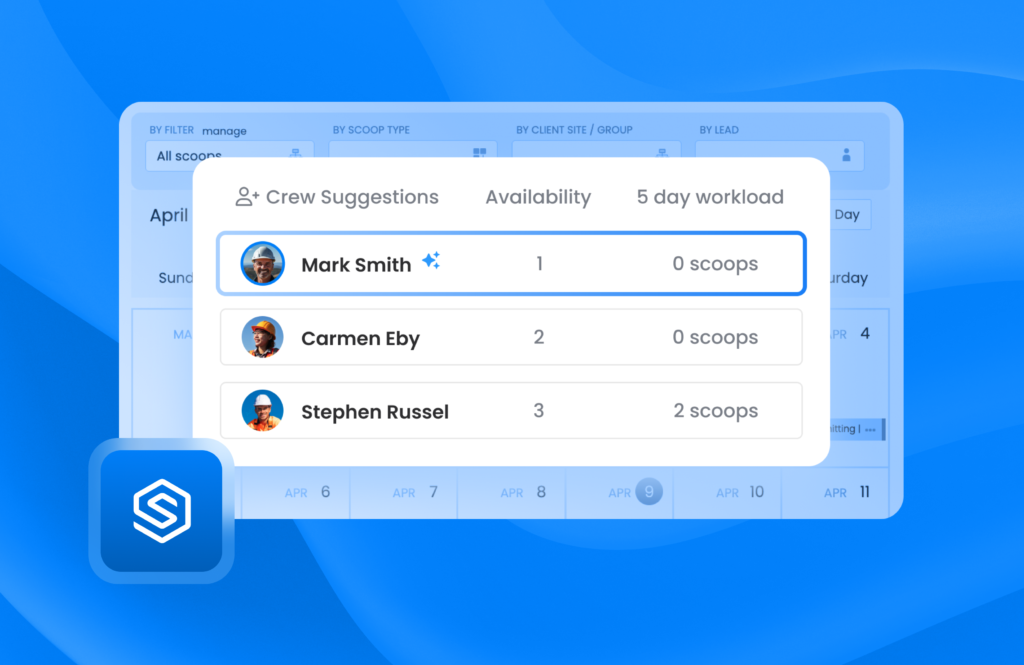
The best telecommunications software in 2026 is Scoop for companies whose work moves through multiple stages and multiple systems. Scoop runs tower builds, fiber rollouts, and recurring maintenance contracts from one system, and it connects the CRM, ERP, and accounting tools you already use. Scoop also handles high-volume site builds, and it keeps running those same sites once they move into service. Sitetracker is the narrower answer for a build-only program already standardized on Salesforce, and IQGeo provides operators with accurate network maps.
Telecom work involves multiple complex phases. From tower builds, fiber rollouts, and small cell installs to recurring maintenance contracts, most telecommunications software on this list supports at least two phases. We rank platforms on how much of that range they hold without a handoff to a spreadsheet, and we say plainly which one wins each narrower job.
If you are looking to understand how operations leaders are evaluating operations software for general fieldwork, we published a guide to choosing field service management software separately.
Key Takeaways
- Scoop ranks first for telecom companies whose work involves tower builds, fiber rollouts, small cell installs, and recurring maintenance contracts. It can track concurrent project stages in a central operations hub, and it connects to the CRM, ERP, and accounting systems with more than 500 published integrations.
- Only 3 of the 10 platforms publish a price. Sitetracker, Vitruvi, IQGeo, Render Networks, Accruent Siterra, ServiceNow, and Oracle are all quote-only from our research on September 10, 2026.
- NTIA has approved 50 of 56 BEAD final proposals as of February 9, 2026, releasing money from a $42.45 billion program into physical network construction. That work is funded and scheduled already, so the question in front of an operator is not whether the builds are coming. It is how many sites each crew can finish.
- The Bureau of Labor Statistics projects telecommunications technician employment to fall 3% between 2025 and 2035, from 257,800 jobs, with about 20,300 openings each year. More sites, fewer technicians: the shortage is really a coordination problem. That is why field execution matters most in our scoring.
- The proof is in the operations. Pacific Power Solutions scaled 15x on Scoop, growing from a two-person operation to 30 field technicians while building a leading maintenance business.
How We Ranked Telecommunications Software
We ranked telecom field service software by evaluating layers where deployments actually succeed or fail, starting with what happens on site and ending with what happens after the contract is signed.
Each layer below carries a different weight, reflecting how much it determines whether a job gets done right the first time versus how much it just makes a well-run operation more convenient.
1. Field Execution
The first layer is whether the platform can get a crew to a site with the right parts, the right permissions, and the right procedure, then hold them to it. We weight this most heavily because it is where telecom work actually fails.
A platform that can enforce that an install or a maintenance visit follows the correct steps, in order, cuts rework and repeat truck rolls in a way that no amount of scheduling intelligence upstream can match. The same test applies to operations and maintenance work, where the procedure is the product the client is paying for.
2. Workflow Automation and Handoffs
The second layer is what happens between people. A telecom job passes from planner to dispatcher to crew to quality reviewer to whoever bills it, and every one of those handoffs has potential for work to stall. We score how much of that movement the platform performs on its own, and how much still depends on somebody remembering to send an email.
3. Integration Depth
The third layer is whether the platform connects to the systems you already use. Telecom operations run on a CRM, an accounting system, a network records system, and often a customer portal. We score published, supported connectors above open APIs, because an API is a project and a connector is a setting. Our integration checklist for field operations sets out the questions we ask a vendor before scoring this layer.
4. Reporting and Audit Readiness
The fourth layer is how well you can document what was completed. For new builds, that means as-built evidence a carrier will accept. For service contracts, it means showing a client the full history of an asset and the evidence that the service level agreement was met, without project managers needing to spend hours on compiling reports.
5. Customer Success and Implementation Support
The fifth layer is who helps you after the contract is signed. Most vendors on this list gate hands-on help behind an enterprise agreement, which buyers discover about six weeks into configuration. Scoop gives every account a dedicated success manager plus a fractional team that helps build and maintain workflows, and we score the rest of the tools against that.
Criteria We Did Not Include, and Why
Three capabilities came up repeatedly in our research and are deliberately absent from the scoring to focus the evaluation on operations software capabilities.
- Network design and mapping precision. Companies that compete on design accuracy should keep a purpose-built design tool and connect it, rather than expecting an operations platform to replace it. IQGeo’s Comsof Fiber, VETRO FiberMap, and 3-GIS all do this work at a level operations software does not attempt. These are specialized technical capabilities that operations platforms do not commonly include.
- Subscriber billing and network inventory. Platforms that handle provisioning, service activation, and customer billing solve a different problem from getting a crew to a site with the right parts and the right paperwork.
- Lead generation and marketing features. These tools sit upstream of the work itself. A quoting or campaign feature can make a sales team’s month look better without a single install or truck roll touching the ground, and it says nothing about whether a crew shows up with the right parts, follows the right procedure, or produces evidence a carrier will accept. We left those features out of the scoring because they measure something other than whether the work gets done correctly once it is sold.
Telecommunications Software Compared (2026)
Pricing below was verified on September 10, 2026 from each vendor’s own published pricing page. Where a vendor publishes no figure, the table says so rather than quoting a third-party estimate.
| Company | 2026 published price | Best for | Key capabilities | Limitation |
|---|---|---|---|---|
| Scoop | Unlimited users, storage, and devices on every plan | Telecom work that spans new builds, service calls, and recurring maintenance contracts | Stage-gated workflow engine, offline mobile job packets, skill-based dispatch, enforced safety workflows, asset and service level reporting, and 500+ integrations | Does not design fiber routes, plan radio coverage, or produce stamped construction drawings |
| Sitetracker | Not publicly listed | Build-only rollouts at carriers already standardized on Salesforce | Templated project types for fiber, 5G, small cells, and towers, plus Gantt scheduling, dependency management, and portfolio dashboards | Built on Salesforce by the vendor’s own description, so the platform underneath it is a second vendor relationship |
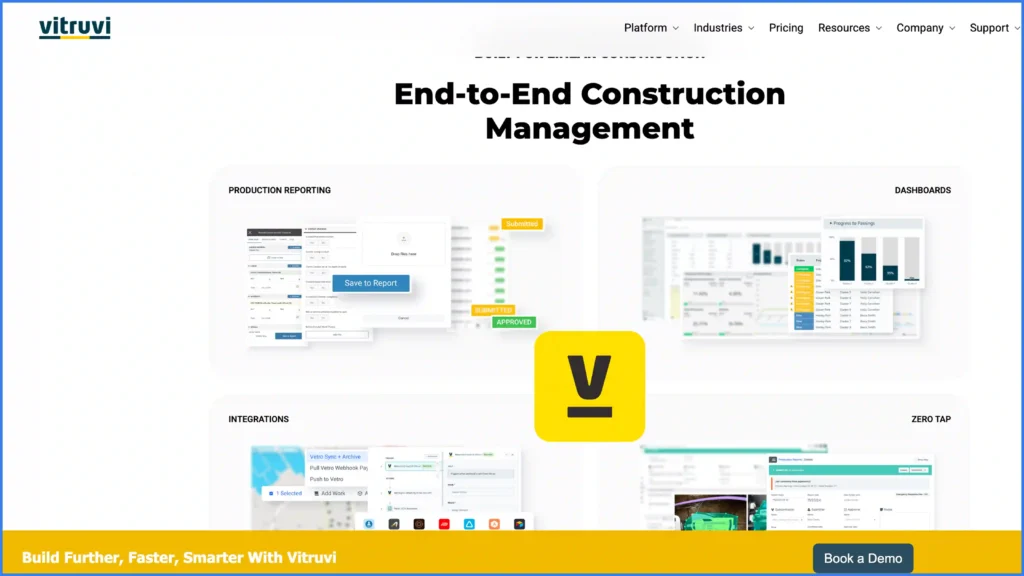
| Vitruvi | Not publicly listed | Fiber and broadband builders paid on verified production | Design to work order conversion, location-stamped field capture, automated quality checks from photos, and billing tied to verified production | Built around linear construction, so recurring service contracts sit outside its core features |
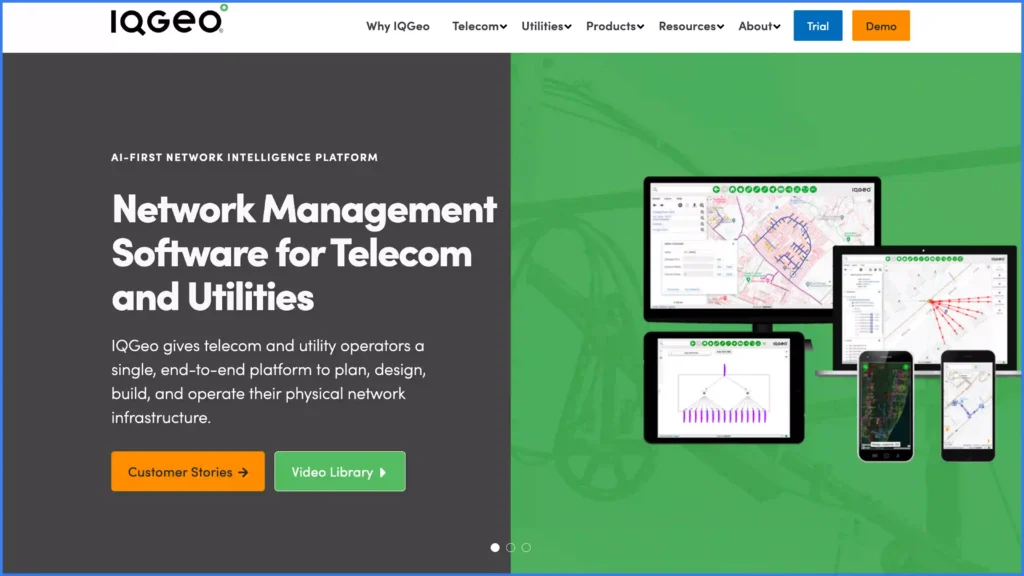
| IQGeo | Not publicly listed | Operators whose network records nobody trusts | Geospatial network records, automated fiber design, field workflow against the live map, and inspection and survey capture | Crew-level dispatch, service contract billing, and subcontractor management need another layer |
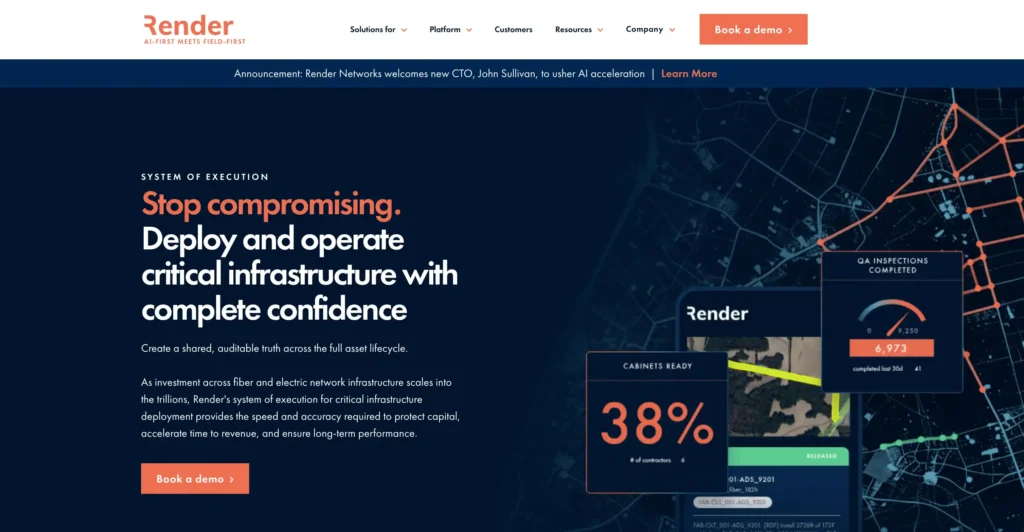
| Render Networks | Not publicly listed | Fiber construction programs losing time to dependencies | Design to task-level instructions, automatic task release on cleared dependencies, completion forecasting, and digital as-builts | A build-phase platform, so recurring maintenance and service-level evidence are handled elsewhere |
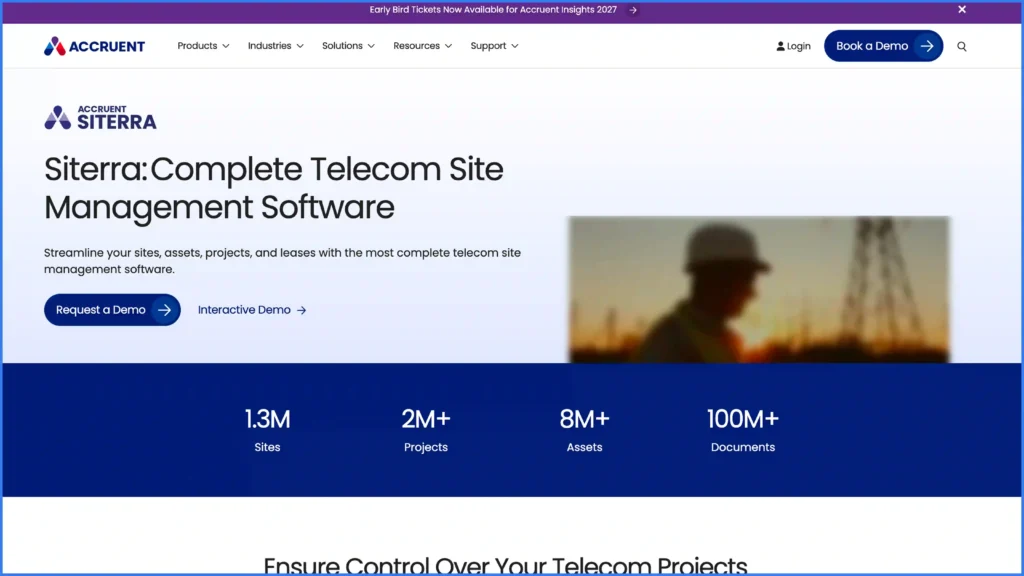
| Accruent Siterra | Not publicly listed | Tower owners and carriers managing leases and site records at portfolio scale | Site, asset, project, and lease records in one system, plus lease payment tracking, critical date alerts, and portfolio forecasting | A system of record first, so crew dispatch and enforced field procedure are lighter |
| Celoxis | Core $10, Essentials $25, Professional $35, and Business $45 per user per month prepaid annually, minimum five full-access users; Enterprise custom-priced | Telecom project management offices coordinating resource-heavy portfolios | Portfolio dashboards, resource allocation across programs, budget and margin tracking, and published pricing | General-purpose portfolio management with no telecom data model for sites, permits, or closeout evidence |
| ServiceNow Strategic Portfolio Management | Not publicly listed | Large operators already standardized on ServiceNow | Demand intake, roadmapping, financial planning, and scenario analysis on the same platform as IT service management | Value depends on an existing ServiceNow footprint, and field execution is a separate licensed product |
| Smartsheet | Pro $12 per member per month billed monthly or $9 billed yearly (1 to 10 members); Business $24 billed monthly or $19 billed yearly (3 member minimum); Enterprise custom-priced | Cross-department coordination on a defined rollout program | Spreadsheet-style grids, automation, forms, and dashboards, with no training curve | No telecom data model, so every site type, checklist, and closeout rule is built and maintained by hand |
| Oracle Primavera Cloud | Not publicly listed on Oracle’s Primavera Cloud product page | Large capital programs with dedicated project controls staff | Critical path scheduling, risk analysis, cost and change control, and contractual milestone tracking | Schedule-first and expects trained schedulers, so field capture and closeout evidence live in other systems |
See It Against Your Own Sites
The table tells you what each platform claims. The faster test is to put one of your own sites through it. Bring a tower build or a maintenance contract you are running right now to a 20-minute discovery call, and we will walk your actual handoffs and show you where the evidence gets lost. No credit card, no obligation, and we respond the same business day. Book a demo.
1. Scoop
What Scoop is Built For
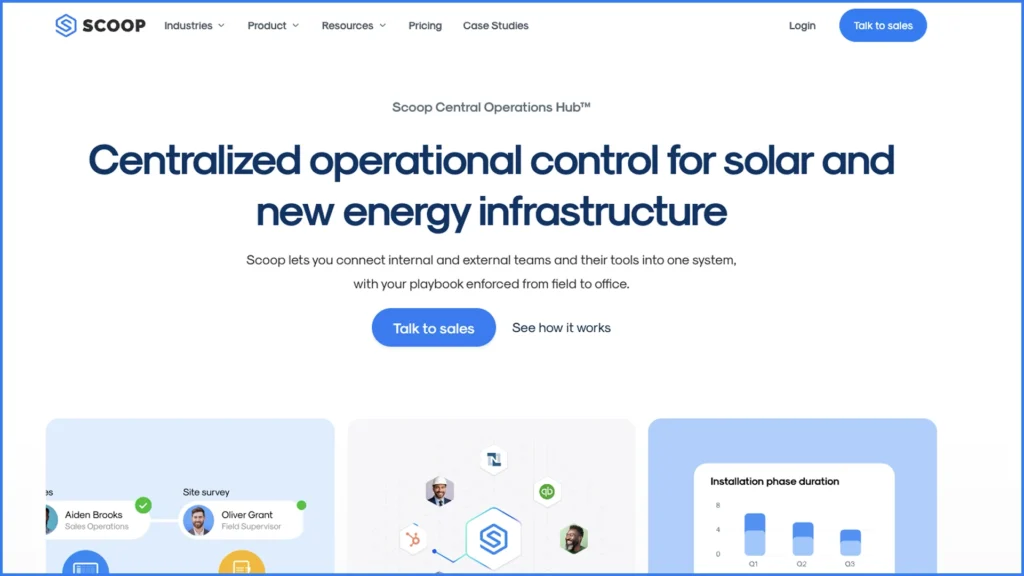
Scoop holds the whole route from site to invoice in one place. Tower builds, fiber rollouts, small cell installs, and microwave work each get a stage-gated workflow, so a site cannot move to the next phase until the evidence from the last phase exists. Crews receive a field-ready job packet per site on a mobile app that works offline, which matters when the site is a rural cabinet with no signal. Dispatch matches jobs to crews by skill and availability, and safety steps for job hazard analysis, personal protective equipment checks, radio frequency exposure checks, and lockout and tagout are enforced at the point of execution rather than filed afterward.
The part we rank highest is what happens after the build. The same platform manages service calls and recurring maintenance contracts, so preventive maintenance schedules, corrective repairs, asset history, and service level evidence live within the original install record instead of in a separate system. That is the difference between a deployment tool and an operations platform.
Scoop connects your tools rather than replacing them, and the integration library is the proof. It has more than 500 integrations, including Salesforce, HubSpot, NetSuite, Zoho, QuickBooks, ServiceTitan, DocuSign, Microsoft 365, SharePoint, Google Drive, and Monday.com, plus an open API through the GLOO integration hub for the systems that need a custom connection. Scoop sits alongside those systems rather than inside any one of them, which matters when you compare it to a platform that is built on somebody else’s.
A published connector is a setting, and a custom API build is a project, so the difference shows up in your implementation timeline.
Pricing
Scoop includes unlimited users, storage, and devices on every plan.
Best For
Telecom contractors, tower companies, and fiber operators running new builds, service calls, and recurring maintenance contracts from the same system. Scoop is strongest where partner crews and subcontractors do part of the work, because the stage gates apply to them the same way they apply to your own technicians, and because unlimited users on every plan means adding a subcontractor crew does not change what you pay.
Operations and maintenance teams are a first-class use case rather than an afterthought. Recurring work orders, preventive maintenance schedules, warranty and service level evidence, and the full history of every asset run on the same records the original build created. The dispatcher to technician to client-report handoff happens inside one system, so a quarterly service report is assembled from what the crews already captured rather than reconstructed from photographs and email.
Scoop also runs large-scale, multi-site charging infrastructure deployments for BTC Power, which is the closest published parallel we have to a telecom rollout.
Scoop Limitations
- Scoop does not design fiber routes, plan radio coverage, or produce stamped construction drawings. That work stays in your design tool, and Scoop connects to them.
- Scoop is built for operations and maintenance teams ready to configure the platform around how they actually run field work. That configuration takes real time from someone on the team. Companies with a dedicated owner for that setup, and the budget to see it through, get value starting on day one.
- Scoop delivers the most value where there is a repeatable process to standardize. The more your sites follow a recognizable shape, the faster the workflow automation compounds.
Verdict
Scoop is the right choice for telecom companies whose work spans new builds and recurring service, across multiple sites and systems.
Want to see Scoop in action on one of your own sites? Book a demo.
2. Sitetracker
What Sitetracker is Built For
Sitetracker is built for deployment operations at volume. Fiber networks, 5G, small cells, and wireless towers each get a templated project type, so a carrier can run thousands of concurrent site builds against standardized processes rather than one-off plans. The platform’s strengths include Gantt chart views, timeline and dependency management, portfolio-level performance measurement, and field status rolls up to an executive dashboard without a manual export. It is used by many companies that manage high-volume infrastructure rollouts.
The structural fact to weigh is where the platform sits. Sitetracker states on its own product page that the Sitetracker Platform is built on Salesforce, so the system underneath your field operations is Salesforce, and the configuration model, the administration, and the commercial relationship all follow from that. For a carrier already standardized on Salesforce, that is a genuine advantage, because the data model and the admin skills are already in the building.
For everyone else it is the reason to look at Scoop first. Scoop is a standalone operations platform that treats Salesforce as one of more than 500 published integrations rather than as its foundation, so you are buying one system instead of two. Sitetracker’s published scope is deployment and asset lifecycle, and Scoop covers the deployment and then keeps running the same sites through service calls and recurring maintenance contracts. Scoop also prices without per-seat exposure, with unlimited users, storage, and devices on every plan, which changes the arithmetic on any program that leans on subcontractor crews.
Pricing
Not publicly listed. Sitetracker publishes no figure on its own site, and quotes come through its sales team.
Best For
Carriers and tower companies running high volumes of similar build-only site work, where the company already runs on Salesforce and an internal admin team owns the configuration.
Sitetracker Limitations
- Sitetracker is built on Salesforce by the vendor’s own description, so the platform underneath it is a second vendor relationship, a second set of administration skills, and a second commercial conversation. Companies standardized on a different stack inherit one they did not choose.
- The template model that makes volume work also makes change expensive. Reshaping a project type after go-live is a configuration project rather than an afternoon, and it usually needs the vendor or a partner.
- Quote-only pricing means budgeting requires a sales cycle before you can compare Sitetracker against anything else on this list.
Verdict
Choose Sitetracker when your problem is running the same repetitive site build and your company is already standardized on Salesforce. If those same sites will need service visits and maintenance contracts once they go live, Scoop covers the build and the service on one platform, without a second one underneath it.
3. Vitruvi
What Vitruvi is Built For
Vitruvi is built for fiber construction measured in route miles. It turns a network design into structured work orders with schedules and cost forecasts, captures production data, photos, and location-stamped markups from a mobile app, then checks the work automatically against what was planned. Invoices are generated from verified field production, which closes the gap between what a contractor claims and what the photographs show. Named customers include Utopia Fiber, Hawaiian Telcom, and Great Plains Communications.
Pricing
Not publicly listed. Vitruvi’s site carries a pricing link and publishes no figure behind it.
Best For
Fiber and broadband builders whose unit of work is a route mile and whose payment terms depend on proving what was built.
Vitruvi Limitations
- Vitruvi is built around linear construction. Recurring service contracts, mixed-asset maintenance, and dispatching sit outside its core features.
- Pricing is quote-only, so the total cost of a multi-crew deployment is not something you can model before you talk to sales.
Verdict
Choose Vitruvi when you are building fiber and the hardest problem is proving what was built before you invoice for it.
4. IQGeo
What IQGeo is Built For
IQGeo gives you one accurate map of the physical network. Network Manager Telecom holds the network records, Comsof Fiber automates design, and Workflow Manager pushes jobs to field crews against that same map, so the crew and the planner are looking at the same version of reality. IQGeo publishes customer-reported figures of a 50% to 90% reduction in planning and design effort and a 30% improvement in first-time-right jobs, meaning jobs completed correctly on the first visit. It names AT&T, Deutsche Telekom, Bell, Virgin Media O2, and Brightspeed among its customers, which is the strongest carrier list on this page.
Pricing
Not publicly listed.
Best For
Operators whose core problem is that nobody trusts the network records, and where design and as-built accuracy drive everything downstream.
IQGeo Limitations
- IQGeo’s strength sits in network records and design automation. Crew-level dispatch, service contract billing, and subcontractor management need another layer on top.
- The customer list skews to national carriers, and the platform is scoped accordingly, so a regional contractor is buying more capability than the job requires.
Verdict
Choose IQGeo when mapping is the bottleneck.
5. Render Networks
What Render Networks is Built For
Render Networks sequences the build. It converts a network design into task-level field instructions and releases each task only when its dependencies clear, so a crew is not dispatched to a location without permits, or where materials have not arrived. Its ClearSight analytics tracks pacing and forecast completion, and digital as-builts pass into downstream network records and payment systems. Render publishes a claim of deploying 15% faster and names Lumen, Quanta, and Shentel among its customers.
Pricing
Not publicly listed.
Best For
Fiber and network construction programs where the schedule slips because work is released before it is ready, rather than because crews are slow.
Render Networks Limitations
- Render is a build-phase platform. Once the network is live, the recurring maintenance, service calls, and service-level evidence that follow are handled somewhere else.
- The task-level model assumes a design detailed enough to decompose. Programs that are still resolving scope in the field get less out of it.
Verdict
Choose Render Networks when your construction program is losing time to dependencies rather than to crew productivity.
6. Accruent Siterra
What Accruent Siterra is Built For
Accruent Siterra manages site records at portfolio scale. Sites, assets, projects, and leases sit in one system, with lease payment tracking, critical date alerts, and project forecasting across multiple overlapping schedules. Accruent publishes portfolio figures of 1.3 million sites, more than 2 million projects, more than 8 million assets, and more than 100 million documents across more than 75 countries, and names American Tower as a customer. For an owner whose revenue depends on lease terms and whose risk sits in missed critical dates, that record-keeping depth is the product.
Pricing
Not publicly listed.
Best For
Tower owners and carriers whose hardest problem is lease administration and site record accuracy across a large portfolio.
Accruent Siterra Limitations
- Siterra is a system of record first. Day-to-day crew dispatch, offline mobile execution, and enforced field procedure are lighter than on the platforms built for that job.
- It sits inside a broader Accruent suite, so the scope of what you license, and what it costs, depends on which neighboring modules you also need.
Verdict
Choose Siterra when leases, site data, and critical dates are what keep you awake.
7. Celoxis
What Celoxis is Built For
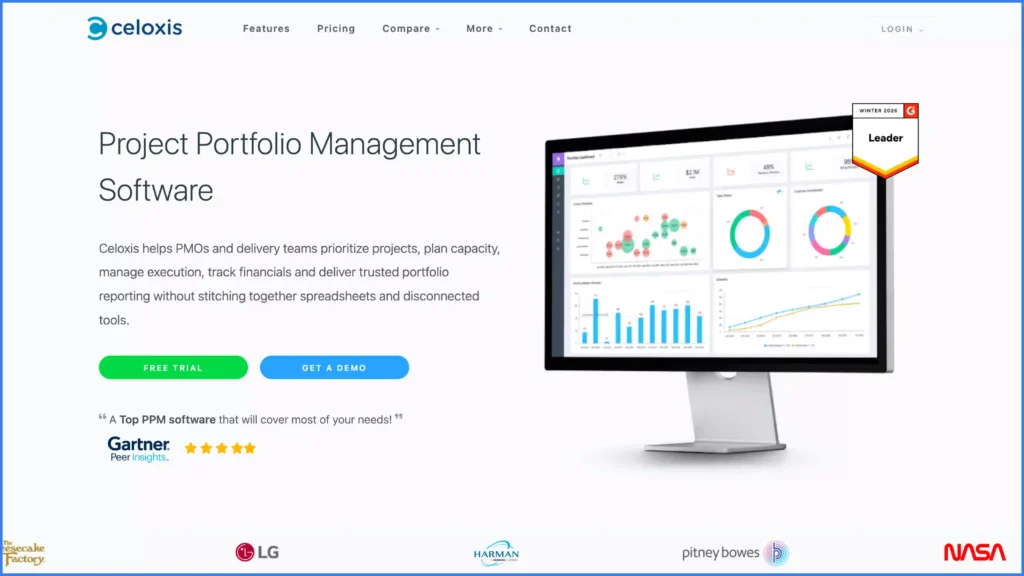
Celoxis is portfolio management for a telecom project management office. Resource allocation across overlapping programs, budget and margin tracking, and portfolio dashboards are the strengths, and it publishes its prices, which seven of the ten platforms on this page do not. If your reporting audience is a steering committee rather than a crew, that combination is hard to beat at the price.
Pricing
Core is $10 per user per month, Essentials is $25, Professional is $35, and Business is $45, all quoted per user per month prepaid annually with a minimum of five full-access users. Enterprise is custom-priced. Team-member and timesheet seats cost less on every paid tier, which lowers the real cost of giving field staff limited access.
Best For
Telecom project management offices coordinating resource-heavy portfolios, where the reporting audience is executives rather than crews.
Celoxis Limitations
- Celoxis is general-purpose portfolio management. There is no telecom data model, so sites, permits, assets, and closeout evidence have to be modeled by hand and maintained by whoever built them.
- Field execution is not the product. There is no offline mobile job packet and no enforced field procedure, so the crew-level layer has to come from somewhere else.
Verdict
Choose Celoxis when you need portfolio visibility on a price you can budget against, and field execution is already handled elsewhere.
8. ServiceNow Strategic Portfolio Management
What ServiceNow Strategic Portfolio Management is Built For
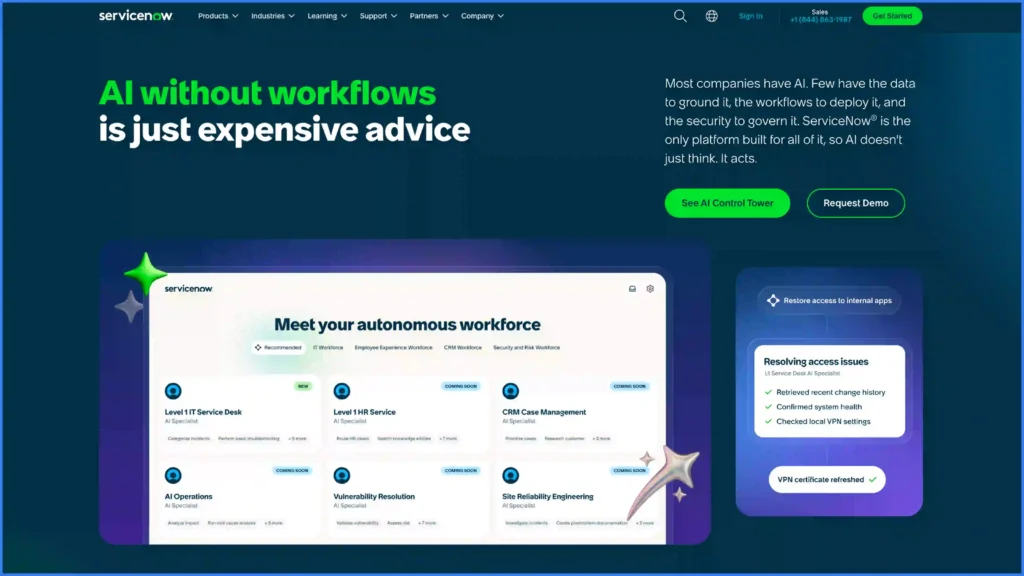
ServiceNow Strategic Portfolio Management aligns a large network program with the rest of the business. Demand intake, roadmapping, financial planning, and scenario analysis sit on the same platform as the IT service management most large operators already run, so the portfolio view and the operational view share one data layer. For a carrier running a network transformation alongside an IT portfolio, that shared layer is the whole argument.
Pricing
Not publicly listed. ServiceNow publishes no figure for Strategic Portfolio Management and routes buyers to its sales team.
Best For
Large operators already standardized on ServiceNow, running network programs alongside IT portfolios under one governance model.
ServiceNow Strategic Portfolio Management Limitations
- The value depends almost entirely on an existing ServiceNow footprint. Without one, you are buying a platform to get a module.
- Field execution is a separate ServiceNow product with a separate license, so the crew-level work this page is about is not included in what you are buying here.
Verdict
Choose ServiceNow Strategic Portfolio Management if you already run ServiceNow and the question is portfolio governance rather than field execution.
9. Smartsheet
What Smartsheet is Built For
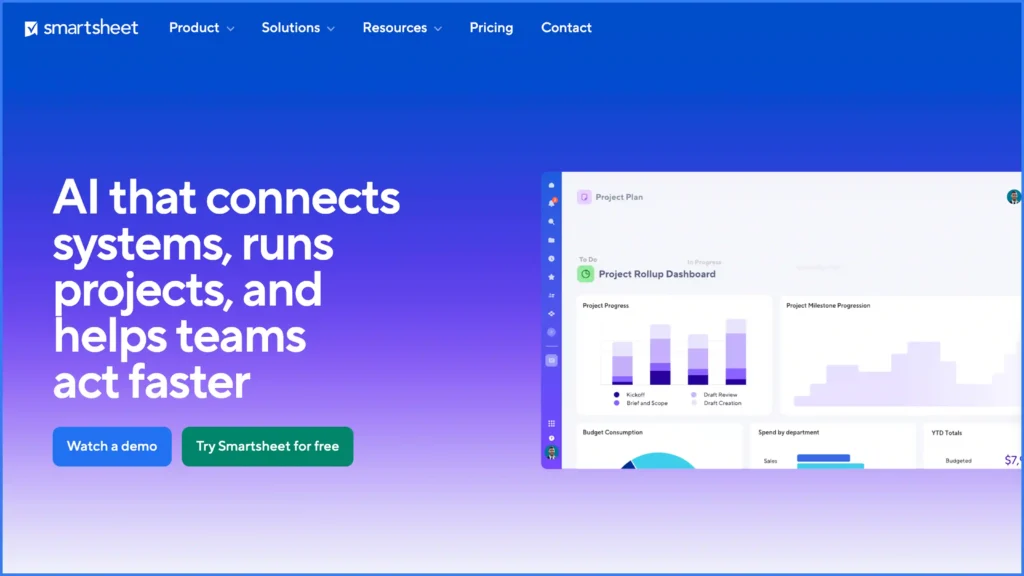
Smartsheet handles cross-team coordination in a format nobody has to be trained on. Anyone who can use a spreadsheet can build a Smartsheet, and the automation, forms, and dashboards on top of it cover a surprising amount of ground for a rollout program that has outgrown email but has not yet earned a platform. It is also the fastest way to get a program visible to people outside operations.
Pricing
Pro is $12 per member per month billed monthly, or $9 per member per month billed yearly, for 1 to 10 members. Business is $24 per member per month billed monthly, or $19 billed yearly, with a three-member minimum. Enterprise and Advanced Work Management are custom-priced.
Best For
Telecom teams coordinating a defined program across departments, where the work is tracked in the tool rather than executed in it.
Smartsheet Limitations
- There is no telecom data model. Every site type, asset relationship, safety checklist, and closeout rule has to be built by hand, and it degrades the moment the person who built it leaves.
- Field capture is a form rather than a job packet, so it records that work happened without enforcing how it was done.
Verdict
Choose Smartsheet for coordination and reporting, not for what happens on the site.
10. Oracle Primavera Cloud
What Oracle Primavera Cloud is Built For
Oracle Primavera Cloud brings schedule rigor to large capital programs. Critical path scheduling, risk analysis, and cost and change control are as deep as this category gets, and on a multi-year build with contractual milestones and financial penalties attached to them, that depth is the point rather than a luxury.
Pricing
Not publicly listed on Oracle’s Primavera Cloud product page.
Best For
Large infrastructure programs with dedicated project controls staff and contractual schedule obligations.
Oracle Primavera Cloud Limitations
- Primavera is schedule-first and expects trained schedulers. Without them, the model decays and the reporting stops being trustworthy.
- Field crews, mobile capture, and closeout evidence live in other systems, so telecom work has to be uploaded into Primavera.
Verdict
Choose Oracle Primavera Cloud when your contract ties payment to schedule milestones and you employ trained schedulers to keep the plan accurate.
Also Evaluated
Six more platforms were assessed and left off the ranked list.
- IFS Cloud is a genuine fit for asset-intensive telecom operators and is scoped for very large teams.
- Salesforce Field Service is the right answer when a carrier is already standardized on Salesforce and dispatch has to share the CRM data layer.
- Fieldwire is affordable and mobile-first at $39 to $89 per user per month billed annually, and it is a construction tool without a telecom data model.
- VETRO FiberMap and 3-GIS are network mapping and design platforms rather than operations platforms, and neither publishes a price.
- Epicflow handles resource prioritization across portfolios and is not telecom-specific.
Several of these are ranked in full on our list of the best field service management software.
Which Telecommunications Software Should You Choose?
The answer depends on which part of the work is currently failing. These are the picks we would make by segment.
- If you run maintenance contracts with service level agreements, choose Scoop. Preventive maintenance schedules, service-level evidence a client will accept, asset history against every site, and fewer repeat truck rolls are the specific outcomes we rank it first for.
- If you build and then maintain, choose Scoop. Companies running new installs, service calls, and recurring maintenance contracts get the most from a single system, because the maintenance record sits against the site record that created it.
- If you run thousands of near-identical site builds, choose Scoop. Volume is a templating problem, and Scoop templates the whole route from site scope to closeout, then keeps running those sites once they go into service. Sitetracker is the alternative when the program is build-only and you are already standardized on Salesforce.
- If you build fiber and get paid on verified production, choose Vitruvi. Billing generated from checked field evidence is the specific problem it solves.
- If your network records are the bottleneck, choose IQGeo. When the planner and the crew disagree about what is in the ground, the map is the product you are buying.
- If your construction schedule slips on dependencies rather than productivity, choose Render Networks. Holding a task until the permit and the material clear is worth more than any dispatch optimization.
- If leases and critical dates are the risk, choose Accruent Siterra. Tower portfolios live or die on lease administration, and that is its center of gravity.
- If you need portfolio reporting at a price you can budget, choose Celoxis or Smartsheet. Both publish real numbers, both report well, and neither one will run your field work.
Stop Paying for Tools That Do Not Talk to Each Other
Most telecom operations teams are not short of software. They are running a project tool, a mapping tool, a scheduling tool, a document store, and an accounting system, and a project manager is retyping between them. That person is the integration, and they are the reason a closeout packet takes three weeks and a service level report takes a day of somebody’s life to assemble.
The fastest way to find out whether that describes you is to bring one of your own sites to a 20-minute discovery call. We will walk your actual handoffs, show you where the evidence gets lost, and be straight with you if a different platform on this list is the better fit. No credit card, no obligation, and we respond the same business day. Book a demo.
Frequently Asked Questions About Telecommunications Software
What is the best software to manage telecom field service?
Scoop is the best software to manage telecom field service in 2026 for companies whose work spans installs and recurring maintenance. It combines skill-based dispatch, an offline mobile job packet per site, enforced safety and quality steps, and service level reporting in one system, so a technician arrives with the right parts and the correct procedure, and the evidence is captured while they are still on site. Sitetracker is the alternative for a build-only program already running on Salesforce, and IQGeo is the stronger answer when the underlying network records are the real problem.
What is the best telecom project management software?
Scoop is the strongest telecom project management software in 2026 for companies whose sites still need managing after they are built, because one platform carries the deployment, the service calls, and the maintenance contract that follows. Stage gates hold each site to the correct sequence, the mobile app works offline at the cabinet, and unlimited users on every plan means a program that leans on subcontractor crews does not pay per head to coordinate them. Sitetracker and Vitruvi are the two other purpose-built telecom options most often shortlisted in 2026, with Sitetracker suited to build-only rollouts at companies already standardized on Salesforce, and Vitruvi suited to fiber construction billed on verified production. Celoxis is the strongest general-purpose option for a telecom project management office, and it publishes its pricing.
Which field service management systems perform best for telecom providers managing network installations?
For telecom providers managing network installations, the systems that perform best are the ones that enforce a procedure rather than record one. Scoop, Sitetracker, and Render Networks all do this, in different ways: Scoop through stage-gated workflows that block a site from advancing without evidence, Sitetracker through templated project types, and Render Networks through task release that waits on permits and materials. Platforms without a telecom data model, including Smartsheet and Celoxis, can track an installation program well and cannot control how the installation is performed.
What is CRM in telecom?
CRM in telecom means the customer relationship management system that holds subscriber and enterprise account records, sales pipeline, service history, and contract terms. It is the commercial system of record, and it is a different system from the one that runs field work. The distinction matters when you buy: a CRM tells you who the customer is and what they were sold, and it does not tell a crew which cabinet to open or prove that the installation met specification. Most telecom operators run both and connect them, which is why we weight integration depth as one of our five criteria.
What is the best telecom software for O&M and recurring service contracts?
Scoop is the best telecom software for operations and maintenance in 2026, because the maintenance contract runs on the same platform as the build that created the asset. Preventive maintenance schedules, corrective repairs, alert-driven dispatch, asset history, and service level evidence sit against the original site record, so a client report is assembled rather than reconstructed. Pacific Power Solutions scaled 15x on that model while building a leading maintenance business.
How much does telecommunications software cost in 2026?
Published telecom software pricing in 2026 splits three ways, and the units do not compare across the split. Per-seat portfolio tools are the cheapest to enter: Celoxis runs from $10 to $45 per user per month prepaid annually, with a five-user minimum, and Smartsheet runs from $9 to $19 per member per month billed yearly. Purpose-built telecom platforms, including Sitetracker, Vitruvi, IQGeo, Render Networks, and Accruent Siterra, publish no figure at all and price by deployment scope. Enterprise platforms such as ServiceNow and Oracle Primavera Cloud are also quote-only and normally carry a platform license underneath the module. Comparing a per-seat portfolio tool against a deployment-scoped telecom platform on price alone is comparing two different units, so normalize on what each one actually replaces. Our breakdown of field service management software pricing walks through how to do that.
What are the best communication tools for project management?
The best communication tools for a telecom project are the ones already inside the system where the work lives, because a message about a site that sits in a separate chat app is evidence nobody will find in six months. Task-level comments, photo capture attached to the site record, automatic status notifications on stage changes, and a client-facing portal all keep the conversation attached to the asset it concerns. General chat and video tools still matter for the human coordination around a program, and they are a supplement to a system of record rather than a substitute for one.
Can telecom software integrate with CRM, ERP, and network records systems?
Yes, and the difference that matters is whether the connector is published and supported or something you build. Scoop publishes more than 500 integrations covering Salesforce, HubSpot, NetSuite, Zoho, QuickBooks, ServiceTitan, DocuSign, Microsoft 365, SharePoint, Google Drive, and Monday.com, plus an open API through its GLOO integration hub. Sitetracker, Vitruvi, IQGeo, and Render Networks all offer APIs and named connectors, and Render specifically passes completion data into downstream network records and payment systems. A published connector is a configuration task and a custom API build is a project, so price the difference before you sign.
Disclosure
Scoop is our own product, and it is ranked first on this page. The reasoning is stated in full above and holds without this note, and you should still read the ranking knowing where it comes from. Scores are our editorial opinion. Competitor pricing was verified on September 10, 2026 from each vendor’s own published pricing page, and no third-party review aggregator was used as a pricing source. All trademarks belong to their owners, and no affiliation or endorsement is implied. If a figure here is wrong or out of date, tell us and we will correct it. You can read more about what we do at Scoop.