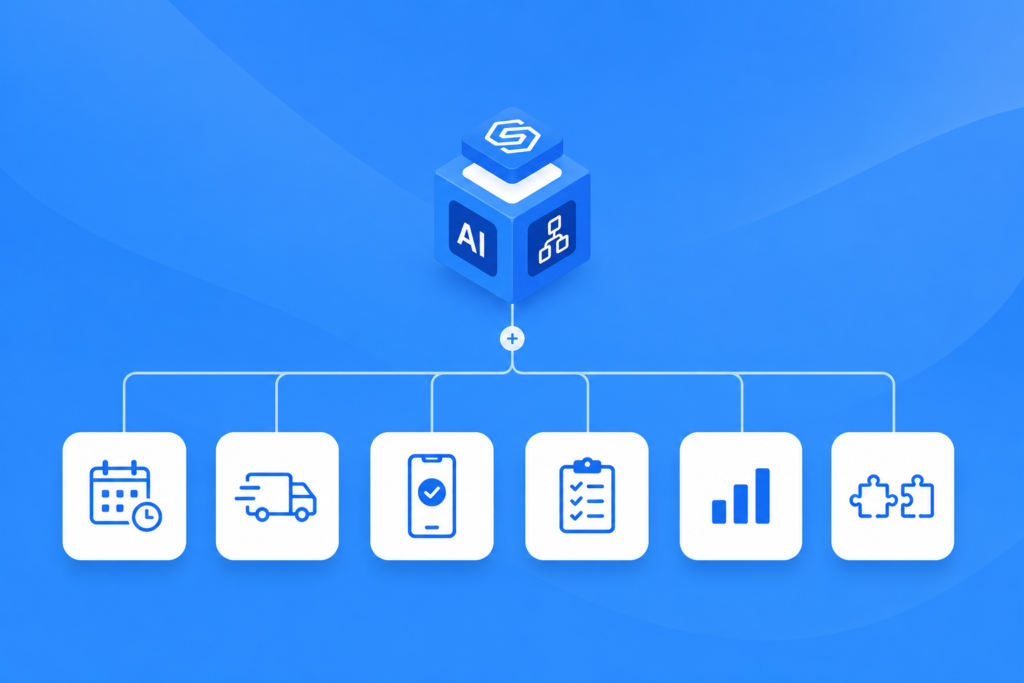
Getting the right technician to the right job site at the right time is the single biggest management challenge for field service teams. For teams running high-volume, multi-site operations across installations, maintenance, and service, these challenges compound. When dispatching breaks down, the consequences hit fast: missed schedule windows, repeat truck rolls, blown SLA deadlines, and stretched response times that limit service capacity.
This guide covers how dispatch works, the real-time coordination challenges that compound as jobs scale, and the best practices and software criteria that separate efficient operations from reactive ones.
What Is Field Service Dispatch?
Field service dispatch is the coordination process that assigns service technicians to customer locations based on job requirements, skills, proximity, and availability. The full dispatching cycle starts with work order intake, moves through technician selection and scheduling, and continues with route planning, real-time status tracking, and communication between field crews and the back office.
Dispatch acts as the operational bridge between a new installation or service request arriving and a qualified technician completing the job on-site.
Core Components of a Dispatch Workflow
5 components make up a standard dispatch workflow:
- Work order creation and intake: Every dispatch cycle starts when a service request, alert, or scheduled task generates a work order with job type, urgency, required skills, and site access details.
- Technician matching by skill and certification: The dispatcher identifies which technicians hold the certifications and equipment knowledge the job requires, narrowing the assignment pool before scheduling.
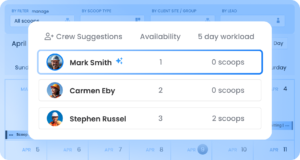
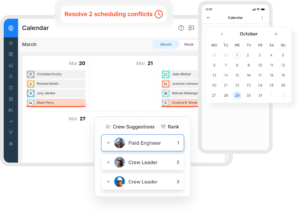
- Job scheduling and calendar management: Open calendar slots, shift availability, and existing commitments set the timeframe for each assignment, and dispatchers manage conflicts to prevent double-bookings or overtime.
- Route optimization and travel planning: Proximity between the technician’s current location and the job site determines travel sequence, reducing windshield time across multiple daily stops.
- Real-time status tracking and updates: Once a technician is dispatched, live status updates (enroute, on-site, completed) keep the back office and the customer informed throughout the process.
How Does Dispatch Differ From Scheduling?
Scheduling determines who works when: shift assignments, recurring appointments, and time-slot allocation planned days or weeks in advance. Dispatch operates in real time, assigning specific jobs to specific technicians based on live conditions like cancellations, emergency tickets, or delays that shift priorities mid-day.
The 2 functions connect directly. Scheduling builds the plan; dispatching executes and adapts it as field operations unfold. A dispatcher with full control over both layers can reassign a technician from a low-priority PM visit to an urgent SLA ticket without creating a gap in the day’s schedule.
That flexibility carries direct financial weight once operations span hundreds of sites and every misassignment costs time, money, and customer trust.
Why Does Field Service Dispatch Matter for Modern Field Operations?
Field service portfolios in renewable energy span hundreds of sites across wide geographies, and the need for better dispatch management grows with every new site added.
The US installed 43.1 GWdc of solar capacity in 2025, with solar accounting for 58% of all new generation capacity, which means installation and service teams face compounding operational pressure across permitting timelines, weather windows, SLA-driven tickets, and preventive maintenance (PM) cycles.
Dispatch is the operational layer that determines whether teams improve their efficiency or fall behind. When the right technician reaches the right site with the right information, the business hits its targets. When dispatch breaks down, every downstream function, from billing to customer retention, slows with it.
The Cost of Inefficient Dispatching
Wrong-skill assignments and reactive workflows create operational costs that compound across every site in a portfolio. The most common consequences hit field teams in 5 areas:
- Repeat truck rolls from sending a technician who lacks the certifications to complete the job on the first visit
- Missed SLA windows that trigger penalty clauses and degrade the customer experience
- Billing delays from incomplete job documentation that stalls the invoicing cycle
- Stretched response times that cap the number of sites a team can service before SLA exposure grows
- Technician idle time between jobs, caused by poor route sequencing or last-minute cancellations without quick reassignment
The field service management market is projected to grow from $6.13B in 2025 to $13.85B by 2033, an 11% CAGR that tracks directly with the industry’s push to improve how quickly field teams move from one completed job to the next through better tracking, automation, and data-driven dispatch.
Can Dispatch Precision Drive Customer Retention?
Dispatch precision has a direct line to customer retention. When the right technician arrives with the right information and completes the work on the first visit, the customer experience improves at every touchpoint: faster resolution, fewer follow-up calls, and better communication throughout the service window.
Field service customers consistently choose to keep working with operators who respond quickly and complete work right the first time. For service teams managing large site portfolios, that reliability translates into contract renewals, expanded scope, and a reputation that supports new business development. For installers, and commercial installers in particular, the same execution turns a single project into the opportunity to win additional installation work across other sites in the customer’s portfolio. Dispatch accuracy is what makes that cycle self-reinforcing, but several structural challenges can break it before it starts.
The Biggest Dispatch Challenges for Field Operations Teams
Dispatch complexity scales with operational volume. As field service teams add sites, regions, and technicians, the process gaps that were manageable at small scale become systemic problems. 3 categories of challenges compound across organizations without a structured dispatch workflow: disconnected data, manual processes that don’t scale, and workforce constraints that limit visibility into who can do what, where.
Data Silos Between Field, Office, and Monitoring Systems
Disconnected tools for monitoring, service management, and billing create blind spots that dispatchers can’t see past, and service technicians arrive on-site without the job history or asset data they need. Install teams hit the same wall from the other direction: when CRM, design and proposal tools, and permitting systems don’t share data, crews dispatched to an installation lose the project context built upstream, especially across rural or low-connectivity sites where mobile access to records is unreliable.
The problem compounds with scale. Every new site added to the portfolio brings another layer of data scattered across multiple software systems, and the team loses shared visibility into what happened at a site last week, last month, or last service visit.
Dispatchers working from one tool can’t view what field crews logged in another, so assignment decisions rely on memory and phone calls instead of structured records.
When Do Manual Dispatch Workflows Start Breaking?
Spreadsheet-based or phone-based dispatch handles 5-10 daily jobs without much friction. The process starts breaking at 30+ daily tickets across multiple regions, where manual workflows generate scheduling conflicts, double-bookings, and communication gaps that no single dispatcher can manage in real time.
Reactive dispatch, waiting for tickets to arrive instead of anticipating demand based on historical patterns, creates bottlenecks during seasonal peaks. Installation season floods the queue with new jobs while existing service operations pile up, and dispatchers who set priorities by gut feel instead of structured intake data end up treating urgent SLA tickets the same as routine PM tasks.
Technician Skill Gaps and Geographic Coverage Constraints
Assigning a technician without the right certifications for a specific job type, whether equipment-specific training, electrical licensing, or safety protocol clearance, leads to repeat site visits that double the cost of a single dispatch. Geographic spread across remote and rural locations increases windshield time between jobs, and the further apart sites are, the fewer jobs each technician can complete in a day.
Skill-based routing and proximity logic solve both problems, but only when dispatchers have structured data to make those decisions. Without a system that matches technician credentials to job requirements and factors in travel distance, assignment decisions default to whoever is available, not whoever is most efficient for that specific site.
Each of these challenges responds to specific dispatch practices that field teams can implement without rebuilding their entire operational stack.
Dispatch Best Practices for Field Operations Teams
The challenges above are operational, not inevitable. The best practices below target the root causes of inefficient dispatching: unstandardized intake, manual routing, flat prioritization, and disconnected feedback loops. Teams that manage these practices as a connected system, not isolated fixes, improve dispatch efficiency faster and optimize each gain as it compounds.
Standardize Work Order Intake and Job Classification
Consistent intake is the foundation of reliable dispatch. Every work order should capture the same set of data points before it enters the dispatch queue:
- Job type and urgency level
- Required skills and certifications
- Equipment needed on-site
- Site access instructions and contact information
- SLA deadline and penalty exposure
Classifying new jobs at intake gives dispatchers structured data to create accurate assignments across the team. When the process is standardized, dispatchers stop guessing which technician to send and start matching based on verified criteria, which means faster task assignment and a dispatch queue that every team member can manage without tribal knowledge.
Does Skill-Based Routing Improve First-Time Fix Rates?
Skill-based routing assigns technicians who hold the right certifications for the specific job type, from install crews who need racking and electrical clearances to service techs handling diagnostics, which directly reduces repeat truck rolls from wrong-skill dispatches. Proximity matching layers on top: the system identifies the closest qualified technician to each job site location, cutting travel time and fitting more jobs into each schedule for a more efficient daily route.
The combination works best when availability checks run in parallel, preventing double-booking and overtime by cross-referencing technician calendars before confirming the dispatch.
Field service management software designed for multi-site operations automates this optimization in real time, rerouting assignments when cancellations, emergency tickets, or technician delays shift priorities mid-day. The result is higher first-time fix rates and fewer dispatches that need to be re-sent.
Prioritize Dispatch Queues by SLA and Business Impact
Not all dispatch tickets carry the same weight. Impact-based prioritization ranks jobs by the deadlines and exposure attached to them, whether that is an SLA breach or critical outage on the service side or a commissioning date, inspection window, or contractual in-service deadline on the install side. High-impact work gets dispatched first, while lower-priority jobs like routine preventive maintenance fill the remaining schedule capacity.
The shift from first-in-first-out to impact-based dispatch gives operations managers a clear view of where the team’s time goes and control over how it’s allocated. Dispatchers stop reacting to whoever calls loudest, which cuts response times for high-priority work and protects the deadlines that carry financial consequences, from service SLAs to install milestones.
Build Closed-Loop Feedback Between Field and Office Teams
Post-job data capture, including completion notes, photos, and time logs, feeds back into dispatch logic in real time. Dispatchers see which technicians completed which job types fastest using historical performance data, and that tracking reveals patterns: recurring issues at specific sites, skill gaps across the team, and routes that consistently run over time.
The feedback loop turns dispatch from reactive assignment into continuous improvement. Teams that connect field reporting software to their dispatch workflow close the gap between what happens in the field and what the back office sees, which means every completed job improves the accuracy of the next dispatch.
That communication channel gives dispatchers a live view across sites instead of waiting for end-of-day reports. Once these practices expose how much dispatch performance depends on structured data flow, the criteria for choosing the right dispatch software become much clearer.

How Should Field Operations Teams Evaluate Dispatch Software?
The dispatch software market is projected to grow from $4.17B in 2025 to $6.87B by 2032, which means field teams need to choose from a growing number of platforms. The best fit for multi-site operations isn’t the software with the longest feature list. It’s the one that integrates into the existing tech stack, scales with the business, and gives dispatchers the right data to use when they manage assignments across regions.
Integration With CRM, ERP, and Monitoring Tools
Dispatch software must connect to the existing tech stack to avoid becoming another data silo. CRM systems hold customer and site data, ERP platforms handle billing and invoicing, and the trigger for new work varies by job type: monitoring tools generate the alerts behind service tickets, while a signed contract or an approved permit is what sets an installation in motion.
When dispatch operates in isolation from these systems, technicians lose access to job history, dispatchers re-enter data across platforms, and the entire business workflow slows down.
Native integrations and API access are the baseline. Teams using dispatch software that connects to their CRM, ERP, and monitoring platforms in real time can route alerts directly into the dispatch queue, pull customer context into work orders, and push completed job data back into billing without manual handoffs.
For teams running solar software alongside dispatch and monitoring tools, the integration layer needs to turn both monitoring alerts and approved install jobs into dispatch-ready work orders, then connect field documentation back to the invoicing cycle across the entire portfolio.
Can Dispatch Software Scale for Multi-Region Operations?
As a team’s site portfolio grows from 50 to 500+ sites, across both installation projects and service contracts, dispatch volume grows proportionally. The software that handled 10 daily assignments efficiently can’t manage 50+ dispatches across multiple regions without automation that distributes the load.
Scalable dispatch software handles increasing job counts, technician rosters, and geographic coverage without requiring proportional increases in dispatcher headcount. Configurable workflows let operations teams optimize routing rules and assignment logic for new regions as they come online, and unlimited user pricing keeps the business model viable as the roster expands.
The difference between a platform that scales and one that doesn’t shows up when a team tries to add a 3rd region and discovers the dispatch process requires 2 new hires instead of a configuration change.
Strengthen Your Field Service Dispatch With a Central Operations Hub
Dispatch coordination, scheduling, field execution, reporting, and billing all run through the same operational layer when you use Scoop as your Central Operations Hub.
We connect your entire dispatching workflow to the tools your team already relies on, so you optimize field operations without replacing your existing software stack or rebuilding processes from scratch.
Book a demo to see how Scoop turns dispatch management into a source of efficiency instead of a bottleneck.
Frequently Asked Questions About Field Service Dispatch
What Is the Difference Between Field Service Dispatch and Field Service Management?
Field service dispatch is one function within field service management (FSM), which covers the full lifecycle: work orders, scheduling, dispatch, field execution, reporting, and billing. Dispatch focuses on assigning and coordinating technicians to jobs in real time, adapting to live conditions as they change throughout the day.
How Does Dispatch Reduce Operational Costs for Field Service Teams?
Optimized dispatch reduces repeat truck rolls by matching technician skills to job requirements, minimizes windshield time through proximity-based routing, and protects the deadlines that carry financial weight, from service SLAs to install milestones. The savings compound across large portfolios where even small per-job improvements multiply across hundreds of monthly dispatches and accelerate billing cycles.
What Skills Does a Field Service Dispatcher Need?
A field service dispatcher needs strong organizational ability, real-time problem-solving skills, working knowledge of technician certifications, and proficiency with dispatch software. In multi-site operations, dispatchers also need to understand site-specific requirements and seasonal demand patterns that shift dispatch volume throughout the year.
Can Small Field Service Teams Benefit From Dispatch Software?
Teams with 5-10 technicians see measurable improvements in job completion rates, travel time reduction, and customer communication once they move from manual to software-based dispatch. The ROI timeline shortens as manual dispatch errors and scheduling conflicts decrease, and the processes that work for 10 technicians carry forward as the team grows.
How Does AI Improve Dispatch Accuracy?
AI-powered dispatch analyzes historical job data, technician performance patterns, travel times, and real-time availability to make assignments that would take a human dispatcher significantly longer to calculate. The system adapts to live changes (cancellations, emergency tickets, technician delays) and reroutes assignments automatically, producing higher first-time fix rates and better SLA compliance across the portfolio.