8 Best Solar Project Management Software (2026)
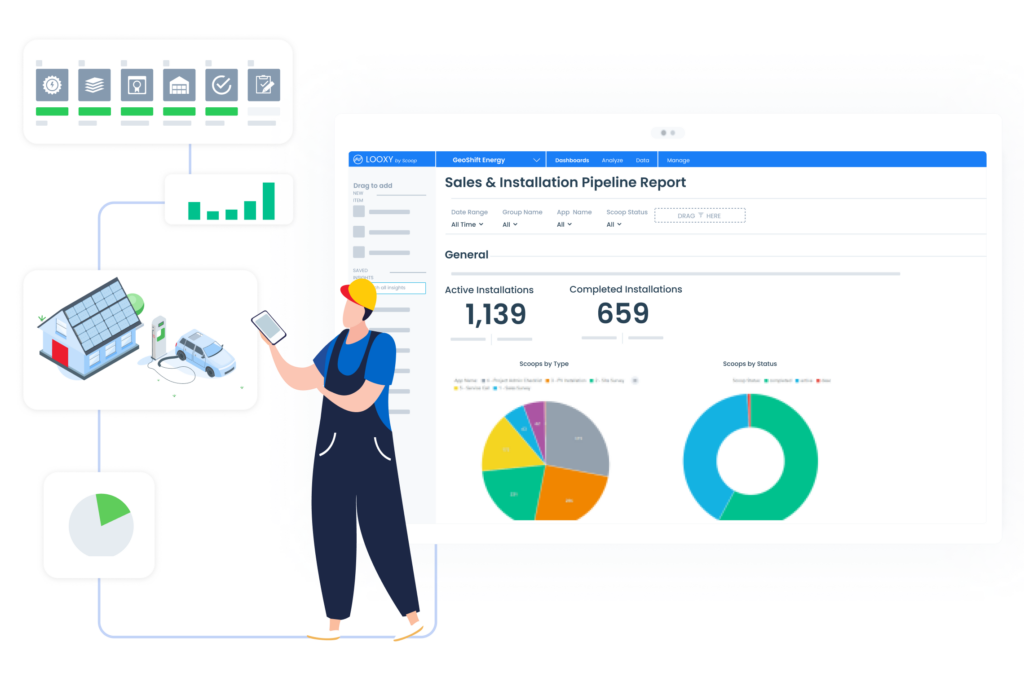
The best solar project management software in 2026 is Scoop, especially for solar teams that need more than simple task tracking. Scoop is a Central Operations Hub built for execution, helping your team plan, schedule, manage workflows, and track real-time progress from pre-construction to installation and close-out, while keeping accurate data in one system without forcing a rigid all-in-one tool.
That said, it’s not the only option worth considering. Here are the top 8 best solar project management software of 2026.
1. Scoop
Scoop is a Central Operations Hub designed to act as the execution system of record for solar operations. In addition to functioning as a comprehensive project management tool, it provides a unified operational layer where workflows, field execution, documentation, and lifecycle continuity are coordinated across both teams & tools companies use to run installation, service, and operations and maintenance (O&M).
Unlike generic solar project management software (or all-in-one business platforms) that operate in a silo, Scoop focuses on how to ensure end-to-end workflows are executed by solar office teams, field teams and subcontractors across the company’s entire technology stack. Scheduling, site surveys, work orders, documentation, checklists, and equipment context are centralized into a single operational workflow, ensuring that teams operate from shared ground truth rather than data scattered across multiple tools or manual handoffs.
With mobile-first field execution, crews can capture data, complete workflows, and update job progress directly on-site, while operations leaders maintain real-time operational visibility.
Why Choose Scoop?
Scoop stands out by solving the operational execution gap that many solar teams experience when using generic project management tools, captive so-called all-in-one’s or fragmented software stacks. Instead of managing projects as isolated tasks, Scoop establishes a consistent execution layer where workflows, field activity, and operational status remain connected to all teams and tools throughout the lifecycle.
A key differentiator is Scoop’s role as a Central Operations Hub. Execution, not just tracking: Scoop brings scheduling, field execution, documentation, and operational oversight into a single system of record so teams can manage work and keep real-time progress accurate across the lifecycle.
This means field teams can capture photos, complete checklists, update task statuses, and upload documentation directly from job sites using the mobile app, including in offline conditions. This keeps project data accurate and accessible while giving operations and project managers real-time visibility as work progresses. If that data needs to be fed into the CRM or design tool the Scoop Central Operations Hub also takes care of that.
Scoop is also designed to scale as operations grow. It supports large teams and complex, multi-site deployments without forcing companies into rigid all in one platforms. By integrating with existing CRM, accounting, and other business tools, Scoop helps connect sales, design, execution, and reporting workflows while maintaining a consistent execution layer across the organization.
- Purpose-built for solar operations, not generic project tracking
- Central Operations Hub that connects your tools, teams, and workflows
- Specialized layered data architecture designed for operations
- Standardized installation and O&M workflows
- Mobile-first field execution, including offline use
- Real-time visibility for operations and project managers
- Scales to large teams and multi-site deployments
- Connects CRM, accounting, e-signature, and other business tools
2. Monday
Monday is a cloud-based work and project management software designed to help teams plan, track, and coordinate projects through customizable workflows. In the solar industry, it is commonly used to organize project activities such as sales pipelines, permitting tasks, installation scheduling, and post-installation follow-ups.
Rather than being built specifically for solar execution, Monday functions as a flexible workflow and coordination platform. Teams can create boards that mirror solar project phases such as lead qualification, site assessment, engineering review, permitting, installation, inspection, and maintenance, helping stakeholders stay aligned within a centralized workspace. However, because Monday is a general-purpose project tool, execution logic, field workflows, and lifecycle continuity must typically be configured manually rather than provided as a native operational system of record.
Why Choose Monday?
Monday is often chosen for its flexibility and visual approach to project coordination, making it appealing to solar companies that want workflows tailored to internal processes. Teams can configure boards and automations to reflect how projects move from sales to installation, although operational execution across field teams may require additional tools or integrations to maintain consistency.
- Highly flexible and customizable workflows
- Visual boards that map well to solar project phases
- Supports end-to-end project tracking in one workspace
- Easy to adapt to internal processes and team preferences
- Strong automation options for task coordination
3. Asana
Asana is a work and project management software built to help teams plan, organize, and track work across complex projects. For solar project teams, it is commonly used to manage multi-stage workflows such as site evaluations, engineering and design, permitting, procurement, installation, inspections, and close-out.
The platform allows teams to break down solar projects into structured tasks and subtasks, assign ownership, set deadlines and dependencies, and track progress in real time.
Why Choose Asana?
Asana is chosen for its flexibility and strong task orchestration capabilities, making it well suited for companies managing multiple projects simultaneously. It provides a centralized workspace where all project activities, timelines, and responsibilities are visible, reducing miscommunication and delays.
- Strong task and subtask management for complex projects
- Clear ownership, deadlines, and dependencies
- Real-time progress tracking across multiple projects
- Centralized workspace that reduces miscommunication
- Well suited for teams managing many concurrent jobs
4. JobNimbus
JobNimbus is a cloud-based CRM and project management platform designed for contractors who need to manage jobs from initial lead through project completion and payment. In the solar industry, it is commonly used to centralize sales activity, customer communications, project stages, scheduling, documentation, and billing within a single system.
While JobNimbus offers an all-in-one environment that combines CRM and project tracking, its structure focuses primarily on contractor workflows and administrative coordination rather than acting as a dedicated execution system of record for solar operations. Teams often configure workflows to reflect solar processes such as permitting, site assessments, and installation phases, but operational continuity across lifecycle stages may depend on how the platform is customized.
Why Choose JobNimbus?
JobNimbus is chosen for combining CRM, project management, and financial workflows into one flexible platform tailored to contractor operations. This all-in-one approach can simplify tool management for growing teams, although it may introduce rigidity when scaling specialized operational workflows or managing complex multi-site deployments.
- Combines CRM, project management, and financial workflows
- Designed for contractor-style operations
- Customizable job stages and solar-specific workflows
- Strong mobile support for field crews
- Improves coordination from sales through close-out
5. Procore
Procore is a cloud-based construction project management platform built to support complex construction projects from pre-construction through closeout. It centralizes project data, communication, and workflows to help teams coordinate across office and field environments. Although Procore is not solar-specific, it is widely used in commercial and utility-scale solar projects because of its strong capabilities in documentation, collaboration, compliance tracking, and cost control.
Why Choose Procore?
Procore is often selected for bringing structure, governance, and accountability to large-scale construction programs involving multiple stakeholders, subcontractors, and regulatory requirements. The platform excels at maintaining documentation standards, audit trails, and financial oversight across complex projects.
Its enterprise-grade capabilities make it well suited for large commercial rooftop installations and utility-scale solar farms where control and reporting are critical. However, because Procore is designed primarily for construction governance rather than solar-specific operational execution, teams focused on field execution speed or repeatable installation workflows may find implementation and day-to-day operation more complex than purpose-built solar operations platforms.
- Built for large and complex construction projects
- Strong documentation, collaboration, and audit trails
- Excellent coordination across multiple stakeholders
- Enterprise-grade scalability
- Robust cost and change management capabilities
6. Sitetracker
Sitetracker is a cloud-based project and asset lifecycle management platform designed for organizations delivering large-scale infrastructure deployments, including utility-scale and distributed solar projects. It supports asset lifecycle tracking from early planning and permitting through construction, commissioning, and long-term operations and maintenance.
Why Choose Sitetracker?
Sitetracker is often chosen by enterprise organizations managing large portfolios that require structured oversight, standardized processes, and strong reporting across multiple regions or programs. The platform emphasizes lifecycle governance, portfolio visibility, and operational consistency at scale.
Its strengths include standardized workflows, centralized reporting, and detailed portfolio-level dashboards that help leadership monitor performance and manage risk across deployments. Because Sitetracker is built with enterprise infrastructure programs in mind, implementation and customization can require significant planning, and teams focused on fast-moving field execution may still rely on additional tools to manage day-to-day operational workflows on job sites.
- Designed for large-scale solar and infrastructure deployment
- End-to-end asset lifecycle management
- Standardized workflows across regions and portfolios
- Centralized data that reduces operational silos
- Strong reporting and dashboard capabilities
7. Sunbase
Sunbase is a cloud-based, all-in-one solar business platform designed for solar installers, EPCs, and growing companies that want to manage multiple parts of the solar project lifecycle from a single environment. In practice, Sunbase is commonly used to combine lead management, CRM, proposal creation, project tracking, field coordination, inventory management, and financial workflows within one system.
Unlike general-purpose project tools, Sunbase is built specifically around solar business processes, helping teams reduce setup complexity and bring sales and operational workflows into a unified interface. However, as an all-in-one platform, it prioritizes broad lifecycle coverage over acting as a dedicated execution system of record, which can introduce limitations when organizations require deeper operational flexibility or specialized execution workflows as they scale.
Why Choose Sunbase?
Sunbase is often chosen for its solar-first, all-in-one structure that reduces the need to stitch together multiple tools. Teams benefit from centralized visibility across sales and project delivery, real-time collaboration between office and field teams, and automation that helps reduce manual coordination.
Because CRM, proposals, project tracking, inventory, and financial data live within one platform, Sunbase can simplify early operational workflows. At the same time, this integrated structure may introduce tradeoffs in flexibility or vendor dependence for teams that need highly adaptable execution layers across complex or multi-site operations.
- Solar-first, all-in-one platform
- Combines CRM, proposals, projects, inventory, and financials
- Reduces need for heavy customization
- Real-time collaboration between office and field teams
- Automation that cuts down manual work and silos
8. SolarGrade
SolarGrade is a solar-specific project and field operations management platform built to support teams across construction, commissioning, and operations & maintenance (O&M). It centralizes on-site inspections, QA/QC workflows, issue tracking, and reporting in a single system designed specifically for solar and energy storage projects.
Why Choose SolarGrade?
SolarGrade stands out because it is purpose-built for the realities of solar fieldwork rather than adapted from generic construction or project management software. Its workflows reflect how solar sites are actually built, inspected, and maintained, which helps teams improve consistency, reduce rework, and speed up reporting.
Automated, professional-grade reports significantly cut down administrative time after site visits, while georeferenced issue tracking makes it easier to navigate large or remote solar installations. For managers, built-in analytics provide insight into recurring issues, close-out rates, and operational trends across single projects or entire portfolios.
- Purpose-built for solar fieldwork and O&M
- Solar-specific QA QC and inspection workflows
- Automated, professional-grade reporting
- Georeferenced issue tracking for large sites
- Analytics for trends, rework, and close-out performance
Enhance Your Solar Operations with Scoop!
Solar project management often comes with challenges around coordination, documentation, and visibility across teams and locations. Scoop brings these functions together by acting as a central operations hub for solar and renewable energy teams trusted across 250k+ client sites worldwide. By combining project management software features, with field execution, and operational oversight in one structured operational layer, Scoop helps your team streamline workflows, improve collaboration, and keep everyone aligned as projects move forward, without forcing you into a rigid all-in-one tool.
Frequently Asked Questions About Solar Project Management Software
How do I choose the right solar project management software?
Choosing the right software starts with understanding how work actually moves through your organization. Solar operations involve more than task tracking. They include handoffs between sales, engineering, field teams, service, and operations. The right tool should support those handoffs, reflect real execution steps, and adapt as your workflows evolve. Teams often benefit from software that connects existing systems while providing a clear execution layer, rather than forcing everything into rigid project templates.
What’s the difference between generic PM tools and solar-specific platforms?
Generic project management tools focus on visibility into tasks and timelines, but they are usually disconnected from how solar work is executed in the field. Solar-specific platforms are designed around permitting cycles, site work, scheduling constraints, inspections, and service follow-ups.
The difference is less about features and more about whether the software owns execution logic and keeps accurate data connected across teams and tools. A Central Operations Hub approach focuses on orchestration across systems so workflows, ownership, and integrations match real operational stages without forcing every team into the same rigid template.
When do all-in-one tools start to fall short for solar operations?
All-in-one tools often work well at early stages, when teams are small and workflows are simple. As operations grow, complexity increases across sites, teams, and service types. At that point, rigid systems can limit flexibility or require workarounds that create operational debt. Teams usually feel friction when they need deeper customization, clearer ownership across stages, or tighter coordination between systems that were never designed to scale together.
Why is field execution critical to successful solar projects?
Field execution is where planning becomes reality. Even well-designed project plans can break down if field teams lack clear instructions, real-time updates, or visibility into upstream changes. Strong execution systems help ensure that schedules, materials, documentation, and reporting stay aligned with what is actually happening on site. This reduces rework, improves predictability, and keeps projects moving forward even when conditions change.
What should teams prioritize as they scale across multiple sites?
As teams scale, consistency becomes more important than speed alone. Priorities usually shift toward standardized workflows, clear ownership at each stage, and shared visibility across locations. Systems that support repeatable execution help teams onboard new staff, maintain quality, and manage growing volumes without adding layers of manual coordination. Flexibility still matters, but it needs to sit on top of a stable operational backbone.
Why does a single system of record matter for solar operations?
A single system of record creates alignment across teams by ensuring everyone works from the same source of truth. When data is scattered across multiple tools, updates lag behind reality and decisions are made on incomplete information. A centralized execution layer helps tie scheduling, field activity, reporting, and integrations together, so operational visibility reflects what is actually happening, not what was last manually updated.