Solar asset management involves operating, monitoring, and maintaining solar PV systems throughout their 25-30 year lifespan to maximize financial returns for system owners. This process includes regular maintenance, performance monitoring through data analytics, predictive maintenance to prevent failures, and ensuring compliance with regulations, all working together to optimize energy production and ROI.
In this article, we break down what solar asset management really is, why it matters today, and share expert tips to help owners and operators get more value out of their solar assets in an increasingly competitive market.
What Is Solar Asset Management?
Solar asset management constitutes the systematic approach to overseeing photovoltaic installations throughout their operational lifecycle. This practice encompasses the operation, monitoring, and maintenance of PV systems with the primary goal of maximizing return on investment. The renewable industry recognizes this as an essential component for extending panel lifespan, which typically ranges between 25–30 years.
Modern solar asset management incorporates advanced data analytics for performance optimization, allowing system owners to extract maximum value from their renewable energy investments.
The comprehensive management of solar assets includes regular assessment of system health, financial performance tracking, and strategic decision-making based on collected operational data. Solar professionals implement these practices to safeguard the technical and economic viability of installations across decades of service.
Why Monitoring And Analysis Matter?
- Real-time performance tracking enables immediate identification of production anomalies before they escalate into costly problems
- Quick issue detection minimizes energy yield losses and prevents cascading component failures
- Predictive maintenance schedules based on performance data extend equipment life and reduce unexpected repair costs
- Cost-saving insights from detailed reports help optimize operational budgets and improve financial forecasting
- Data analytics prevent extended downtime by identifying potential failures before they occur
- System performance comparisons across similar installations highlight optimization opportunities
- Monitoring systems provide documentation for warranty claims and insurance purposes
- Performance ratio calculations help quantify the actual versus expected energy production

Why Is Asset Management Becoming Operationally Critical?
Solar asset management has evolved into a critical function for operating successful renewable energy projects. Robust management practices significantly reduce financial risks by ensuring consistent energy production and revenue streams. The strategy involves maintaining regulatory compliance amid changing industry standards and grid requirements.
But effective asset management extends well beyond monitoring dashboards and maintenance schedules. It requires orchestrating the full operational lifecycle, from SLA execution and contract tracking to connecting field activity directly to billing and financial performance. Teams focused on asset management must coordinate across service delivery, finance, and customer management functions, not just technical operations. Without this cross-functional coordination, even well-monitored systems can suffer from missed SLA deadlines, revenue leakage, and disconnected workflows that erode margins over time.
Risk mitigation represents a core benefit of professional asset management. By establishing clear protocols for responding to technical issues, weather events, and market fluctuations, and ensuring those protocols are tied to enforceable service agreements and financial accountability, solar project stakeholders protect their investments against various threats to profitability.
How to Implement Proper Solar Asset Management?
Establish Efficient Performance Tracking
Continuous monitoring serves as the foundation for successful solar asset management. In practice, it connects day-to-day system performance with long-term operational decisions. Solar operators who implement thorough performance tracking gain valuable insights that directly impact their bottom line, from identifying underperforming assets to validating expected returns. As this data accumulates over time, the production data collected from solar installations creates a reliable track record of system efficiency, making it easier to spot trends, address issues early, and plan improvements with confidence.
Accurate data collection is only valuable when it leads to informed action. By centralizing operational metrics, solar operators gain a clearer understanding of how each asset contributes to overall performance. This visibility makes it easier to compare expected output with real-world results, prioritize maintenance efforts, and support smarter financial and operational planning over time.
Balance Maintenance And Operations
Balancing maintenance and operations is a critical part of long-term solar asset performance. Operators must weigh the short-term urgency of reactive maintenance against the stability and predictability of preventive strategies. The table below outlines the key differences between reactive and preventive maintenance across operational, financial, and performance-related factors.
| Aspect | Reactive Maintenance | Preventative Maintenance |
| Cost Structure | High emergency repair costs | Predictable budget allocation |
| Downtime Impact | Extended unplanned outages | Minimal scheduled downtime |
| Staff Requirements | On-call emergency teams | Planned technical visits |
| Equipment Lifespan | Shortened due to stress | Extended through regular care |
| ROI Outcome | Diminished by repair costs | Enhanced by consistent output |
| Reliability Factor | Unpredictable performance | Stable generation profile |
| Owner Experience | High stress, uncertainty | Peace of mind, predictability |
Solar asset owners benefit from a comprehensive maintenance strategy that balances preventive care with operational demands. The right service partners provide technical support that extends beyond fixing problems to optimizing system performance.
Managers who successfully balance these aspects create reliable energy production facilities that deliver consistent returns. Operation protocols should adapt to seasonal changes while maintaining core reliability standards.
Ensure Compliance And Risk Management
Regulatory compliance forms an essential part of solar asset management. Each solar installation must adhere to local grid connection requirements and safety standards. The asset manager becomes responsible for maintaining all necessary permits and certifications throughout the project lifecycle.
Policy changes affecting renewable energy can significantly impact financial performance, making regulatory awareness a core responsibility for asset managers. By staying informed about evolving requirements and incentive structures, proactive managers can anticipate risks and adjust strategies before changes affect clients. In parallel, insurance requirements represent another critical layer of risk management, where properly designed coverage helps protect solar assets against both physical damage and liability concerns.
Technical compliance ensures equipment meets both current standards and future grid requirements. Non-compliance can result in disconnection orders, financial penalties, or invalidated warranties.
Integrate Renewable Storage Solutions
Battery storage integration represents a significant advancement for solar asset optimization. These systems capture excess power during peak production periods for use when solar generation decreases. The addition of storage transforms intermittent solar resources into dispatchable power sources with greater grid value.
Storage solutions enhance sustainability by reducing curtailment during overproduction periods. By capturing excess generation instead of wasting it, solar projects with integrated batteries deliver more consistent output and better support the clean energy transition. As this integration deepens, the focus naturally shifts to operations, where the lifecycle management of these combined systems requires coordinated attention to both photovoltaic and electrochemical components.
Battery performance monitoring becomes an additional technical responsibility within the asset management framework. Opportunities exist for revenue stacking through participation in grid services markets alongside basic energy shifting. Sustainable asset management practices should consider end-of-life recycling for both solar and storage components.
What Are Technologies Used for Solar Asset Management?
Advanced Monitoring Systems & Asset Visibility
- SCADA Systems: These control networks collect real-time data across global solar installations, with proven reliability for companies managing large-scale operations.
- IoT Sensors: Smart devices monitor equipment health, environmental conditions, and performance metrics, providing years of consistent data collection.
- Remote Monitoring Platforms: Cloud-based solutions offer access to performance data from anywhere, giving expertise to technicians without requiring site visits.
- Control Interfaces: User-friendly dashboards display critical information across multiple sites, allowing operators to provide quick responses to system anomalies.
- Drone Inspection Technology: Aerial imaging reduces manual inspection time while identifying issues that might go unnoticed from ground level.
- Weather Prediction Integration: Advanced forecasting tools help predict output fluctuations based on regional climate patterns.
Analytics & Reporting Tools
Most solar asset management software platforms focus on data aggregation and reporting. These systems gather performance information from multiple project sites and present it through dashboards that help teams track key performance indicators. While this visibility is valuable, a reporting dashboard is not the same as a workflow engine, centralizing data does not, on its own, drive operational execution.
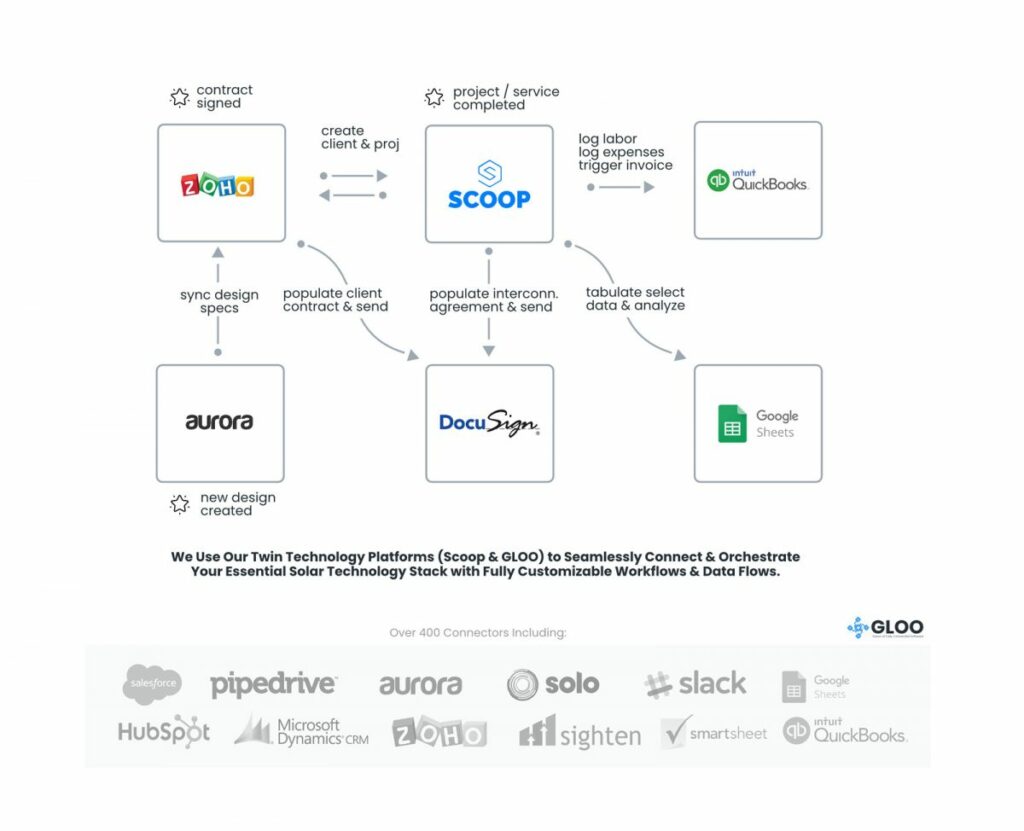
The distinction matters because analytics tools and operational platforms serve different functions. Analytics tools deliver views of system health, production efficiency, and financial returns, helping teams identify where improvements are needed. Operational execution platforms go further by connecting those insights to automated workflows, service coordination, and financial accountability, turning data into action across teams and systems, not just reports.
Process Automations
Automated workflows represent a significant advancement in solar asset management. These systems reduce human error by standardizing routine tasks such as maintenance scheduling and performance reporting. The financial benefits become apparent through reduced operational costs and increased system uptime.
But the most impactful automation goes beyond individual task execution. Cross-functional workflow orchestration, connecting monitoring alerts to service dispatch, linking completed field work to contract SLAs, and feeding maintenance outcomes into billing and financial systems, is what separates basic automation from a true operational backbone. When these workflows span monitoring, service delivery, finance, and CRM, they create end-to-end accountability that helps solar operators scale their portfolios without scaling their overhead at the same rate.
Storage Integrations
- Battery Management Systems: These solutions coordinate between solar production and storage capacity, creating effective power dispatch strategies for maximum financial returns.
- Peak Shaving Applications: Integrated storage allows excess daytime production to offset high-demand periods, reducing costs for commercial installations.
- Grid Stability Solutions: Storage systems provide frequency regulation and voltage support, making solar plants more valuable to the electrical grid.
- Microgrid Capabilities: Combined solar and storage can isolate from the main grid during outages, maintaining power to critical loads.
- Energy Arbitrage Functions: Smart storage systems may automatically store energy when prices are low and discharge when prices rise, optimizing the lifecycle value of generated electricity.
- Curtailment Reduction: Storage captures excess production that would otherwise be wasted during periods of high generation and low demand.
- Backup Power Configuration: Strategic storage deployment provides resilience against grid outages, enhancing the overall value proposition for new solar work.

Implement Your Solar Asset Management with Scoop!
Managing solar assets requires more than inspections and maintenance schedules. It requires operational control across monitoring, service execution, contract obligations, and revenue tracking. Scoop acts as a Central Operations Hub that converts monitoring alerts into structured workflows, guides field teams through standardized asset-level checklists, and automatically syncs completed work to billing and financial systems. Instead of just tracking performance data, teams gain a connected execution layer that links asset health, technician activity, SLAs, and cash flow in one unified operational system built for solar and storage portfolios.
Ready to streamline your solar asset operations? Book a demo now.
Frequently Asked Questions About Solar Asset Management
What Are The Most Critical Factors For Asset Management Success?
Success in solar asset management hinges on 3 key elements: performance optimization, preventive strategies, and financial oversight. Regular monitoring using advanced analytics helps identify issues before they affect energy production. Implementing scheduled maintenance protocols extends system lifespan while maximizing return on investment. Proper documentation of all operational activities creates accountability that supports long-term reliability.
How Often Should Maintenance Activities Be Scheduled?
Most commercial solar systems follow quarterly inspections, with comprehensive evaluations conducted twice yearly. Thermal imaging should happen annually to detect potential hotspots or connection issues. Panel cleaning frequency varies by location, dusty or high-pollen areas may need bi-monthly attention, while cleaner environments can manage with seasonal maintenance. Weather events might necessitate additional checks to ensure optimal energy harvest throughout the system’s 25-30 year lifespan.
Does Solar Asset Management Require Specialized Software?
Yes, dedicated solar software platforms provide essential functions for effective solar asset oversight. These systems deliver real-time performance data, allowing operators to spot production anomalies quickly. Modern management tools integrate weather forecasting with output analysis to predict maintenance needs.
But performance monitoring alone isn’t enough. The most effective platforms also connect monitoring insights to work order automation, field execution, contract tracking, and billing triggers, creating cross-team accountability from the moment an issue is detected through to the invoice. Financial tracking features should calculate actual returns against projections while staying linked to the service activity that drives those returns, making budget planning more accurate and operationally grounded for long-term management.
What Is The Best Way To Handle Regulatory Changes?
Establishing relationships with industry associations offers early warnings about upcoming policy shifts. Creating a compliance calendar with automatic reminders helps track deadlines for new requirements. Allocating budget specifically for regulatory adaptation prevents financial surprises during transitions. Many solar operators benefit from consulting services that specialize in translating complex regulations into actionable steps for continued project viability.