
Field service scheduling is the process of planning and assigning technicians to on-site jobs, matching each job to a technician with the right skills, location, availability, and parts, inside the time window promised to the customer.
Schedulers, dispatchers, and operations managers own the schedule. For solar, wind, battery storage, and EV charging teams, that schedule has to carry new installations, service calls, and recurring operations and maintenance (O&M) work at the same time, so one late job does not push every crew off track.
Key Takeaways
- Field service scheduling matches every job to a technician on five checks: skill, location, availability, priority, and parts.
- Scheduling is the planning step and dispatching is the execution step. Scheduling decides who goes where and when; dispatching notifies the technician and sends them to site.
- Field teams schedule 5 types of work: reactive, planned, preventive, predictive, and multi-day project work. Each one protects a different commitment.
- Every extra mile on the schedule has a price. The IRS business mileage rate rose to 76 cents per mile on July 1, 2026.
- Technician supply is tight. The Bureau of Labor Statistics projects about 569,000 openings per year in installation, maintenance, and repair occupations from 2025 to 2035, so the schedule has to get more completed work from the same crews.
- Running installations, service calls, and recurring O&M work from one schedule raises first-time fix rates and cuts repeat site visits.
What Is Field Service Scheduling?
Field service scheduling is the operational process of matching the right technician to the right job at the right time, accounting for skill sets, geographic proximity, equipment requirements, and customer commitments.
It goes far beyond calendar management: as a decision-making engine, field service scheduling determines execution quality across every stage of a service operation by connecting job queues, workforce tracking, and resource allocation into a single coordinated system.
Within the broader field service management lifecycle, scheduling is the solution that translates incoming demand into structured field action.
Field Service Scheduling vs. Dispatching vs. Field Service Management
Field service scheduling is the planning step, dispatching is the execution step, and field service management is the full operation that contains both. The table shows where each one starts and stops.
| Term | What it covers | When it happens | Who owns it | Output |
| Field service scheduling | Matching jobs to technicians by skill, location, availability, priority, and parts | Before the work day, and again whenever the plan changes | Scheduler or operations manager | A confirmed assignment and arrival window |
| Dispatching | Notifying the technician, sending job details, and tracking arrival on site | On the day of the job | Dispatcher | A technician on site with the work order |
| Route optimization | Ordering each technician’s jobs and travel path to cut drive time | While the schedule is built, and when a job is added mid-day | Scheduler or scheduling software | A route per technician |
| Field service management | The full lifecycle: work orders, scheduling, dispatch, field data capture, inventory, reporting, and invoicing | End to end, from request to invoice | Operations leadership | A completed, documented, and billed job |
In small teams one person often schedules and dispatches. As job volume grows, the two roles split, and field service management software keeps both working from the same job record, so the dispatcher never sends a technician to a job the scheduler has already moved.
How Does Field Service Scheduling Work?
The field service scheduling process starts when a service request enters the system and ends with a confirmed technician arrival window, with real-time adjustments throughout the day as field updates change the plan. It runs in five steps:
- Capture and triage the request. Rank each job by urgency, SLA window, and equipment criticality before it enters the queue.
- Match skills and certifications. Shortlist technicians who hold the certifications and equipment clearance the work type requires.
- Confirm parts and site readiness. Check that parts are in stock, permits are approved, and the site is accessible before the job is booked.
- Optimize location and route. Group jobs by area and order each technician’s day to keep drive time low.
- Dispatch and adjust in real time. Send the job to the technician’s phone, then re-sequence the day when a job runs long, a customer cancels, or an urgent fault comes in.
Job Prioritization and Triage in Field Service Scheduling
Incoming service requests are categorized by urgency, SLA requirements, and revenue impact before entering the scheduling queue.
In high-volume maintenance and repair operations, triage weighs alert severity, contractual SLA windows, and equipment criticality across distributed sites, so the urgent jobs that need immediate attention don’t compete with routine maintenance for the same dispatch slots.
Installation and construction teams apply the same triage logic to a different set of inputs, sequencing jobs around permit approvals, equipment delivery windows, and crew certifications so an install only enters the schedule once its prerequisites are in place. This prioritization step gives field service managers direct control over which technicians receive which assignments and in what order.
Technician Skill Matching in Field Service Scheduling
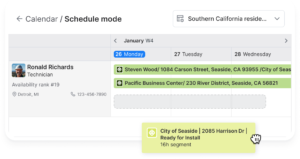
Skill matching assigns the right technician to each job based on certifications, experience level, and equipment clearance required for the work type.
Qualified technicians are getting harder to hire. The Bureau of Labor Statistics projects employment of wind turbine service technicians to grow 49.9% and solar photovoltaic installers to grow 42.1% from 2024 to 2034, the two fastest-growing occupations in the country. In Europe, electricians and welders are among the occupations with the most reported shortages in 2025.
Field service businesses operating in multi-trade environments (electrical, structural, commissioning) need a structured approach to prevent mismatched assignments that create repeat visits and wasted travel.
Scheduling systems that track technician availability against job-specific requirements, certification expiration dates, and training status help teams manage workforce capacity without relying on tribal knowledge.
Route Optimization and Travel Time Reduction
Geographic clustering and route planning optimize technician paths between job sites, reducing windshield time and increasing the number of completed jobs per day.
When scheduling accounts for location proximity, real-time traffic tracking, and job duration estimates, each technician covers a tighter service radius, which directly improves fuel efficiency, lowers vehicle wear, and cuts carbon output. Better route planning produces compounding returns: fewer miles driven per job means more capacity for additional appointments without adding headcount.
How teams execute prioritization, skill matching, and route planning depends on the scheduling model they adopt, from manual coordination to AI-driven automation.
What Are the Different Types Field Service Scheduling Models?
The field service scheduling model a team selects shapes every downstream management decision, from dispatcher workload to technician output.
3 distinct approaches serve different operational maturity levels, and the right solution depends on job volume, workforce size, and how much process automation the existing tools and software systems can support.
Manual Field Service Scheduling
Spreadsheets, whiteboards, and phone-based coordination from the office remain common for teams with fewer than 5 technicians and predictable job volumes. The process works when dispatchers can manage the full schedule in their heads, but it offers no conflict detection, no historical information for pattern analysis, and no real-time visibility into field progress.
Once volume or complexity grows, manual scheduling loses control: double-bookings, missed appointments, and scheduling gaps become the norm rather than the exception.
Operations That Benefit From Rule-Based Scheduling
Rule-based scheduling software assigns jobs automatically using predefined criteria: proximity, skill match, availability windows, and priority level. These tools shift the dispatch process from manual assignment to exception management, so dispatchers use their time handling disruptions (cancellations, emergencies, weather delays) rather than building the daily schedule from scratch. The system features work well for medium-volume operations with repeatable job types, but rule-based scheduling can’t create real-time adjustments when conditions shift mid-day.
Key Differentiators of AI-Powered Field Service Scheduling
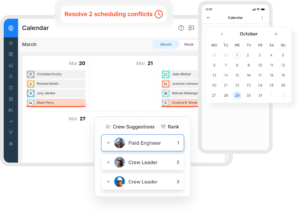
Machine learning models continuously optimize field service schedules based on real-time data inputs: traffic conditions, job duration variance, last-minute cancellations, and technician assignments, replacing the hours dispatchers spend manually reshuffling appointments around mid-day disruptions.
For service teams managing distributed sites across wide territories, AI-powered scheduling improves efficiency by re-routing technicians in response to emergency calls and breakdowns, keeping SLA commitments intact without adding headcount. The same adaptability matters for installation teams running multi-day, multi-crew projects: when a permit clears late or an equipment delivery slips, the system re-sequences crew assignments and downstream jobs automatically instead of forcing dispatchers to rebuild the week by hand.

The scheduling model sets the ceiling for what’s possible, but the real payoff shows up in the operational metrics it moves.
7 Benefits of Optimized Field Service Scheduling
The benefits of field service scheduling show up in the metrics operations leaders already track:
- Higher first-time fix rates. Matching skills, parts, and service history before assignment gets the job done on the first visit and cuts repeat truck rolls.
- Less travel time and lower fuel cost. Grouping nearby jobs and ordering routes reduces drive time between appointments.
- Higher technician utilization. Fewer idle windows and less admin time mean more billable hours from the same crews.
- Stronger SLA performance. Urgent faults are ranked ahead of routine work, so response times stay inside the contract.
- Accurate arrival windows. Live job status lets the office give customers an arrival time they can rely on.
- Preventive maintenance done on time. Recurring O&M work orders are generated on schedule instead of being remembered.
- Audit-ready job records. Every visit is tied to a technician, a time, photos, and a completed checklist, which supports warranty claims and SLA reporting.
Technician utilization rate measures billable hours as a percentage of total available working time, one of the core field service management metrics that show how much of a technician’s day produces revenue. When dispatchers can track assignments in real time and redistribute work based on actual field conditions, field service teams manage capacity more effectively without growing headcount.
Who Is Responsible for Field Service Scheduling?
Field service scheduling is owned by the scheduler or dispatcher, with operations managers setting the rules and technicians feeding back what happens on site.
- Scheduler or dispatcher: builds the daily and weekly schedule, assigns jobs, and handles changes during the day.
- Operations or service manager: sets priority rules, SLA targets, and crew capacity, and reviews schedule performance.
- O&M program manager: plans recurring preventive maintenance across a portfolio of sites and contracts.
- Field technicians and crew leads: update job status, flag missing parts, and close out work orders from the field.
- Project managers: sequence installation crews around permits, deliveries, and inspections on multi-day projects.
Field Service Scheduling in Practice: An O&M Example
Pacific Power Solutions grew from a two-person operation to 30 field technicians and scaled 15x while building its O&M business on Scoop. When a technician completes a report, an automated trigger notifies the dispatch team to review it before it goes to the client. Mandatory fields stop a report from being submitted incomplete, and clients can see site history directly, which cut the return trips that used to fill the schedule.
Does Optimized Scheduling Improve Technician Utilization?
Technician utilization rate measures billable hours as a percentage of total available working time, one of the core field service management metrics that reveals how much of a technician’s day produces revenue. Teams using optimized field service scheduling consistently report higher utilization and better operational efficiency than teams relying on manual methods, the difference coming from fewer idle windows between jobs, less time spent on admin tasks, and mobile app access to job details in the field. When dispatchers can track assignments in real-time and redistribute work based on actual field conditions, field service teams manage capacity more effectively without growing headcount.
Knowing the benefits is one thing; building the operational habits that sustain them is where scheduling strategy becomes scheduling reality.
Which Field Service Scheduling Best Practices Improve Results?
The best field service scheduling outcomes don’t come from technology alone. These practices improve the process at the management level, separating field service teams that react to scheduling problems from teams that prevent them.
Centralize Scheduling in One Platform
When scheduling data lives in one system, CRM records in another, and job history in a third, dispatchers manage appointments and assignments based on incomplete information. A centralized field service management software solution eliminates double-booking, conflicting assignments, and version-control issues by addressing the data silos behind common scheduling breakdowns.
When scheduling, dispatch, and job tracking share the same communication tools and data layer, every decision operates from the same operational truth, giving the control center full visibility into what’s happening across every active job site.
Teams that address these field service management challenges through platform consolidation see faster dispatcher response times and fewer data conflicts across departments.
Why Should Dispatchers Use Real-Time Data?
Live technician location, job progress updates, and traffic data transform field service scheduling from a static morning plan into a continuous optimization loop. Mobile app access (including offline sync at remote or low-connectivity sites that updates automatically once connectivity returns) gives dispatchers real-time tracking and the information they need to reassign jobs, adjust routes, and notify customers without waiting for a phone call from the field. This shift turns dispatch from a scheduling function into an operational coordination role, where every decision reflects current field conditions rather than assumptions made at the start of the day.
This shift turns dispatch from a scheduling function into an operational coordination role, where every decision reflects current field conditions rather than assumptions made at the start of the day.

Build Buffer Time Into Field Service Schedules
Overloaded field service schedules create a domino effect: one late job delays every subsequent appointment, and the backlog compounds through the rest of the day. Smart buffer allocation accounts for job complexity variance, travel uncertainty, and documentation time, giving field service teams the flexibility to manage disruptions without cascading failures. On multi-day installation projects, that same buffer absorbs inspection delays and weather windows that would otherwise push every downstream crew assignment off track.
The goal is predictable service windows that maintain efficiency, not maximum theoretical throughput that collapses at the first delay.
When these practices are in place, the next step is choosing a platform that supports them at scale.
Common Field Service Scheduling Mistakes
The most common field service scheduling mistakes come from treating the schedule as a calendar rather than a set of decisions about skills, parts, and priority:
- Assigning by availability alone. The free technician is not always the qualified one, and the result is a repeat visit.
- Booking before parts are confirmed. The technician arrives, diagnoses the fault, and leaves to order the part.
- Packing every hour. A schedule with no buffer collapses at the first late job.
- Keeping O&M work on a separate calendar. Preventive visits get bumped by urgent jobs because nobody sees both at once.
- Staying on spreadsheets too long. Manual scheduling hides conflicts until a customer calls to ask where the technician is.
- Not reviewing outcomes. Without tracking first-time fix rate and schedule adherence, the same mistakes repeat every week.
Take Control of Field Service Scheduling
The gap between reactive scheduling and proactive field service operations comes down to whether teams have the system, data, and workflows unified in one place. Organizations that centralize scheduling, dispatch, and job tracking on a single platform gain the visibility and speed to scale without adding operational overhead.

Ready to see it with your own jobs? Book a demo and our team will walk through your scheduling workflow with you.
Frequently Asked Questions About Field Service Scheduling
What Is the Difference Between Field Service Scheduling and Field Service Management?
Field service scheduling focuses on assigning and timing technician jobs based on priority, skill requirements, and availability. Field service management covers the full operational lifecycle (scheduling, dispatching, inventory, work orders, invoicing, and customer communication), with scheduling being the component that most directly controls daily field execution.
Does AI Improve Field Service Scheduling Accuracy?
AI analyzes real-time inputs like traffic, technician location, job duration patterns, and cancellations to continuously re-optimize schedules throughout the day. AI-powered scheduling recovers from disruptions within minutes instead of hours, maintaining schedule integrity across the full technician roster where traditional rule-based systems cannot adapt.
What Is a Good First-Time Fix Rate for Field Service Teams?
Top-performing field service organizations maintain first-time fix rates above 80%, while the industry average sits closer to 70-75%. The difference typically traces back to whether the scheduling system accounts for technician certifications, parts availability, and job history before making assignments.
Jobs Per Day: What Should Field Service Technicians Complete?
Job completion rates depend on job complexity, travel distance, and industry vertical, with residential maintenance technicians typically completing 4-8 jobs per day. Complex commercial installations, equipment overhauls, or multi-trade service calls may average 2-3 jobs per day, and optimized scheduling increases output by reducing windshield time between assignments.
Can Field Service Scheduling Software Integrate With Existing CRM Systems?
Most modern field service scheduling platforms offer native integrations or API connections to major CRM systems (Salesforce, HubSpot, custom CRMs), syncing customer data, service history, and work orders automatically. Dispatchers get full context when assigning jobs, and operations teams maintain a single source of truth across scheduling and customer records.