
The best wind energy O&M automation software in 2026 is Scoop, for teams whose work moves from a SCADA alarm through dispatch, field execution, and documentation to an invoice. It runs new construction, corrective repairs, and recurring preventive maintenance from one wind turbine O&M software platform. ONYX Insight is the strongest choice for fault detection and case triage on drivetrain and pitch system faults. SkySpecs Horizon is the strongest choice for blade programs, specifically leading edge erosion, lightning damage, damage propagation tracking and warranty claims.
Key Takeaways
- Wind energy O&M automation software turns a SCADA alarm into a dispatched technician, a completed procedure, and a billable line item without anyone retyping the same fault code three times.
- We evaluated 9 platforms against 5 criteria we call the Fault-to-Invoice Test, and Scoop ranks first because it is the only one that helps teams manage the process from detection through to field execution and client service reporting.
- We estimate that a 15-technician wind O&M team pays between $2,850 and $11,700 a year in software subscriptions. That range is the entry tier at the low end and the top published tier at the high end, across the platforms that publish per-user rates.
- A single repeat site visit to a remote turbine costs roughly $460 in mileage and crew time by our calculation, using the IRS 76 cents per mile rate and the BLS median wind technician wage of $31 an hour.
- US wind generated 464,000 gigawatt-hours in 2025 and 11.8 GW more is planned for 2026, so the installed base under service contract keeps growing while the technician pool grows by only about 1,500 openings a year.
- Condition-based triggers, offline mobile inspections, and SCADA integration are the three capabilities that separate a wind O&M platform from a general maintenance database.
How We Ranked These Platforms
The typical wind turbine fault involves many steps and people. SCADA raises an alarm, someone decides whether it is worth a truck roll, a crew gets dispatched with the right parts and specific procedure, the work gets documented well enough to survive a warranty claim, and somebody bills for it. Each platform on this list is strong at one or two of those steps. The differences show up at the handoffs between them.
We call our method the Fault-to-Invoice Test, because the question that actually separates these platforms is how many handoffs happen inside the software and how many happen in somebody’s inbox.
We scored every platform against the same five criteria.
- Field execution. Can the platform put the correct procedure in a technician’s hands in the nacelle, offline, and enforce that the procedure is followed? This is what raises first-time fix rates and cuts repeat site visits.
- Workflow automation and handoffs. Does a SCADA alarm, a vibration threshold or an oil analysis result generate a work order on its own, and does that work order reach the right crew without a dispatcher retyping it?
- Integration depth. Does it connect to SCADA, condition monitoring, CRM, ERP and accounting, and does it do so natively rather than through a project you have to fund yourself? We covered the difference in our comparison of native integrations against API work.
- Reporting and audit readiness. On a service contract, can you show an asset owner the full maintenance history of a turbine and the proof that the SLA was met, without assembling it by hand?
- Customer success and implementation support. Most vendors gate hands-on help behind an enterprise contract. We score access to real configuration help because buyers discover the absence of it in month three, not in the sales cycle.
Criteria We Did Not Include, and Why
Two things we deliberately left out of the scoring, because they are not commonly evaluated when looking for operations software.
- Design, siting and resource modeling. Layout optimization, wake modeling and energy yield assessment are a separate discipline with separate tools. Teams that treat siting precision as a competitive advantage should keep a purpose-built package such as Shoreline Wind’s simulation modules and connect it to operations rather than expect an O&M platform to replace it.
- Lead generation and marketing features. Several of the general maintenance platforms bundle request portals and customer-facing marketing modules. They are real features, but they have nothing to do with keeping a turbine turning, and scoring them would reward breadth over fitness for wind.
Wind Energy O&M Automation Software Compared (2026)
Pricing last verified on 8 September 2026 from each vendor’s own published pricing page.
| Company | 2026 published price | Best for | Key capabilities | Limitation |
| 1. Scoop | Unlimited users, storage and devices on every plan | Wind O&M companies running new construction, corrective repairs and recurring preventive maintenance in one system | Fault-to-dispatch routing, offline mobile procedures, preventive maintenance schedules, SLA proof, asset history, client reporting, 500+ integrations | Does not perform turbine design, wake modeling, or resource assessment |
| 2. ONYX Insight | Not publicly listed | Connecting automated fault detection to a resolution workflow | Case management, fleetMONITOR condition monitoring, fieldPRO inspections, derate dashboards, ecoPITCH and ecoBLADE component monitoring | Diagnostics-first. Dispatch, field execution and billing sit outside the platform |
| 3. SkySpecs Horizon | Not publicly listed | Blade asset management, damage tracking and warranty claims | Consolidated blade inspections, damage propagation analysis, lightning strike monitoring, AEP loss analysis, warranty and FSA claim management | Blade-centric. Gearbox, converter and balance-of-plant work orders are outside its scope |
| 4. Shoreline Wind | Not publicly listed | Simulating and planning O&M campaigns before committing vessels and crews | Shoresim AI modeling, O&M and construction simulation, marine coordination, work planning, permit and defect management | Planning-led and offshore-weighted. Day-to-day onshore work order execution is thinner |
| 5. Power Factors Unity | Not publicly listed | Portfolio asset performance management across mixed wind and solar fleets | SCADA, power plant controller, energy management, asset performance management, invoice management, field service management, Unity REMI | Enterprise scale and enterprise procurement. Heavy for a service provider with a few hundred turbines |
| 6. OxMaint | Lite free; Pro $19 per user per month or $190 per user per year; Agentic $49 per user per month or $490 per user per year; Enterprise custom | Turbine-level maintenance records on a small budget | Gearbox oil analysis trending, blade condition logs by section, operating-hours-based PM triggers, mobile inspections, SCADA data via API | A maintenance database rather than an operations platform. No native CRM, billing or subcontractor workflow |
| 7. MaintainX | Basic free; Essential $20 per user per month annual; Premium $65 per user per month annual; Enterprise custom | Mobile work orders for a small crew that wants a published price | Unlimited work orders, digital procedures, meter-based maintenance, parts inventory, purchase orders, open REST API on Premium | General maintenance software. No turbine component hierarchy and no SCADA fluency out of the box |
| 8. UpKeep | Essential $24 per user per month; Premium $55 per user per month; Professional and Enterprise quoted | Service teams that need mobile inspections above all else | Unlimited work orders and locations, PM scheduling, custom checklists, parts and inventory, offline mode on Professional | Offline mode, the capability a nacelle crew needs most, sits two tiers above the entry plan |
| 9. eMaint (Fluke) | Not publicly listed. Professional (3-user minimum) and Enterprise (5-user minimum) tiers named | Teams already standardized on Fluke condition monitoring hardware | Work orders and PM, offline mobile, advanced reporting, API integrations to ERP, BI and SCADA, eMaint AI Suite on Enterprise | Industry-neutral. Wind-specific logic is something you configure yourself |
See the Fault-to-Invoice Workflow on One of Your Own Turbines
Book a demo and we share the entire workflow with you: the fault notification, work order schedule and dispatch, mobile field execution, and the SLA proof landing in a client-ready report.
Bring a turbine you are servicing right now and we will show you where the process breaks and what it takes to fix it. Most teams start with a 20-minute discovery call so we understand your portfolio before anyone opens a screen. No credit card, no obligation, and we respond the same business day.
1. Scoop: Best Wind Energy O&M Automation Software Overall

What Scoop Does Best
Scoop is the operations layer between your monitoring stack and your field crews. A SCADA or condition monitoring alert becomes a routed work order, the technician opens the correct procedure for that turbine model on a phone that keeps working with no signal, the photos and readings attach themselves to that asset’s maintenance history, and the completed job feeds both the client report and the invoice.
The reason we rank Scoop first is coverage of the whole Fault-to-Invoice workflow. ONYX Insight is better at deciding whether a gearbox is degrading. SkySpecs is better at deciding which blade repair to fund first. Neither of them, and none of the general CMMS tools, carries that decision through dispatch, offline field execution, warranty documentation and the client-facing report in one system of record.
Scoop’s versatile field service platform can be configured to manage recurring preventative and reactive maintenance processes for wind O&M companies.
Pacific Power Solutions scaled 15x while building a leading O&M business on Scoop, and RWE reports $1.4M in annual savings and 40% less administrative time.
Field work runs on digital checklists that adapt to the turbine model, so a crew servicing three different platforms in a week is not working from a generic form. Photos, videos, barcodes, signatures and timestamps capture on the device and sync when the crew regains signal.
Pricing
Unlimited users, storage, and devices on every plan. Talk to our team about fit for your asset portfolio.
Best For
Wind O&M companies with recurring service contracts, owner-operators running mixed onshore and offshore portfolios, EPCs handing commissioned assets into a service book, and renewable energy companies coordinating partner-led or subcontracted field delivery.
Scoop Limitations
- Scoop does not design turbines, run wake or resource simulations, or produce layout optimizations. That work stays in your design and siting tools, and Scoop connects to the systems around them.
- Scoop is built for operations teams ready to configure the platform around how they actually run field work. That configuration takes real time from someone on your team. Companies with a dedicated owner for that setup, and the budget to see it through, get value starting on day one.
- Scoop delivers the most value where there is a repeatable process to standardize. The more your service visits follow a recognizable shape, the faster the workflow automation compounds.
Verdict
Scoop is the right choice if your turbines are already monitored and your problem is everything that happens after the maintenance alert.
2. ONYX Insight: Best for Wind Turbine Case Management

What ONYX Insight Does Best
ONYX Insight is a wind-native diagnostics company, and its case management product turns a detected fault into a tracked case. It brings fleetMONITOR condition monitoring and fieldPRO inspection data into a single case record, shows which turbines are derated and where the downtime risk sits, and lets you configure the workflow that moves a case from open to resolved. ONYX reports monitoring 32,000+ turbines across 35+ countries and 180+ GW of operational assets, with named North American owner-operators including bp Wind and Pattern Energy’s 4.2 GW fleet.
The component-level work behind it is strong. ONYX launched ecoBLADE for blade root monitoring in April 2026, won a Technical Innovation Award for it in May 2026, acquired blade specialist ELEVEN-I in September 2025, and partnered with Aviva in July 2026 on turbine insurance risk and asset life extension. If your question is whether a component is degrading and how fast, ONYX is a top contender.
Pricing
Not publicly listed. ONYX Insight does not share pricing on their website.
Best For
Owner-operators and asset managers whose gap is fault detection and case triage across a large fleet, particularly where gearbox, pitch bearing and blade root failures drive the operating expenditure.
ONYX Insight Limitations
- It is diagnostics-first. A case tells you what is wrong and how urgent it is, but crew scheduling, offline field procedures, subcontractor coordination, warranty documentation and billing sit outside the platform.
- No published pricing and no published tier names, so budgeting requires talk to the sales team.
Verdict
We rank ONYX Insight second because it is the best answer on this list to a narrower question than the one this page asks. Buy it for detection, and connect it to the system that runs the work.
3. SkySpecs Horizon: Best for Blade Asset Management
What SkySpecs Horizon Does Best
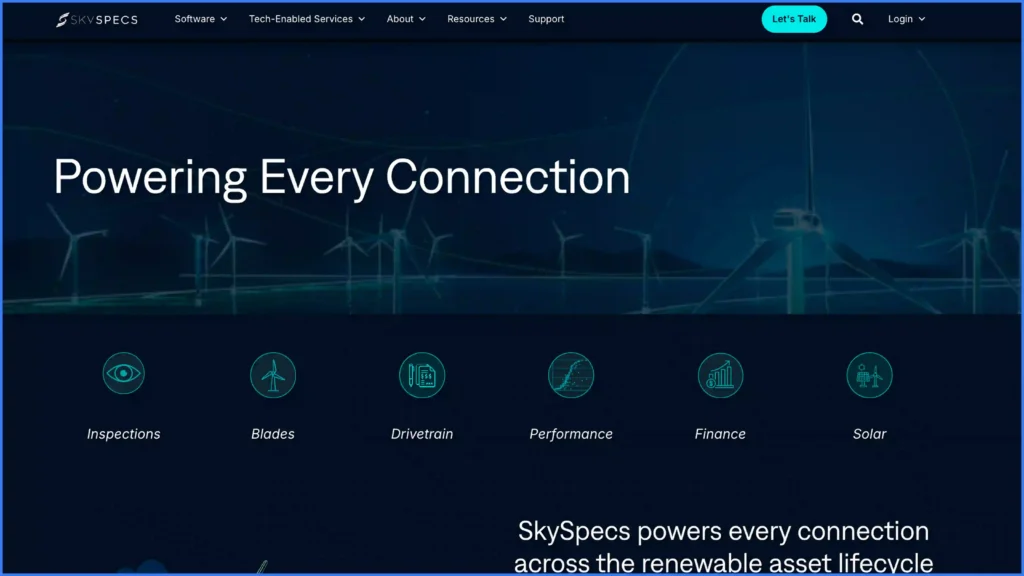
Horizon Blade Asset Management is the most focused product on this list and the best for blade asset management. It consolidates blade inspection results from every source you use, runs damage review and propagation analysis so you can see which damage types are spreading across the fleet, tracks lightning strikes and the inspections they trigger, quantifies annual energy production loss, and manages warranty and full service agreement claims from the same record. SkySpecs reports 745,000+ blades inspected, 130 GW served, $42B in assets under contract, and roughly 65% of North American blades monitored annually.
Blade software exists as its own category because blade repair decisions are capital allocation decisions. Horizon is built to show which repair campaign to fund this season, in what order, and with what expected AEP recovery. That is a different question from work order management, and SkySpecs answers it better than any general platform.
Pricing
Not publicly listed. SkySpecs does not share pricing on their website.
Best For
Owner-operators and asset managers where leading-edge erosion, lightning damage, and blade repair campaigns are the leading cost line, especially fleets carrying active warranty or FSA claims worth pursuing.
SkySpecs Horizon Limitations
- Blade-centric by design. Gearboxes, converters, pitch systems and balance-of-plant work sit outside its scope, so it does not become your one operations system.
- No published pricing.
Verdict
If blade repair is your biggest line item, SkySpecs Horizon. Run the rest of the service book somewhere that handles work orders, crews, and client reporting.
4. Shoreline Wind: Best for O&M Planning and Simulation
What Shoreline Wind Does Best
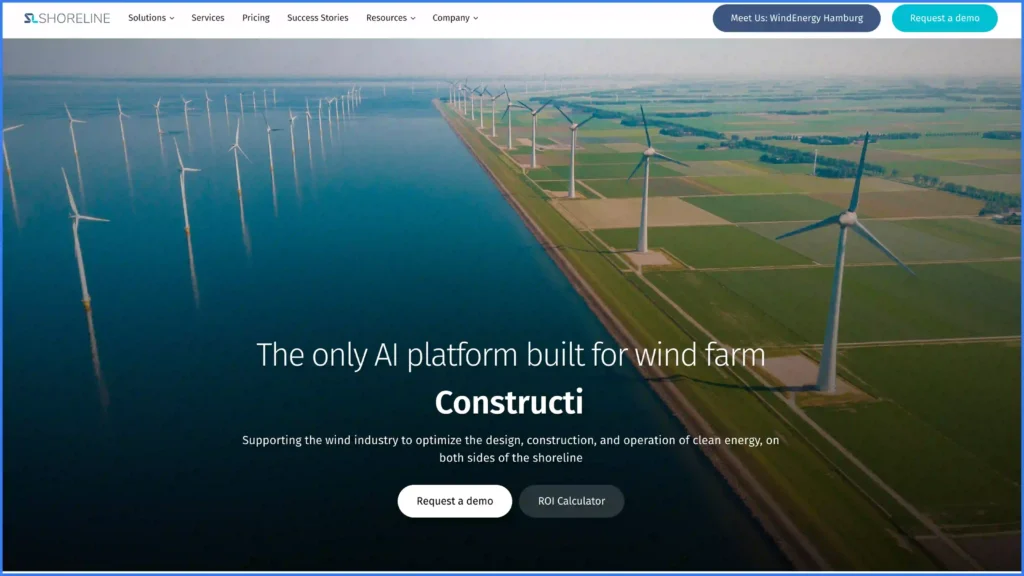
Shoreline Wind models what an O&M campaign will cost and how long it will take before you commit vessels, crews, and cranes to it. Shoresim AI drives the modeling, forecasting, and business case analysis, and around it sit construction and O&M simulations, work planning, marine coordination, resource management, permit management, defect management, inventory, and time tracking. Shoreline reports 60+ global companies on the platform and names Ørsted among them, with published customer stories including Ocean Winds and RENOVA in August 2025 and Head Energy in July 2026.
Marine coordination is the capability nobody else on this list has. If your maintenance windows are set by vessel availability and weather rather than by technician calendars, that module is the reason to look at Shoreline.
Pricing
Not publicly listed. Shoreline Wind does not share pricing on their website.
Best For
Offshore wind operators and developers, and onshore teams whose annual planning cycle is complex enough that simulating it is worth doing before executing it.
Shoreline Wind Limitations
- Planning-led and offshore-weighted. The daily loop of a corrective fault becoming a dispatched onshore crew with a procedure in hand is thinner than in a purpose-built field execution platform.
- No published pricing.
Verdict
We rank Shoreline Wind fourth and rate it highly for what it is. It answers the annual planning question, not the Tuesday morning dispatch question.
5. Power Factors Unity: Best for Portfolio Asset Performance Management
What Power Factors Unity Does Best
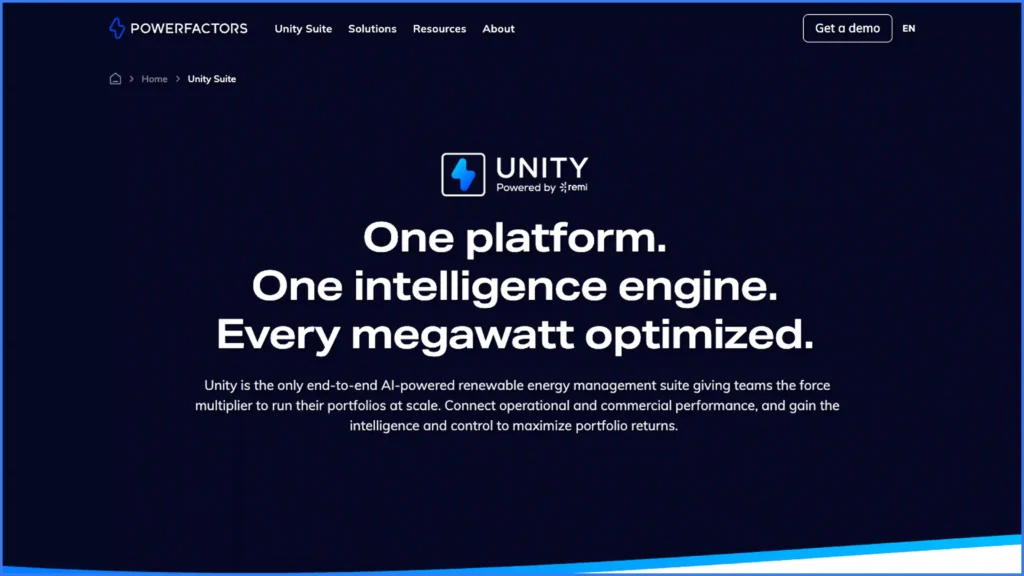
Unity is the broadest platform here. It runs local and central SCADA, a power plant controller, an energy management system, asset performance management, portfolio asset oversight, invoice management, and field service management as modules of one product. In April 2026, Power Factors launched Unity REMI, an intelligence engine the company says was trained on operational data from 310 GW of assets globally and is active across 30+ GW inside Unity. Mubadala took a minority stake the same year.
For a mixed portfolio where wind, solar and storage sit under one operations team, Unity is the most credible single-vendor answer on this list, and it is the platform most likely to already speak to your SCADA layer without a custom project.
Pricing
Not publicly listed.
Best For
Utility-scale owner-operators and independent power producers managing large mixed renewable portfolios who want SCADA, performance management, and field service under one vendor.
Power Factors Unity Limitations
- Enterprise scale and enterprise procurement. For a service provider with a few hundred turbines and a dozen technicians, the platform and the buying process are both heavier than the problem.
- Field service management is one module among many rather than the center of the product, so the technician experience is not what the platform is optimized around.
- No published pricing.
Verdict
Unity is the right answer at utility scale and the wrong answer at service provider scale. Size the platform to the team that has to use it every day.
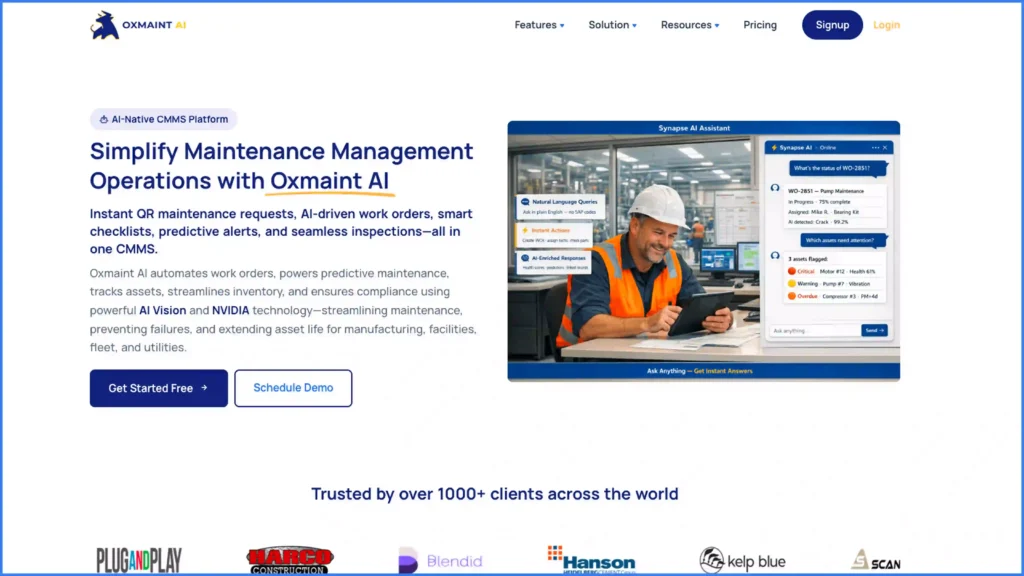
6. OxMaint: Best Turbine-Level CMMS on a Small Budget
What OxMaint Does Best
OxMaint is the only low-cost tool on this list for wind turbines. Its wind pages describe gearbox oil analysis trending with particle count, viscosity, water content, wear metals, and total acid number tracked per gearbox, with automatic trend lines and configurable alert thresholds. Blade condition logs are organized by blade designation, spanwise section, and surface area, so leading edge erosion can be compared across inspection cycles. Preventive maintenance triggers run on operating hours and start counts rather than calendar dates, and production data can arrive from SCADA through an API.
OxMaint claims 97%+ fleet availability under CMMS-driven programs, 40% lower O&M cost per MWh against reactive maintenance, and a $65K average gearbox replacement against $3K for planned oil analysis. Those are vendor-reported figures, not independent benchmarks, and we treat them as such.
Pricing
Lite is free with a cap of 3 work orders per month and 1 schedule. Pro is $19 per user per month, or $190 per user per year. Agentic is $49 per user per month, or $490 per user per year. Enterprise is custom. Free trials require no credit card.
Best For
Small independent service providers and single-site operators who need turbine-aware maintenance records and cannot fund an enterprise platform.
OxMaint Limitations
- It is a maintenance database, not an operations platform. There is no native CRM, no quoting, no subcontractor workflow, and no client-facing service reporting.
- Per-user pricing means the cost scales directly with headcount, which is the opposite of what a growing service book wants.
Verdict
The best value on this list, and a reasonable first system for a team of five. Expect to outgrow it when billing and client reporting become the bottleneck.
7. MaintainX: Best Published-Price Work Order Platform
What MaintainX Does Best
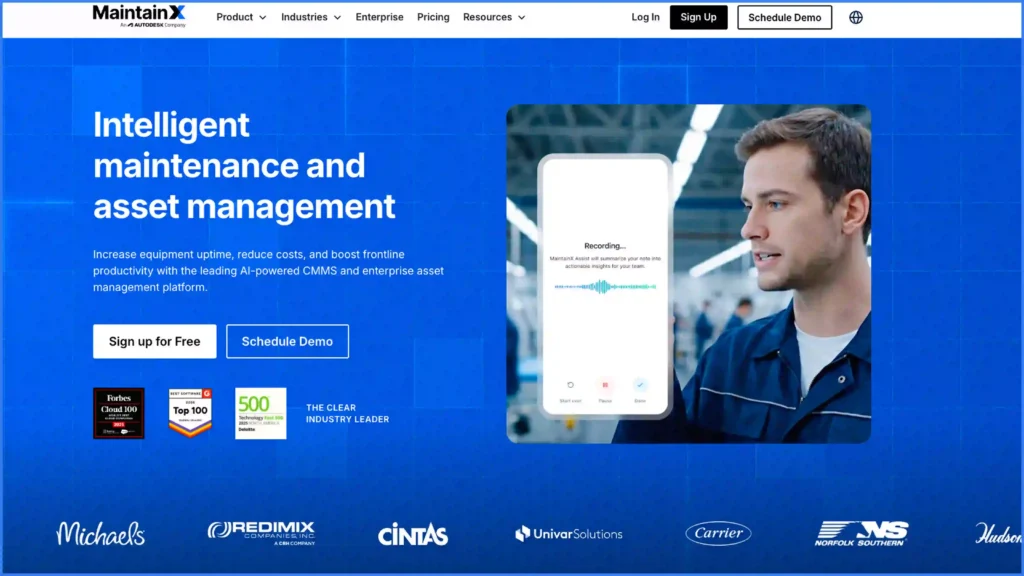
MaintainX is the cleanest mobile work order product in this group. Unlimited work orders and digital procedures, meter-based maintenance triggers, parts inventory, purchase orders, time and cost tracking, and an open REST API from the Premium tier.
Pricing
Basic is free. Essential is $20 per user per month billed annually, or $25 monthly. Premium is $65 per user per month billed annually, or $75 monthly. Enterprise is custom and adds asset health insights, resource planning, IoT integrations, and single sign-on.
Best for
Small wind service teams that want a published price, fast adoption and a straightforward work order loop.
MaintainX Limitations
- General maintenance software. There is no turbine component hierarchy, no SCADA fluency, and no wind reporting out of the box, so every wind-specific behavior is something you configure.
- The API and the advanced analytics both sit on Premium, which more than triples the per-user cost against Essential.
Verdict
A good work order system that is not a wind system. Reasonable if your fleet is small and your integrations are few.
8. UpKeep: Best for Mobile-First Maintenance Teams
What UpKeep Does Best
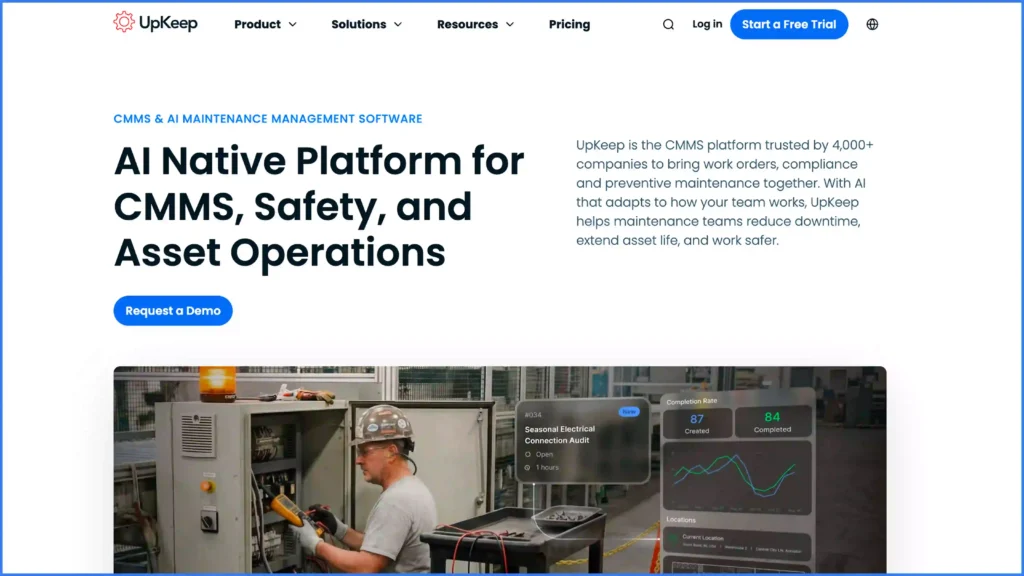
UpKeep is built around the phone. Unlimited work orders and locations from the entry tier, preventive maintenance scheduling, custom checklists, parts and inventory, time and labor tracking, and asset lifecycle tracking further up the range. For a distributed crew that lives in the field, the mobile experience is the product, and UpKeep treats it that way.
Pricing
Essential is $24 per user per month. Premium is $55 per user per month. Professional and Enterprise are quoted. UpKeep lists monthly per-user rates only and does not publish an annual rate on its pricing table.
Best Dor
Service teams whose technicians need checklists and photo capture on a phone more than they need portfolio analytics.
UpKeep limitations
- Mobile offline mode, the single capability a nacelle crew cannot work without, appears on the Professional tier, which is quote-only. The two published-price tiers do not include it.
- No wind-specific asset model, and no native workflow from a SCADA fault code to a work order.
Verdict
Strong mobile maintenance software with the wrong capability behind the wrong wall for wind. Confirm what offline mode costs before you shortlist it.
9. eMaint (Fluke): Best for Teams Already on Fluke Hardware

What eMaint Does Best
eMaint is Fluke’s CMMS, and the argument for it is the hardware relationship. If your condition monitoring runs on Fluke vibration and thermal imaging instruments, having the maintenance system from the same vendor removes a data handoff. The Professional tier covers work orders, preventive maintenance, an offline-capable mobile app, advanced reporting and a dedicated Fluke account manager. Enterprise adds multi-site management, API integrations to ERP, BI and SCADA, and the eMaint AI Suite.
Pricing
Not publicly listed. eMaint names two tiers, Professional with a 3-user minimum and Enterprise with a 5-user minimum.
Best Dor
Maintenance organizations standardized on Fluke condition monitoring hardware that want one vendor across instruments and software.
eMaint Limitations
- Wind-specific logic is something you build. The platform is industry-neutral and configuration-heavy.
- No published prices despite naming tiers and user minimums.
Verdict
A sound industrial CMMS whose best argument is the hardware you may already own. It is not a wind operations platform and does not claim to be.
Solar and Wind Energy Software Integrations: What Has to Connect
Solar and wind energy software integrations don’t fail because their software is bad — they fail because nobody built the bridge between ‘we found a problem’ and ‘we fixed it,’ and that missing bridge becomes the field tech’s problem to solve manually every time. Monitoring platforms, condition monitoring hardware, CRMs, ERPs and accounting systems each own one slice of the asset’s history, and the technician in the field pays for the disconnect between those tools.
There are four essential connections before you choose software to manage you wind asset portfolio.
- SCADA or condition monitoring to work order. A SCADA alarm, a derate, a vibration threshold or an oil analysis result should create a work order with the asset, the fault code and the maintenance history already attached. If a person retypes that, you have bought a dashboard, not automation.
- Work order to field mobile. The procedure, the parts lis,t and the last three service records have to reach the technician on a device that works with no connectivity, and the completed documentation has to sync back to the asset record rather than to a folder.
- Field completion to billing. A completed service visit should produce the billable record without a second data entry pass. This is where service revenue leaks quietly, and it is why we treat invoicing as part of the O&M loop rather than as a finance problem.
- Asset history to client reporting. On a service contract, the asset owner should be able to see what happened and when, and you should be able to prove the SLA was met without assembling a report by hand at renewal.
Scoop connects the tools you already run rather than replacing them. It integrates natively with Salesforce, HubSpot, Zoho, NetSuite, QuickBooks, DocuSign, ServiceTitan, Monday.com and Zapier, and the GLOO integration service extends that to 500+ integrations with a dedicated solution engineer building and maintaining the connection rather than handing you an API key.
Which Wind O&M Platform Should You Choose?
- Independent service provider with recurring O&M contracts. Choose Scoop. Recurring work orders, preventive maintenance schedules per turbine model, audit-ready documentation, warranty proof, full asset history, and client reporting come from one system, and repeat site visits are the metric it is built to reduce.
- Owner-operator whose costs are concentrated in blades. Choose SkySpecs Horizon for the blade program, and run the rest of the service book in an execution platform.
- Owner-operator whose costs are concentrated in drivetrain faults. Choose ONYX Insight for detection and case triage, and connect it to whatever runs the crews.
- Offshore developer or operator planning campaigns around vessels and weather. Choose Shoreline Wind for the planning layer.
- Utility-scale IPP with a mixed wind, solar and storage portfolio. Choose Scoop if you want SCADA, performance management and field service from one vendor at that scale.
- Five-person service team with no budget. Choose OxMaint Pro at $19 per user per month, or MaintainX Essential at $20 per user per month if you would rather have the better mobile experience than the turbine-specific fields.
- EPC commissioning assets into a growing service book. Choose Scoop, because the handoff from construction to service is the seam that costs you money, and it is the only platform here that owns both sides of it.
Stop Paying for Tools That Do Not Talk to Each Other
Most wind O&M teams we meet run a monitoring platform, a spreadsheet, a messaging app and an accounting system, and pay people to move information between them. The software is not the expensive part. The retyping is, and so is the second truck roll.
Bring a turbine you are servicing right now to a 20-minute discovery call, and we will show you where the process breaks and what it takes to fix it. If it is not a fit we will tell you. No credit card, no obligation, same-day response.
Frequently Asked Questions About Wind Energy O&M Software
What does wind O&M software cost?
On the platforms that publish rates, entry tiers run $19 to $24 per user per month and top published tiers run $49 to $65 per user per month. OxMaint is $19 on Pro and $49 on Agentic, MaintainX is $20 on Essential and $65 on Premium billed annually, and UpKeep is $24 on Essential and $55 on Premium.
What is the best software for O&M and recurring service contracts?
Scoop, because recurring service is a different workload from one-off repairs and needs preventive maintenance schedules, contract-level SLA tracking, complete asset history and client-facing documentation rather than just a work order queue.
How does wind turbine O&M software connect to SCADA?
Through an integration layer that turns time-series alerts into work orders. In practice that means a connector between the monitoring or condition monitoring platform and the operations platform, so a threshold breach creates a work order with the turbine, the fault code and the maintenance history already attached.
Can one platform manage both solar and wind assets?
Yes, and for mixed portfolios it is usually the right call. The field work differs but the operational shape is the same: an alert, a dispatch decision, a documented visit, an SLA to prove and an invoice.
What is condition-based maintenance for wind turbines?
Condition-based maintenance generates work from measured asset condition rather than from the calendar. Vibration monitoring, gearbox oil analysis, thermal imaging, temperature trends and operating-hour counts trigger the work order, so you intervene when a component is actually degrading. It reduces both unnecessary truck rolls and catastrophic failures, and it only works if the trigger creates a work order automatically. If a person reads a dashboard and then types a task into another system, the calendar has been replaced by a different kind of guesswork.
Do wind technicians need offline mobile access?
Yes, and it is the capability most often missing from the tier you were quoted. Wind sites are remote, and the inside of a nacelle is one of the worst connectivity environments in industrial work. If the procedure, the parts list and the asset history are not available offline, and the completed documentation does not sync when signal returns, your technicians will use paper and someone will retype it later. Check which tier includes offline mode before you compare prices: on UpKeep, for example, it sits on the quote-only Professional plan.
How much does a repeat site visit to a turbine cost?
About $461 by our calculation, for a 120-mile round trip and a two-technician crew for six hours, using the IRS 76 cents per mile business rate and the BLS median wind technician wage of $30.83 an hour. That excludes lost production, cranes and vessels. It is our own arithmetic from federal figures rather than a published benchmark, and it is the number worth putting next to any platform’s subscription cost.
Is wind O&M demand actually growing?
Yes. US wind generated 464,000 gigawatthours in 2025, and EIA expects 11.8 GW of new wind capacity in 2026, more than double the previous year and 14% of all planned generating capacity additions. Every gigawatt added becomes a maintenance obligation for the next 20 to 25 years, while the Bureau of Labor Statistics projects only about 1,500 wind technician openings a year against 30% employment growth from 2025 to 2035. The installed base is growing faster than the crews available to service it.
What should a wind O&M software shortlist include?
Five things. Automatic work order creation from a SCADA or condition monitoring signal, offline mobile procedures your technicians will actually use in a nacelle, native integrations to the CRM, ERP and accounting systems you already run, asset history and SLA proof you can hand to a client, and real implementation support that is not gated behind an enterprise contract. Anything that fails on offline mobile or on integration depth will cost you a second truck roll, and the second truck roll costs more than the software.
Should we replace our monitoring platform to get O&M automation?
No. Detection and execution are different products, and the platforms that are best at detection are rarely best at execution. The better pattern is to keep the monitoring or condition monitoring system your analysts trust and connect it to an operations platform that turns its output into dispatched, documented, billable work. That is the whole argument for the Fault-to-Invoice Test: the gap is at the seam, not in either system.
Disclosure
Scoop publishes this comparison and Scoop is one of the platforms in it, ranked first. The rankings are our editorial opinion, formed from the five criteria above and applied identically to every platform including our own, which is why our own limitations are listed alongside everyone else’s. Pricing was verified on 8 September 2026 from each vendor’s published pricing page, and we state “not publicly listed” rather than repeating third-party estimates. Vendor-reported performance figures are labeled as vendor-reported. All trademarks belong to their owners, and no affiliation or endorsement is implied. If we have a fact wrong, tell us and we will correct it.