The best roofing installation software in 2026 is Scoop for roofing and solar installers who run installations, service calls, and warranty work from one system, connected to the CRM, measurement, and proposal tools you already use. AccuLynx and JobNimbus are the roofing CRM alternatives when residential sales and supplier ordering are the main jobs.
We ranked seven platforms on field execution, workflow automation, integration depth, reporting, and implementation support. Pricing was verified on October 7, 2026 from each vendor’s own pricing page.
Key Takeaways
- Roofing backlogs are long. In the Q2 2026 Market Index Survey for Reroofing from the National Roofing Contractors Association, 24% of contractors reported backlogs of three to four months and 13% reported five months or more, so crew scheduling and handoffs influence how fast a signed roof turns into revenue.
- Storm work drives demand. The Insurance Information Institute reports $51 billion in U.S. insured losses from severe convective storms in 2025, with roofs carrying an estimated 70% to 90% of insured residential catastrophe losses.
- A Central Operations Hub keeps the tools roofers already rely on. The CRM keeps sales, measurement and proposal tools keep estimates, and one operations platform runs installation, service, and warranty work across them. Scoop manages more than 250,000 active client sites across 14 countries this way.
- Installed roofs create recurring service work. A repeat site visit costs between $500 and $1,500, so a work order that carries the installation photos and roof details into every leak call and warranty visit pays for itself quickly.
- Published pricing for the platforms we ranked runs from Roofr’s free Starter plan to Leap SalesPro at $750 per month for six users, verified on October 7, 2026.
How We Ranked Roofing Installation Software
We ranked each platform on how well it gets a roofing job from signed contract to closed warranty file without repeat data entry. Five criteria carry the score, weighted by how much each one affects a roofing company’s margin.
- Field execution (30%). Crews arrive with the right roof details, material list, and safety checklist, required photos and data fields block a phase from closing until they are captured, and capture works offline on the roof. Roofers recorded 48.7 fatal injuries per 100,000 full-time workers in 2024, against 3.3 for all workers, according to the Census of Fatal Occupational Injuries, so a safety checklist the crew completes before work starts is part of this score.
- Workflow automation and handoffs (20%). Alerts and triggers move the job from sales to production to service, and a stalled work order reaches the person who can fix it.
- Integration depth (20%). The platform connects to the CRM, accounting and invoicing, measurement and proposal tools, supplier ordering, and document storage, so job details are entered once.
- Reporting and audit readiness (15%). Every roof has a photo history, milestone reports go to homeowners and facility managers, and warranty and service records are ready when a claim or a contract renewal needs them.
- Customer success and implementation support (15%). A dedicated support team helps configure workflows and keeps them current as the business changes. The Bureau of Labor Statistics projects about 12,000 openings for roofers each year from 2025 to 2035, so the procedure has to live in the app where new crew members can follow it.
Criteria We Did Not Include, and Why
Two capabilities matter to roofers but are specialized features that operations software does not commonly include, so we left them out of the score:
- Aerial roof measurements and proposal design. Companies that compete on estimate speed and proposal presentation should keep a dedicated measurement provider such as EagleView or Hover and a proposal tool, then connect them. Roofing and solar installers do the same with their solar proposal software.
- Lead generation, canvassing, and marketing. These are sales features, and the roofing CRMs ranked below cover them in depth.
Roofing Installation Software Compared (2026)
The table compares the seven platforms on published price, buyer segment, key capabilities, and main limitation. Prices were verified on October 7, 2026 from each vendor’s published pricing page.
| Company | 2026 published price | Best for | Key capabilities | Limitation |
| Scoop | Unlimited users, storage, and devices on every plan | Roofing and solar installers running installation, service, and warranty work | Integrated work orders, automated alerts and triggers, mandatory photo fields, offline field app, GLOO integration service, milestone reports | Measurements and proposals stay in your existing tools and connect |
| AccuLynx | Not publicly listed (Pro and Elite plans) | Residential roofing contractors doing retail and insurance work | Roofing CRM, estimates with e-signature, production calendar, supplier ordering to ABC Supply, QXO, and SRS | Recurring maintenance on commercial roofs pairs with a second system |
| JobNimbus | Not publicly listed (Essentials, Pro, Premium, and Enterprise plans) | Growing roofing contractors that want sales boards and proposals in one tool | CRM and production boards, SumoQuote proposals included, crew and subcontractor work orders, QuickBooks sync | Integrations and automations capped by plan below Enterprise |
| ServiceTitan | Not publicly listed | Large residential roofing and exterior companies with high insurance volume | Xactimate integration, supplement tracking, bulk crew scheduling, job costing | Commercial roofing tools in a limited pilot as of October 2026 |
| Roofr | Starter $0; Essentials $249 per month; Scale $349 per month (unlimited users) | Small roofing teams that sell on fast measurements and proposals | Measurement reports, proposals, Instant Estimator, kanban CRM, supplier ordering | QuickBooks only on Scale, in beta and U.S. only |
| Leap | Leap CRM from $79 per month; SalesPro from $750 per month for 6 users | In-home retail sales teams across roofing, siding, and windows | CRM with production management, SalesPro in-home sales app, lender financing, supplier ordering | Xactimate integration planned for winter 2026 |
| Jobber | Core $49, Connect $139, and Grow $199 per month for 1 user; Plus $499 per month for 5 users | Small residential crews doing repairs and reroofs | Quotes, scheduling, recurring jobs, client hub, EagleView measurements | Supplier ordering and insurance claim work pair with other tools |
If your crews re-enter job details between your roofing CRM, your field app, and your service schedule, bring one roofing job you are running right now to a 20-minute discovery call, and we will show you how Scoop carries it from signed contract to warranty file in one record. Book a demo. No credit card, no obligation, and a response the same business day.
1. Scoop
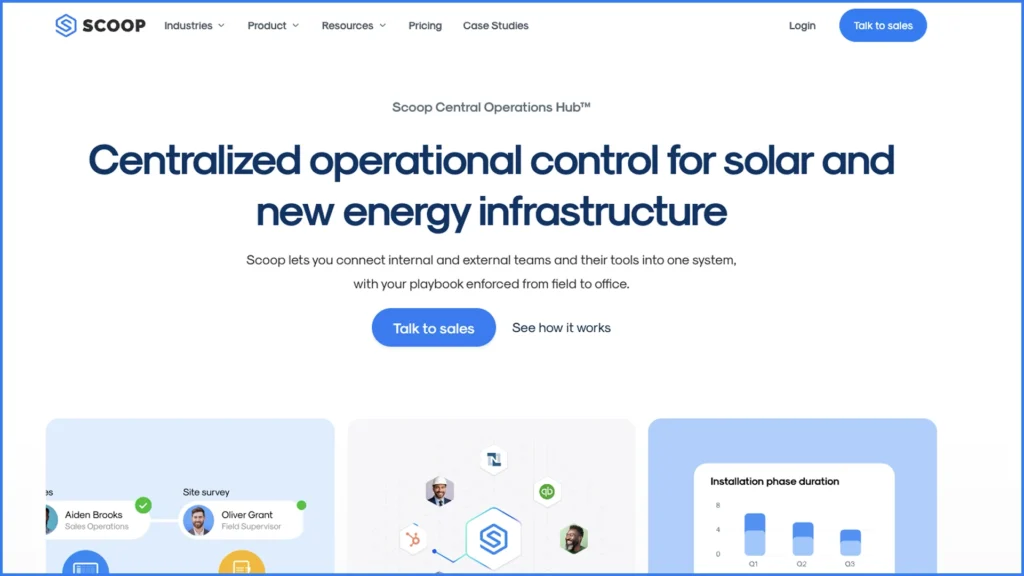
Scoop is a Central Operations Hub that includes roofing project management software. We connect the CRM, measurement, proposal, and accounting tools a roofing company already uses, and we run the installation, service, and warranty work across them from one system.
What Scoop is Built For
Scoop is built for roofing and solar installers who need every crew, subcontractor, and service technician working from the same job record.
- Integrated roofing work orders. Customer and location details, roof specifications, photos, and documents from the installation phases carry forward into every service and warranty work order.
- Field app alerts and triggers. Automated actions and conditional rules notify the next team when a phase closes, alert accounting to invoice when an installation is approved, and notify a project manager when a work order needs attention.
- Field-ready mobile app. Offline capture, geotagged photos, and mandatory photo fields mean a phase cannot close until the required photo is captured. Smart Forms carry safety logs, labor, and expenses.
- Subcontractor access. Permissions are scoped to a single group, so a subcontracted crew follows your checklists in our system and sees only its own jobs. Our guide to subcontractor management covers the setup.
- Integrations by category. CRM, accounting and invoicing, measurement and proposal, inventory, and document storage connect through GLOO, our fully hosted and managed integration service. Roofing photos and documents can also back up automatically through our Dropbox integration.
- Reporting. PDF reports are generated at key milestones for homeowners and facility managers, and LOOXY, our analytics module, adds dashboards across every job.
Pricing
Unlimited users, storage, and devices on every plan.
Best For
Roofing and solar installers running high-volume residential or commercial installations, roofing contractors with warranty and recurring maintenance programs, and teams that manage subcontracted crews.
For service work, we treat recurring maintenance as a first-class use case. Preventive roof inspections run as recurring work orders, every visit adds to the photo history for that roof, warranty documentation stays attached to the asset, and the handoff runs from dispatcher to technician to the client report without repeat data entry.
Scoop Limitations
- Scoop does not produce aerial roof measurements, estimates, or proposals, and Scoop does not design PV systems, run shading simulations, or produce stamped plan sets. That work stays in your measurement, proposal, and design tools, and Scoop connects to them.
- Built for operations and maintenance teams ready to configure the platform around how they actually run field work. That configuration takes time from someone on the team. Companies with a dedicated owner for that setup, and the budget to see it through, get value starting on day one.
- Delivers the most value where there is a repeatable process to standardize. The more your roofing jobs follow a recognizable shape, the faster the workflow automation compounds.
Verdict
Scoop is the right roofing installation software for installers who run installations, service calls, and warranty work on the same roofs and want one record per job from contract to closeout. Bring a reroof or a roof and solar job you are running right now, and see how Scoop streamlines it. Book a demo.
[CRO image]
2. AccuLynx
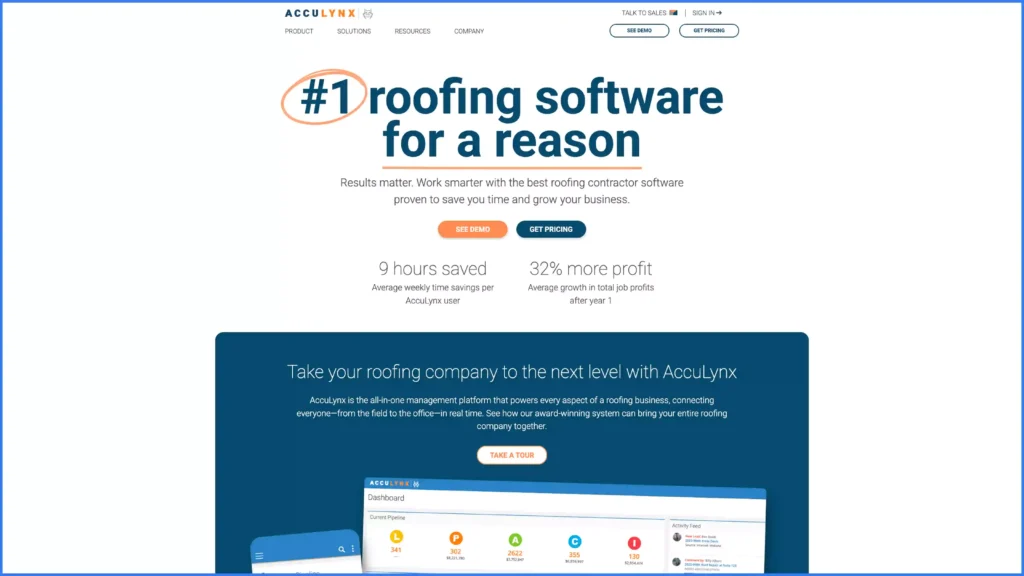
AccuLynx is a roofing CRM and production platform for residential roofing contractors.
AccuLynx is built for residential roofing sales and production. It covers the CRM, estimates with e-signature, aerial measurement ordering, a production calendar with crew and subcontractor scheduling, and direct material ordering to ABC Supply, QXO, and SRS.
The mobile app stores unlimited photos and collects signatures, and the Elite plan adds supplement tracking, mortgage check tracking, permits, and commissions.
Pricing
Not publicly listed. AccuLynx publishes two plans, Pro and Elite.
Best For
Residential roofing contractors doing retail and insurance work who want sales, measurements, and supplier orders inside one roofing CRM.
AccuLynx Limitations
- Built for residential roofing sales and production, so recurring maintenance programs on commercial roofs pair with a second system.
- Its published mobile features assume a connected job site.
3. JobNimbus

JobNimbus is a CRM and project management platform for roofing and exterior contractors.
JobNimbus is built for running the roofing sales pipeline and production from boards. It covers the CRM, estimates with built-in measurements, SumoQuote proposals included with every subscription, production boards, work orders for crews or subcontractors, material ordering to ABC Supply, SRS, and QXO, photo markup and forms, payments and financing, and two-way QuickBooks sync.
Pricing
Not publicly listed. JobNimbus publishes four plans: Essentials for up to 3 users, Pro for up to 10, Premium for up to 19, and Enterprise for 20 or more, with monthly or annual billing.
Best For
Growing roofing contractors that want CRM boards, proposals, and production in one roofing-specific tool.
JobNimbus limitations
- Integrations and automations are capped by plan, if they are below Enterprise. Essentials allows 2 integrations and 10 automations per month, Pro allows 5 and 30, and Premium allows unlimited integrations and 100 automations.
4. ServiceTitan

ServiceTitan is a multi-trade field service platform with a roofing package for residential roofing and exterior companies.
ServiceTitan is built for high-volume retail and insurance roofing work. Its roofing package covers two-way Xactimate integration, supplement and claims tracking, AI summaries of insurance carrier documents, Good, Better, and Best estimates, financing, bulk crew scheduling, dispatch, material ordering to ABC Supply, QXO, and SRS, and job costing. Service agreements for maintenance contracts are a separate platform feature.
Pricing
Not publicly listed.
Best For
Large residential roofing and exterior companies with high insurance volume and more than one trade.
ServiceTitan Limitations
- On October 6, 2026, ServiceTitan announced a limited pilot of new tools for commercial and roofing contractors, so commercial roofing workflows are still rolling out.
5. Roofr
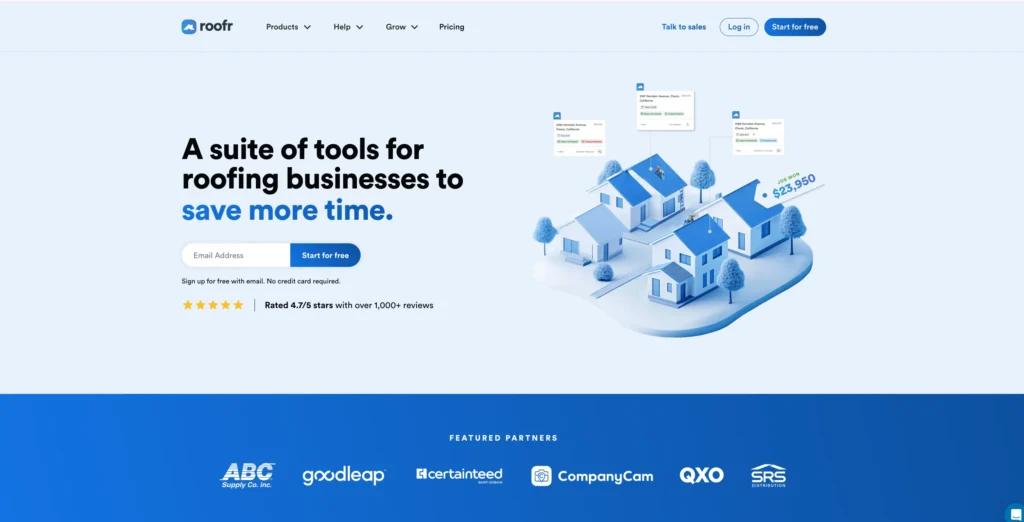
Roofr is roofing proposal software and a roofing CRM built around measurement reports.
Roofr is built for winning roofing jobs quickly. It covers measurement reports, proposals, an Instant Estimator, a CRM with a kanban job board and automations, a calendar, invoices, card and ACH payments, a mobile CRM, and material ordering to ABC Supply, QXO, and SRS. Every plan includes unlimited users.
Pricing
Starter is $0, with measurement reports at $19 each. Essentials is $249 per month, or $209 per month billed yearly. Scale is $349 per month, or $299 per month billed yearly. Measurement reports cost $13 each on paid plans.
Best For
Small and mid-size roofing teams that win jobs on fast measurements and proposals.
Roofr Limitations
- QuickBooks Online is available only on Scale, in beta, and only in the U.S.
- Sales, measurements, and proposals lead the product, so crew production and warranty service pair with an operations platform.
6. Leap
Leap is a CRM and in-home sales platform for residential roofing, siding, windows, and other exterior trades.
Leap is built for closing residential retail jobs at the kitchen table. Leap CRM covers production management, automations, customer and subcontractor portals, Leap Pay, measurements from Hover, EagleView, and GAF QuickMeasure, and supplier orders to SRS, QXO, and ABC Supply. SalesPro is the in-home sales app, with financing from up to 12 lenders, and it works without a wifi connection.
Pricing
Leap CRM Essential is $79 per month for 1 user. Leap CRM Team starts at $298 per month with 1 user included and $99 per additional user. SalesPro Premium starts at $750 per month for 6 users, and SalesPro Enterprise is not publicly listed.
Best For
Residential retail sales teams that close roofing jobs in the home.
Leap Limitations
- The Xactimate integration announced on September 25, 2026 is planned for winter 2026, so insurance estimating pairs with a separate tool today.
- Offline capture is published for SalesPro, the sales app, rather than for crew production work.
7. Jobber
Jobber is a field service platform for home service businesses, with a roofing package for small residential crews.
Jobber is built for small crews that quote, schedule, and invoice from one app. It covers quotes, a CRM, scheduling, recurring jobs, a Client Hub portal, EagleView measurements, Wisetack financing, job costing, photo checklists, and QuickBooks Online.
Pricing
Without a commitment, Core is $49 per month, Connect $139, and Grow $199, each for 1 user, and Plus is $499 per month for 5 users. Billed annually, the same plans are $29, $99, $149, and $399 per month. Additional users are $29 per month.
Best For
Repair-focused roofing crews of one to five people.
Jobber Limitations
- Built for home service businesses across many trades, so supplier material ordering and insurance claim work pair with other tools.
- Its published mobile features assume a connected job site.
Roofing CRM vs Roofing Project Management Software
A roofing CRM manages the sale, and roofing project management software manages the job after the contract is signed.
- Roofing CRM. Leads, canvassing, measurements, proposals, and contracts. Roofing proposal software sits here: Roofr, JobNimbus with SumoQuote, and Leap SalesPro all carry proposals inside the sales workflow.
- Roofing project management software. Work orders, crew and subcontractor scheduling, materials, required photos, inspections, closeout, and warranty service.
Running both without a connection means the office re-enters every job.
Roofing companies that keep their CRM usually connect it to contractor field service management software so the signed scope becomes a work order automatically.
Our guide to eliminating double data entry between CRM and field service tools walks through the steps.
Software for Roofing and Solar Installers
Roofing and solar installers need software that runs two job types on the same roof: the reroof and the solar installation. The Solar Energy Industries Association reports 995 MWdc of residential solar installed in Q2 2026, down 12% from a year earlier, so many installers are leaning on roofing work while solar volume slows.
Running both lines from one system matters in three places:
- Sequencing. The reroof closes, with photos and inspection sign-off, before the solar crew is scheduled on the same address.
- Service. Removing and reinstalling panels during a later reroof opens as a service work order with the original installation photos attached.
- Warranty. One file per address holds the roof warranty and the solar warranty, so a leak call reaches the crew with the full history.
If solar is the larger line of business, compare the solar software companies we ranked separately.
How Field App Alerts and Triggers Handle Roofing Escalations
Field app alerts and triggers turn a missed step on a roofing job into a notification for the person who can fix it, before it becomes a callback. Roofing teams commonly configure escalations for these moments:
- A required photo of the flashing or underlayment is missing, so the phase stays open and the project manager is notified.
- A material delivery has not been confirmed before the scheduled tear-off.
- Weather pushes a tear-off, and the schedule change reaches the crew, the homeowner, and the office at once.
- A leak call arrives on a roof under warranty, and the service work order opens with the installation photos attached.
- An installation is approved, and accounting is alerted to invoice.
In Scoop, an operations lead configures these as automated actions and conditional rules without developers.
Weather delays and crew changes are covered in more depth in our ranking of field service scheduling software.
What Integrated Roofing Work Orders Include
An integrated roofing work order is one record that carries the customer, the roof, and the job history from the CRM through installation and into every service visit. It includes:
- Customer and property details synced from the CRM
- Roof specifications, measurements, and the signed proposal scope
- The material list and delivery status
- The crew or subcontractor assignment
- Required photos, the safety checklist, and the homeowner sign-off
- Milestone reports and the trigger that sends the job to invoicing
- Warranty registration and the service history for that roof
A repeat site visit costs between $500 and $1,500, so a work order that arrives complete the first time protects the margin on every roof.
Which Roofing Installation Software Should You Choose?
Match the software to the work your company runs after the contract is signed:
- If you run warranty, leak repair, and recurring roof maintenance on roofs you installed, choose Scoop because we treat recurring service as a first-class use case.
- If you install both roofs and solar, choose Scoop to run both job types and their shared warranty file from one record.
- If your crews include subcontractors who use their own systems, choose Scoop for permissions scoped to each subcontracted crew.
- If you sell residential retail and insurance roofs and want supplier orders inside the CRM, choose AccuLynx.
- If you want a roofing sales pipeline with proposals included, choose JobNimbus.
- If you run a large residential exterior company with high insurance volume across several trades, choose ServiceTitan.
- If you win jobs on fast measurements and proposals with a small team, choose Roofr.
- If your sales team closes jobs in the home, choose Leap.
- If you run a crew of one to five people doing repairs, choose Jobber.
Stop Paying for Tools That Do Not Talk to Each Other
Most roofing companies already pay for a CRM, a measurement provider, a proposal tool, and accounting software. Scoop connects them and runs the installation, service, and warranty work across them, so your crews, subcontractors, and office team work from one job record.
Bring a roofing job you are running right now to a 20-minute discovery call, and we will show you where it breaks and how Scoop streamlines it.
Book a demo. No credit card, no obligation, and a response the same business day.
Disclosure
Scoop publishes this ranking, and Scoop is one of the platforms ranked. The rankings are our editorial opinion, based on each vendor’s published product and pricing pages. Pricing was last verified on October 7, 2026. All trademarks belong to their owners, and no affiliation or endorsement is implied. If you see an error, contact us and we will correct it.
Frequently Asked Questions About Roofing Installation Software
What is the best roofing installation software?
The best roofing installation software in 2026 is Scoop for roofing and solar installers who run installations, service calls, and warranty work from one system. AccuLynx and JobNimbus are the roofing CRM alternatives when residential sales and supplier ordering are the main jobs, and Jobber suits crews of one to five people doing repairs.
What is the difference between roofing management software and a roofing CRM?
A roofing CRM manages leads, measurements, proposals, and contracts. Roofing management software, also called roofing project management software, runs the job after the contract is signed: work orders, crew and subcontractor scheduling, materials, required photos, closeout, and warranty service. Many roofing companies keep their CRM and connect it to an operations platform so job details move across without repeat data entry.
What is the best software for roofing and solar installers?
Scoop is the best software for roofing and solar installers because we run the reroof, the solar installation, and the shared warranty file from one job record. Measurement, design, and proposal tools stay in place and connect, and service work such as removing and reinstalling panels during a reroof opens with the installation photos attached.
What is roofing proposal software?
Roofing proposal software turns roof measurements into a priced proposal the homeowner can sign online. Roofr, JobNimbus with SumoQuote proposals, and Leap SalesPro all carry proposals inside the sales workflow. Once the proposal is signed, an operations platform such as Scoop turns the scope into work orders for the crew.
How do field app alerts and triggers handle roofing escalations?
Field app alerts and triggers notify the right person when a roofing job needs attention. Common triggers include a missing required photo, an unconfirmed material delivery, a weather delay on a tear-off, and a leak call on a roof under warranty. In Scoop, an operations lead configures these as automated actions and conditional rules without developers.
What are integrated roofing work orders?
Integrated roofing work orders share one record with the CRM, the field app, and accounting. The customer, roof details, material list, photos, and sign-offs carry from the installation into every service visit, and an approved job alerts accounting to invoice, so nothing is entered twice.
How much does roofing software cost?
Published roofing software pricing runs from Roofr’s free Starter plan to $349 per month for Roofr Scale with unlimited users. Jobber runs from $49 to $499 per month without a commitment, and Leap runs from $79 per month for one CRM user to $750 per month for six SalesPro users. AccuLynx, JobNimbus, and ServiceTitan prices are not publicly listed. Pricing was verified on October 7, 2026.
What is the best roofing software for warranty and recurring maintenance work?
Scoop is the best roofing software for warranty and recurring maintenance work because we treat recurring service as a first-class use case. Preventive roof inspections run as recurring work orders, every visit adds to the photo history for that roof, and a client report generates when the visit is approved. A repeat site visit costs between $500 and $1,500, so completing the work on the first visit matters.