Aurora Solar is solar design and sales proposal software. Scoop is a Central Operations Hub that runs solar installations, service calls, and recurring O&M work after the contract is signed. The two cover different parts of a solar business, so most installers connect them rather than choose one over the other.
If your deals are won on design accuracy, use Aurora Solar to design and sell. If projects stall, need rework, or lose details between the sale and the field, choose Scoop and connect Aurora Solar to it.
Key Takeaways
- Aurora Solar is a software company, not a solar installer. More than 20 million solar projects have been designed on it.
- Scoop runs the work after the sale: project stages, crew dispatch, mobile field forms with required data fields and photos, service calls, and recurring O&M work.
- The two platforms connect. When a design or proposal is accepted in Aurora Solar, the project, the work order, and the site visit are created in Scoop automatically.
- Aurora Solar is priced per user, from $135 per user per month on annual billing, with 50 projects per user per month on Basic and Premium. Scoop includes unlimited users, storage, and devices on every plan.
- Sunlight Solar uses Aurora Solar for design and Scoop for operations, and grew from 20 to 120 installations a month.
- Every installed system becomes a service relationship. We built Scoop to keep preventive maintenance, warranty visits, and SLA records in the same system as the original installation.
What Is Scoop?
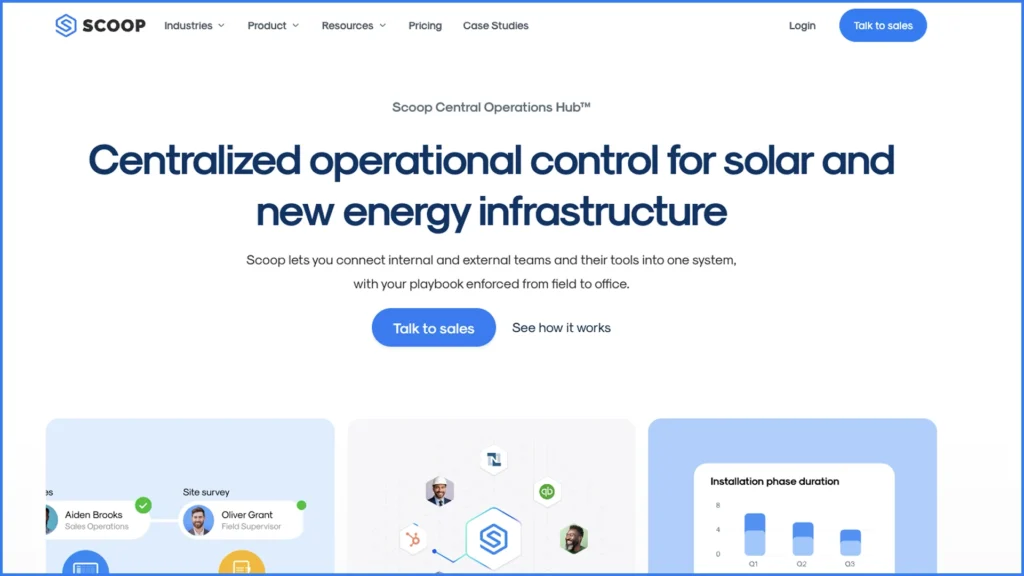
Scoop is a Central Operations Hub that includes solar project management software. We run installations, service calls, and recurring O&M work from one system and connect the CRM, design, and accounting tools you already use.
Your CRM keeps sales, your accounting platform keeps the financials, and Aurora Solar keeps the design. Scoop runs the operational work between them: project stages, scheduling, crew dispatch, field data, and closeout. More than 250,000 project sites run on Scoop.
What operations and maintenance teams use Scoop for:
- Configurable workflows. Conditional rules and structured forms that an operations lead can change without waiting for a software release.
- Field mobile app. Geotagged photos and required data input fields can be captured even offline, and ensure a project phase cannot close out until the right data is captured.
- Scoped permissions. A subcontractor or partner works in the same system and sees only its own projects.
- Reporting across projects. Native reports on every project, with LOOXY dashboards available as an added module.
- Managed integrations. More than 500 integrations, built and run through our proprietary GLOO integration service.
What Is Aurora Solar?

Aurora Solar is a software company that makes cloud-based solar design and sales software. Installers use it to model a roof in 3D, run shading analysis, lay out panels, and turn the design into a customer proposal.
Aurora Solar does not install solar systems. The company was founded in 2013, and more than 7,000 solar companies use its platform.
Aurora Solar’s main products:
- Design Mode for 3D roof modeling, shading analysis, and panel layout, with LiDAR-assisted modeling on the Premium plan.
- Aurora AI, which generates the roof model and panel layout automatically.
- Sales Mode for interactive proposals with savings and financing options, plus Contract Manager for sending the contract for signature.
- Plan Sets, a paid service that prepares permit-ready documents, and Expert Design Services for roof models built by Aurora Solar’s own designers.
- HelioScope, its separate design tool for commercial projects.
In September 2026, Aurora Solar added home electrification to its proposals, including heat pumps, batteries, and home EV charging, and became fully available in the United Kingdom.
Aurora Solar vs Scoop: Main Features Compared
Aurora Solar covers the work before the contract is signed, and Scoop covers the work after it. The table groups each feature by the job it does.
|
Job to be done |
Aurora Solar |
Scoop |
|
Primary use |
Solar design, shading analysis, and sales proposals |
Project management, field service, and recurring O&M work |
|
Roof modeling and shading |
3D models, LiDAR-assisted modeling (Premium), shade reports, and AI-generated designs |
Pairs with your design tool through the Aurora Solar integration |
|
Proposals and contracts |
Sales Mode proposals, financing options, and Contract Manager |
Receives the signed project and starts the installation workflow |
|
Permit documents |
Plan Sets service for permit-ready documents |
Tracks permitting as a stage in the project workflow |
|
Handoff after the sale |
Sends accepted design and proposal data through its API |
Creates the project, work order, and site visit from Aurora Solar data |
|
Crew scheduling and dispatch |
Pairs with an operations platform |
Schedules and dispatches installation and service crews |
|
Field execution |
Tablet-friendly proposals for the sales visit |
Offline mobile app, smart forms, geotagged photos, and required data fields |
|
Service and O&M |
Pairs with an operations platform |
Service calls, preventive maintenance schedules, asset history, and SLA records |
|
Integrations |
API and pre-built connectors on the Enterprise plan |
More than 500 integrations, built and managed through GLOO |
|
Reporting |
Design and sales data |
Reporting across projects, plus LOOXY dashboards |
|
Access control |
Team management and project access controls |
Permissions scoped to a single group for subcontractors and partners |
Where they overlap. Both platforms are cloud-based, both control which users see which projects, and both connect to CRMs. Neither one replaces the other’s core job. Scoop helps you choose the right tools for every stage of a solar project. Compare design, sales, and operations platforms in our list of best solar software companies.
Want to see the handoff on one of your own projects?
Book a demo and bring an Aurora Solar proposal that has been signed and is waiting for installation.
Aurora Solar vs Scoop Pricing Compared
Aurora Solar charges per user, with a project limit on its Basic and Premium plans. Scoop includes unlimited users, storage, and devices on every plan. Request Scoop pricing for your team.
|
Plan |
Annual billing |
Monthly billing |
Users and projects |
What is included |
|
Aurora Solar Basic |
$135 per user per month ($1,620 per year) |
$159 per user per month |
1 user, 50 projects per month |
Sales proposals, design tools, HD imagery, and on-demand site models |
|
Aurora Solar Premium |
$220 per user per month ($2,640 per year) |
$259 per user per month |
1 user, 50 projects per month |
Basic features plus LiDAR-assisted modeling, bankable shade reports, and battery modeling |
|
Aurora Solar Enterprise |
Custom, priced per project |
Custom, priced per project |
Unlimited users, custom project volume |
Premium features plus AI-assisted site models, API and integrations, advanced permissions, and access to plan sets and engineering stamps |
|
Scoop |
Unlimited users, storage, and devices on every plan |
|||
Aurora Solar pricing verified September 24, 2026 from Aurora Solar’s published pricing page. Annual plans carry a 15% discount against monthly billing.
The two platforms price in different units. Aurora Solar prices each design and sales user, with a project cap per user on Basic and Premium. Scoop includes unlimited users, so office coordinators, field technicians, and subcontractors all work in the same system.
How Aurora Solar and Scoop Compare Feature by Feature
Aurora Solar and Scoop handle different stages of the same solar project. Aurora Solar covers design, shading analysis, proposals, and contracts, up to the point where the customer signs. Scoop takes the signed project from there and runs the installation, crew scheduling, field data, service calls, and recurring O&M work.
The sections below compare the two platforms one feature at a time.
Solar design and shading analysis
Aurora Solar handles solar design. It models the roof in 3D from aerial imagery and LiDAR data, runs shading analysis, and generates the panel layout, and Aurora AI can build the model automatically.
Scoop does not design PV systems. The design stays in Aurora Solar and moves into Scoop when the customer accepts the proposal.
Sales proposals and contracts
Aurora Solar builds the proposal and sends the contract. Sales Mode turns the design into an interactive proposal with savings and financing options, and Contract Manager sends the contract for signature.
For a wider view of this category, see our ranking of solar proposal software.
Our guide to automating solar proposals covers each step from remote site assessment to the signed document.
The handoff from sale to installation
The handoff is where Aurora Solar and Scoop connect. When a design or proposal is accepted in Aurora Solar, the Aurora Solar integration creates the project, the work order, and the sales or service visit in Scoop. It can also advance the project stage and update fields, and changes in one system show up in the other.
Without that connection, someone copies system size, equipment, and customer details from one tool into the other by hand. A copied field is how the wrong panel count reaches a crew, and a repeat site visit costs $500 to $1,500 depending on whether it is a service call or an installation project.
A GLOO solution engineer scopes the integration with your team, tests it in a sandbox, and monitors it after launch. When your process changes, we adjust the triggers and field mappings.
Field execution and crew management
Aurora Solar is built for the sales visit, and Scoop is built for the crews who follow it. Scoop schedules and dispatches installation and service crews, and technicians work from a mobile app that runs offline.
Each installation step has its own smart form. Required data fields and geotagged photos can be captured even offline. A phase cannot close until the right data is captured, which cuts rework and repeat truck rolls. The office sees progress on every project without calling the crew.
Service, maintenance, and O&M
Scoop manages the service work that follows an installation because we treat recurring service as a first-class use case. Preventive maintenance schedules, service work orders, warranty visits, and asset history sit on the same record as the original installation.
For O&M contracts, that record gives you SLA evidence to show a client. The dispatcher creates the work order, the technician completes it on mobile, and the client report comes from the same data.
Service revenue from systems already installed carries more weight in 2026. SEIA expects the U.S. residential solar market to contract by 21% this year.
Integrations
Aurora Solar connects to CRMs, financing platforms such as loan and third-party ownership (TPO) providers, field operations platforms such as Scoop, and racking design suppliers. It uses DocuSign for contracts, and API access and integrations sit on the Enterprise plan.
Scoop connects to more than 500 tools across CRM, accounting and invoicing, design and proposal, inventory, and monitoring. We build, host, and maintain each integration through GLOO, so your team does not own the code. If you are still choosing the CRM that sits beside both platforms, start with our guide to choosing a solar CRM.
Reporting
Aurora Solar reports on design and sales activity. Scoop reports across every project in progress, from permitting to closeout, and LOOXY adds dashboards and KPI modeling for operations leaders.
The U.S. Department of Energy puts average U.S. residential system pricing between $3.20 and $4.20 per watt in the first half of 2025. At those prices, a delayed or reworked project reduces the margin on that job, and cross-project reporting shows you where it happens.
Which Platform Is the Best for You?
Most solar companies that sell and install need both platforms: Aurora Solar to win the sale and Scoop to deliver it. Use these conditions to decide where to start:
- If you run recurring service or O&M contracts on installed systems, choose Scoop. We keep preventive maintenance schedules, SLA-ready records, and asset history in one place and cut repeat truck rolls.
- If projects stall or lose details between the signed contract and the installation, choose Scoop and connect Aurora Solar to it, so every accepted proposal becomes a project automatically.
- If you install at high volume with many crews and subcontractors, choose Scoop. Unlimited users and group-level permissions keep everyone in one system.
- If your sales team wins deals on design accuracy and proposal quality, use Aurora Solar for design and sales, and connect it to Scoop for delivery.
- If one person designs, sells, and installs only a few systems a month, Aurora Solar’s Basic plan may be sufficient until the operations work grows.
To compare more design, sales, and operations platforms, read our list of solar software companies.
Connect Aurora Solar to the Rest of Your Operation
Keep Aurora Solar for design and sales, and let Scoop run everything after the signature: the project, the crews, the field data, and the service calls that follow. Sunlight Solar runs this setup and grew from 20 to 120 installations a month.
Bring a signed Aurora Solar project you are about to install to a 20-minute discovery call, and we will show you how Scoop turns it into a scheduled, tracked, and documented installation. Book a demo. No credit card and no obligation.
Frequently Asked Questions About Aurora Solar vs Scoop
Is Aurora Solar a solar installer or a software company?
Aurora Solar is a software company. It does not install solar systems. It sells design and sales software to solar installers, and its Aurora Solar Marketplace lets homeowners compare quotes from local installers, who do the installation work.
Is Aurora Solar software for homeowners, solar installers, or both?
Both, in different ways. Solar installers and their design and sales teams use the paid software to design systems and build proposals. Homeowners use Aurora Solar Marketplace to see estimates modeled to their roof and compare local installers before sharing their contact details.
What software integrations does Aurora Solar support?
Aurora Solar integrates with CRMs, loan and third-party ownership (TPO) financing providers, field operations platforms such as Scoop, and racking design suppliers, and it sends contracts through DocuSign. Custom connections run through its API, and API access and integrations are included on the Enterprise plan.
Can Scoop replace Aurora Solar for solar design?
No. Scoop does not design PV systems, run shading simulations, or produce stamped plan sets. Keep Aurora Solar for design and proposals, and connect it to Scoop so the design data carries into the project.
How much does Aurora Solar cost in 2026?
Aurora Solar Basic costs $135 per user per month on annual billing ($1,620 per year) or $159 month to month. Premium costs $220 per user per month on annual billing ($2,640 per year) or $259 month to month. Both plans include one user and 50 projects per month, and Enterprise is custom-priced per project with unlimited users. Prices verified September 24, 2026.
Is Aurora Solar worth the money?
For teams that win deals on design accuracy and proposal quality, Aurora Solar is worth the per-user cost. The value depends on how many projects each user designs, since Basic and Premium allow 50 projects per user per month. The return improves when the design data flows straight into your operations platform instead of being typed in again.
Who owns Aurora Solar?
Aurora Solar is a privately held company. Christopher Hopper and Samuel Adeyemo founded it in 2013, its investors include Energize Ventures, ICONIQ, and Coatue, and Charlie Herche is its CEO.
What is Aurora Solar’s revenue?
Aurora Solar is private and does not publish its financial results. The most recent widely reported figure is from 2022, when annual revenue passed $100 million around its Series D round at a $4 billion valuation.
What is the right software for solar O&M and recurring service work?
For recurring solar service and O&M work, we recommend Scoop. We keep preventive maintenance schedules, service work orders, asset history, and SLA records in the same system as the original installation. Pacific Power Solutions scaled 15x on Scoop while building its O&M business, and Aurora Solar pairs with Scoop for the design on each new installation.
Disclosure
We publish this comparison, and our platform integrates with Aurora Solar. The assessments are our editorial opinion. Aurora Solar pricing and features were verified on September 24, 2026 from Aurora Solar’s published pages. Aurora Solar, HelioScope, and other product names are trademarks of their owners, and no affiliation or endorsement is implied. If anything here is out of date, contact us and we will correct it.