As public solar companies report slipping solar sales, lower growth rates, and a number of large-scale rooftop providers file for bankruptcy, it is clear that the solar market has approached a new stage in its lifecycle.
Keep in mind that this is not all bad news.
As the industry matures and the cost of energy continues to rise, more consumers will embrace solar as a mainstream product. However, solar companies that do not adapt to a more calculated and efficient business approach will likely get left behind in the near future. In other words, “what got you here won’t get you there,” as the expression goes!
Why Solar Sales Are Harder in 2026?
As the solar industry shifts into a more mature growth phase, the target audience for residential solar contractors is also evolving. No longer are there masses of environmentally-friendly, tech-oriented homeowners ready to embrace solar for emotional and altruistic reasons, as many of them have already jumped on board.
With the early adopters tapped out, and a number of governmental incentives sunsetted, solar sales and marketing teams need to recognize that they are no longer selling to the same groups of people and that the competitive space is getting tighter.
For many large solar panel businesses, it is evident their solar panel sales strategies have not changed even though they are now targeting homeowners who are potentially more cost sensitive and uncertain about the benefits of rooftop solar.
The first question you need to ask is, Who is my ideal customer? A detailed answer to this question will define your marketing strategies and how you’ll be selling solar panels. Revisit this question every year to ensure your business model aligns with your core customer profiles and market segment. Another great approach is making sure that everyone inside, and even outside, your organization is clear about who your ideal customer is.
For many customers, investing in a solar and storage system has historically been an emotional decision. But increasingly, going solar is a financial and rational choice. Today, ensuring energy savings as well as resilience for family and home is often the main reason, especially with natural disasters and uncertainties regarding energy reliability from traditional utilities. It is therefore paramount to ensure your marketing and sales messaging prioritizes these benefits, clearly spelling out the dollar savings and resilience benefits of a solar plus storage system.
Reframing the Solar Conversation Around Value
In small and medium-sized solar contractors, solar sales or business development managers have the flexibility and control to take the necessary action to ensure they maximize customer satisfaction.
This starts with building and enforcing processes, standards and protocols that ensure service quality, system reliability. These basics form the bedrock to enhance and maintain the company’s brand, credibility and connection with the customers. Given the leading role that sales plays in forming and maintaining customers’ perception, here are some sales-oriented examples of basic audit questions you may want to explore:
- Do your sales reps look presentable when they’re doing their pre-sales site visits?
- Do they seem to know all the info or at least have access to it if asked?
- Are they submitting realistic information versus inflating the numbers to make the purchase look more attractive at the moment?
- How often do your engineers look at pre-sales proposals and realize that something is impossible?
Make it your mission to train sales reps correctly and reinforce a process, supported by the right solutions, to prevent inflated proposals and incorrect expectations that leave the customer perplexed and disillusioned when they see the jump in cost on the final contract.
Leading With Energy Cost Analysis Instead of Product Specs
Most homeowners don’t compare panel wattage or inverter specs before deciding on solar. They compare their current electricity bill to what it could be after installation. Reps who open with module specifications force prospects into a technical evaluation they’re not equipped to make, which stalls decisions and drives cancellations.
Start every consultation by pulling the homeowner’s recent utility statements and walking them through 3 numbers:
- What they spend now
- How much solar would offset this spend
- How long until they can start saving money
Panel brand and inverter type become supporting details, only once the financial case is clear. From there, reps can layer in energy independence. Battery storage eliminates exposure to rate hikes and grid outages, converting a variable expense into a predictable fixed cost.
This framing resonates with mainstream buyers who now make up most of the residential market.
The key to sell solar panels with this approach is making utility data, savings calculations, and proposal templates accessible in the field, not locked in office-bound spreadsheets. Because when reps can pull accurate cost analyses on-site and submit them for engineering review before leaving the home, the homeowner sees a coordinated process rather than a single salesperson guessing at numbers.
Handling the Most Common Solar Objections
Almost every solar rep hears the same pushbacks. The difference between stalling and selling solar panels isn’t avoiding these objections, it’s having a clear framework for each before the conversation starts.
“It’s too expensive.“
This objection is almost always about sticker shock, not actual affordability. Reps should redirect to monthly cost comparison: what the homeowner pays the utility now versus what they’d pay on a solar loan or lease.
“The payback period is too long.“
Homeowners who raise this are thinking in terms of breaking even, not total return. Reframe it. Solar isn’t a purchase that “pays off” at year 8 or 10 and stops there. It keeps producing value for the full system lifespan. The real question isn’t when they break even, it’s how much they save after that point.
“My roof might need work first.“
This is a legitimate concern, not a stall tactic. Acknowledge it directly. If the roof has 5+ years of life left, solar installation is viable. If it doesn’t, some companies bundle roof work with the solar project. Either way, a proper site survey answers this question fast, so reps should position the survey as the next step rather than trying to overcome the objection verbally.
“I’m locked into a contract with my utility.“
In most markets, utilities don’t have exclusivity contracts for residential customers. This objection usually signals confusion about net metering agreements or past solar lease terms from another provider. Reps should ask what contract the homeowner is referring to, because the answer almost always clears the objection on its own.
Speed-to-Lead and Follow-Up Sequences
Most solar companies treat lead generation efforts as their bottleneck, but the bigger problem is what happens after you generate your lead. A homeowner who fills out a form or requests a quote is at peak interest in that moment. Every hour that passes without contact drops the odds of conversion significantly.
When solar teams audit their lost deals, the pattern is consistent: the leads we generate aren’t bad, they just go cold because nobody’s following up fast enough or often enough.
This is why speed-to-lead is the highest-leverage fix for most solar sales teams. It doesn’t require more ad spend, better creative, or new markets. It requires responding faster and following up more consistently with the leads already in the pipeline.
Response Time Benchmarks and Their Impact on Close Rates
The window between a lead submitting a request and losing interest is far shorter than most teams assume. Industry data across home services consistently shows that leads contacted within 5 minutes are dramatically more likely to convert than those contacted at the 30-minute mark. By the time an hour passes, that lead has likely moved on, started researching competitors, or simply lost the motivation that prompted them to reach out.
Solar sales cycles already face a high cancellation rate between initial quote and signed contract. Slow response compounds this because a homeowner who waits hours for a callback starts the relationship feeling like an afterthought. Fast response does the opposite: it signals professionalism and urgency, which sets the tone for the entire sales process.
The operational takeaway is simple. Response time isn’t a soft metric. It should be tracked, benchmarked, and treated with the same seriousness as close rate or average deal size.
Connecting Your Sales Stack to Eliminate Handoff Failures
Throughout the solar sales cycle, different tools may be used in your solar software stack to help your business operations. A CRM to manage leads and contacts, emailing and texting to communicate with those leads as well as customers, a solar design and digital proposal tool for contracts, accounting software to manage invoicing and payments, and the list goes on. With customer data dispersed over so many platforms, it can be challenging for organizations to obtain actionable insights.
Many fast-growing solar installers and service providers are experiencing the setbacks of disconnected solar tools that are not conducive to building a scalable solar sales solution.
A big problem in most solar companies today is that data is stored on office-bound software, and sales reps can’t access the details they need and end up guessing. Finding a way to put that info in their hands is key to making them appear ready to the potential customer.
Bridging the Gap Between Sales, Design, and Installation Teams
For example, a sales rep could use a field solution to submit details and pictures to the office while still at the site visit so that engineers can review and quickly reply with their adjustments to the estimate.
This ensures that the homeowner won’t be surprised by a difference between estimates and the eventual contract. It also boosts credibility as the potential customer will appreciate the process as it will be clear that there is more than one person on the team making sure that everything is done right.
Using the right tools can make a positive difference for your solar sales reps’ success.
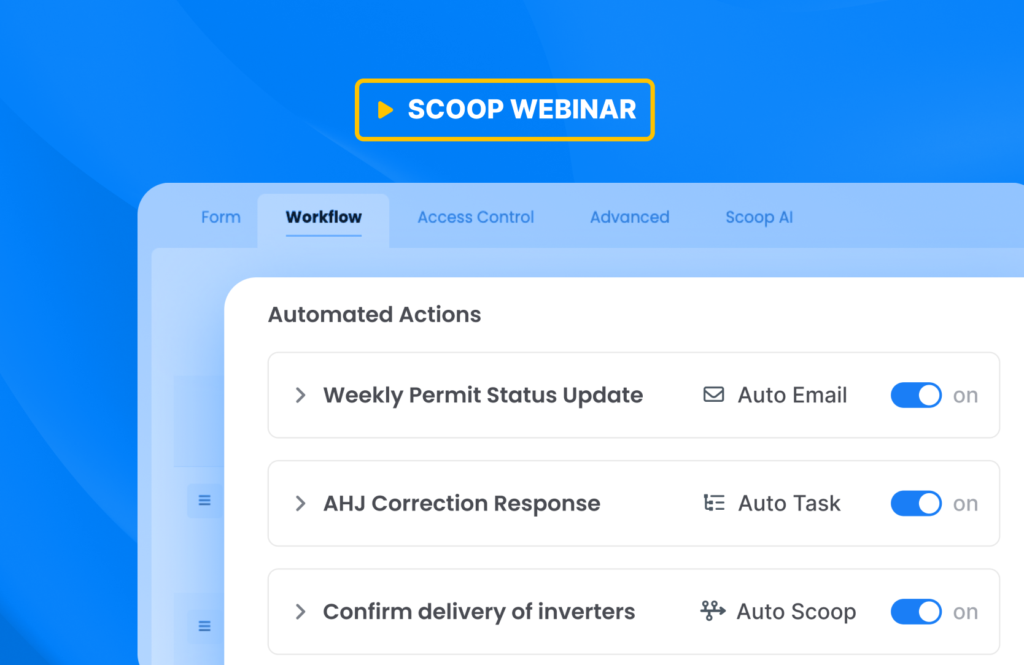
Take a look at mobile field data collection and collaboration tools like Scoop that help you reinforce good practices and establish reliability in the sales rep’s communications with the potential customer.
Automating Appointment Setting and Reminders
Manual scheduling is one of the quietest sources of lost deals in solar sales. A rep closes a strong first conversation, promises to book a site survey, then gets pulled into the next lead. By the time they circle back, the homeowner’s momentum has faded. Multiply this across a team handling dozens of leads per week, and the drop-off adds up fast.
Automated scheduling removes this gap entirely. When a lead reaches a specific stage, the system can trigger a booking link or calendar invite without waiting for a rep to remember. The homeowner picks a time while they’re still engaged, and both sides get confirmation instantly.
Reminders work the same way. Automated texts or emails sent 24 hours and 1 hour before an appointment reduce no-shows and keep the project moving. After the appointment, milestone-triggered notifications can push the next step forward automatically, whether that’s using solar proposal automation to send the quote, assigning a design review, or notifying the install team that a contract is signed.
Financing Conversations That Remove the Biggest Barrier to Yes
Solar energy systems are a significant investment, and the cost can be a major obstacle for many potential customers. To overcome this, offer a variety of financing options that suit different customer needs, such as zero-down payment plans, leasing options, or attractive loan terms.
By providing financing flexibility, you make solar more accessible to a wider audience, increase conversion rates, and attract customers who may be hesitant about the upfront costs. Customers appreciate having choices, and flexible financing can be the differentiator that closes the sale.
Presenting Loan, Lease, and PPA Options With Confidence
Most homeowners don’t walk into a solar conversation understanding the difference between a loan, a lease, and a power purchase agreement (PPA).
Reps who can’t explain all 3 clearly end up defaulting to whichever option they’re most comfortable with, which isn’t always the best fit for the buyer. That mismatch creates friction later in the process and drives cancellations.
Solar loans let the homeowner own the system outright. They qualify for the federal tax credit, build home equity, and benefit from the full lifetime savings. This option works best for buyers with strong credit who want maximum long-term return and don’t mind a monthly payment during the payback period.
Solar leases remove the ownership component entirely. The homeowner pays a fixed monthly fee to use the system but doesn’t own it, doesn’t claim the tax credit, and doesn’t handle maintenance. Leases work well for buyers who want lower electricity costs with zero upfront commitment and aren’t focused on long-term asset value.
Power purchase agreements (PPAs) are similar to leases, but instead of a flat monthly fee, the homeowner pays per kilowatt-hour at a rate lower than their utility. PPAs appeal to buyers who want immediate savings tied directly to what they consume, with no ownership responsibility.
The rep’s job isn’t to push one model over another. It’s to ask the right qualifying questions early: Does the homeowner want to own or rent? Do they plan to stay in the home long-term? Are they eligible for tax credits? The answers point clearly to the right structure, and presenting it that way builds trust instead of triggering sales resistance.
Positioning Federal and State Incentives as Urgency Drivers
Incentives are one of the strongest closing tools in solar sales, but only when reps understand them well enough to explain them simply. A vague reference to “government rebates” doesn’t move anyone. A clear, accurate explanation of what the homeowner may qualify for, and what’s changing, does.
Federal Tax Credit: What Reps Need to Know in 2026
The federal solar landscape changed significantly at the end of 2025. The residential Investment Tax Credit (Section 25D), which previously allowed homeowners who purchased and owned their systems to claim a percentage of installation costs as a federal tax credit, expired on December 31, 2025. Homeowners buying and owning a system in 2026 no longer have access to this credit.
However, the federal ITC (Section 48E) remains available for third-party-owned systems — meaning leases and power purchase agreements (PPAs), at 30% for projects where construction begins by July 4, 2026. The credit goes to the system owner (the leasing company), but this typically results in lower monthly payments for the homeowner. Reps should understand this distinction clearly: owned systems no longer carry a federal tax benefit, while leased and PPA structures still do for a limited window.
Importantly, reps should never present tax credits as guaranteed outcomes or calculate specific dollar savings tied to a homeowner’s tax situation. Every homeowner’s circumstances are different. The appropriate guidance is to recommend that the homeowner consult a qualified tax professional and reference IRS resources (such as IRS Form 5695) for personalized advice. Reps are not tax advisors, and positioning themselves as such creates both compliance risk and liability.
State-Level Incentives: Know Your Local Landscape
State-level incentives vary widely and are now the primary financial drivers in most markets. Some states offer upfront rebates that directly reduce system cost. Others provide performance-based payments tied to actual energy production over time. States like Massachusetts, New Jersey, Maryland, and Washington, D.C. have active solar renewable energy certificate (SREC) markets, where homeowners earn tradeable credits based on the energy their system generates.
Net metering policies also differ significantly by state and utility, determining how much credit homeowners receive for excess energy sent back to the grid. Some states offer full retail rate credit, while others have moved to reduced compensation structures. Reps need to know their local incentive landscape thoroughly, because a buyer in one state may have a completely different financial picture than a buyer two states over.
Policy Changes: Present the Facts, Not Pressure
These incentives do change. The federal residential credit expired at the end of 2025. State rebate programs can exhaust their funding allocations. Net metering policies are being restructured in multiple states, California’s NEM 3.0, for example, reduced export compensation rates significantly in 2023. These are real shifts that affect the economics of going solar.
When discussing policy changes in a sales conversation, reps should present the current facts in neutral, informational terms. Lay out what incentives are available today and note any publicly documented changes on the horizon. Provide this as written material the homeowner can review on their own time.
What reps should avoid: using expiration timelines or funding limitations as pressure tactics to accelerate a decision. Regulators, including the FTC, CFPB, and multiple state consumer protection agencies, have specifically flagged urgency-driven solar sales tactics as an enforcement priority. The goal is to give the homeowner accurate information so they can make an informed decision at their own pace. That approach builds trust, reduces cancellations, and keeps your team on the right side of consumer protection rules.
Metrics That Tell You What’s Working and What to Fix
Data is your best friend when it comes to making informed business decisions. Track key metrics such as customer acquisition cost, conversion rates, and sales cycle length.
Use solar software like Scoop to gather insights on customer behavior and preferences. Unlike standalone CRMs that store contact data without connecting it to what’s actually happening in the field, Scoop acts as a Central Operations Hub that ties your sales activity to design, installation, and service workflows in one system. This means the data your team uses to refine the sales process, identify which strategies help, and adjust where necessary is coming from live execution, not stale spreadsheet exports. That connected visibility helps you optimize resources and improve sales efficiency without adding layers of manual reporting.
In order to notice patterns or inconsistencies across your organization, your data must be integrated and up-to-date. Unfortunately, it is not uncommon for data to be hosted across individual platforms so when it comes time to assemble reporting, it can be a painstakingly manual process that involves several accounts and static spreadsheets. Even if you are able to consolidate your data, it may be in different formats that do not paint a bigger picture. By the time these reports have been shared or presented, the data is already out-of-date and the process starts again.
If your solar sales team is relying on dashboards and reports that are outdated or incorrect, this can have an impact on your entire business. For example, if you believe that your sales team is working on a certain number of high-value deals that are all at the end of your solar sales funnel, you might approve additional spend for next quarter. However, if it turns out that several of these deals have been lost, pushed to next quarter, or were duplicates of one another, this can have expensive consequences.
Close Rate, Cost Per Acquisition, and Average Deal Size
Although a number of investors have stated that the rate of cancellation is not as important as whether the company hits their deployment targets, this remains a key metric that solar sales managers should be concerned about.
This challenge of having multiple data types and sources, and data being unreliable, outdated, or altogether missing, means that your solar sales team will have a difficult time answering important questions such as: What is my sales team or external sales partners currently working on? How many deals are currently being worked by my sales reps? What stage are the various deals at? What is the value of these deals? How long have they been at the various stages along the funnel?
Running Weekly Pipeline Reviews to Catch Stalled Deals
A pipeline review that happens monthly is a postmortem. One that happens weekly is a course correction. The difference matters because solar deals don’t stall dramatically. They decay quietly, sitting in the same stage for days while reps focus on newer, more exciting leads.
Structure the review around 3 questions:
- Which deals haven’t moved stages in the last 7 days?
- Which proposals were sent more than 5 days ago without a response?
- And which leads came in this week but haven’t been contacted yet?
These 3 filters surface the exact deals most likely to die from neglect, not from lack of interest.
Keep the meeting short and action-oriented. The goal isn’t to review every deal in the pipeline. It’s to flag the ones that need intervention right now, assign a next step to each, and move on. If a rep can’t explain what’s happening with a stalled deal, that’s the answer. It’s stalled because no one is driving it forward.
Training and Coaching Your Sales Team for Consistent Performance
Your sales team is the face of your company, and their skills directly impact your solar sales. Regular training sessions can help keep your sales representatives updated on the latest industry trends, customer pain points, and effective sales techniques. Equip your team with detailed information about your products, competitors, and common customer concerns. Encourage them to listen actively to prospects and address their unique needs.
By empowering your sales team with the right knowledge and tools, they can build strong relationships, instill confidence in potential clients, and close more deals.
Ride-Alongs, Role-Plays, and Peer Learning Structures
Generic sales training fades fast. The coaching formats that actually stick are the ones built into the weekly rhythm of the team, not scheduled as one-off events.
Shadow sessions are the fastest way to ramp new reps. Pair them with a top performer for live ride-alongs on site visits and consultations. New reps learn more from watching 3 real conversations than from any onboarding deck. After each visit, a 10-minute debrief on what worked and what they’d do differently turns observation into retention.
Weekly objection role-plays keep the whole team focused. Pick 1 objection per week, have reps pair up, and run through it in both directions. The rep who plays the homeowner often learns the most, because they start hearing how weak a poorly framed response actually sounds. Rotate the objections so the team cycles through the full set every couple of months.
Win/loss reviews done as a group are more valuable than individual deal postmortems. Once a week, have a rep walk through a recent close and a recent loss. The team dissects both: what moved the deal forward, where it stalled, what the homeowner’s real hesitation was. This builds pattern recognition across the entire team instead of keeping lessons trapped with individual reps.
Building Trust in a Market Crowded With Aggressive Competitors
Customer experience can be the deciding factor between you and your competitors. Ensure you provide seamless support throughout the entire customer journey, from initial contact to after-sale service. Choose a solar CRM to stay organized and track interactions with potential and existing clients.
Provide proactive communication and make it easy for clients to contact you through multiple channels, whether it’s email, phone, or even chat on your website. By offering personalized experiences to homeowners and other clients and going the extra mile, you create loyal customers who are more likely to refer you to others.
With increasing competition in the solar space, contractors cannot afford to lose the touch of good customer service when convincing the more analytical and cost-conscious mainstream customers to sign up. It’s more important than ever to ensure that your sales reps exude professionalism, credibility and customer-oriented focus in their work, not only to lower your rate of cancellation, but to save you wasted resources, keep your team motivated and build a better brand for your solar company.
Leveraging Reviews, Case Studies, and Installation Photos
“Going solar” is still relatively new, so make sure you have plenty of customer testimonials on your website and in your sales materials to show credibility and ease customer anxiety. This builds credibility and eases customer anxiety.
Turn Your Solar Sales Process Into a Repeatable System
The strategies in this guide, from reframing the conversation around value to speeding up response times, structuring follow-ups, and running tighter pipeline reviews, all share one thing in common. They only work consistently when your tools, teams, and data are connected.
That’s what Scoop is built for. As a Central Operations Hub, Scoop ties your sales activity to design, permitting, installation, and service workflows in one system. Reps get field access to the data they need. Managers get real-time visibility into what’s moving and what’s stuck. And handoffs between teams happen through structured workflows instead of memory and manual follow-up.
Solar companies using Scoop don’t just track their pipeline. They execute through it.
Book a free demo to see how Scoop can help your team close more deals with fewer dropped balls.