The best solar software company in 2026 is Scoop, a Central Operations Hub that connects your field teams, your office teams and your existing tools (CRM, design, proposal, ERP, accounting and e-signature) into one set of end-to-end workflows. It runs new installs, service calls and recurring O&M work from the same system. Teams that sell on design accuracy normally keep a dedicated design platform alongside it, and Scoop is built to connect to those tools rather than compete with them.
In this guide, we rank the 8 best solar software companies for 2026, assess each one against the same five criteria, publish real pricing wherever the vendor publishes it, and state the limitations of every tool on the list, including ours.
Key Takeaways
- Scoop ranks first because it is the only platform on this list built to run field execution and connects tools rather than replacing them. In practice it works alongside the platforms below, with native integrations for Aurora Solar, OpenSolar, HelioScope, Solo and Bodhi, so the tools you already pay for stay exactly where they are.
- Solar teams running Scoop report results at scale: Sunlight Solar reached 500% operational growth, RWE saves over $1.4 million a year, and Pacific Power Solutions scaled 15x while building a leading O&M business.
- Published per-seat pricing in 2026 runs from $1,620 per user per year (Aurora Solar Basic, HelioScope Basic) to $2,640 per user per year (Aurora Premium, HelioScope Pro). Solargraf sells by project volume instead, starting at $2,799 per year for 240 projects and 2 users.
- OpenSolar is still free at the core platform level, which makes it the cheapest route into design and proposals if software budget is limited.
- The U.S. installed 43 GW of new solar capacity in 2025, the fifth consecutive year solar led all new generating capacity (SEIA and Wood Mackenzie, March 2026). Volume, not design accuracy, is now the operational bottleneck for most installers.
- Every system installed becomes an asset someone has to service, so O&M and recurring maintenance are a growing share of installer revenue. That work is scheduled, repeated and SLA-bound, which makes it an operations problem rather than a design one.
- Most solar teams use two to four tools across design, sales, field execution, invoicing and customer experience. What impacts efficiency and profit margins is whether those tools are connected.
What Changed for Solar Software Buyers in 2026
Three things moved in the last twelve months that should change how you evaluate solar software.
- Volume is up and margins are tighter. The U.S. added 43 GW of new solar capacity in 2025 and solar makes up 51% of the 86 GW of new utility-scale capacity planned for 2026 (U.S. Energy Information Administration, February 2026). More jobs through the same office headcount is an operations problem, not a design problem. It also means a larger installed base to maintain, which is why service and O&M revenue is growing alongside new installs.
- The residential federal credit is gone. The IRS states the Residential Clean Energy Credit is not available for any property placed in service after December 31, 2025. Residential proposals now have to win on price, speed and experience, which raises the value of proposal software and post-sale communication, and punishes slow closeouts.
- Ownership is moving under the vendor list. Bodhi was acquired by solar lender OneEthos in March 2026. If you are signing a multi-year agreement in 2026, confirm who owns the platform and what the roadmap looks like after the deal.
How We Evaluated the Best Solar Software Companies
We assessed these 8 solar software companies against the five pain points solar operations teams run into as they grow. Every tool below is scored on the same five criteria, in the same order.
1. Field execution. Can a crew capture the job on a phone, offline, with mandatory fields, and can the office see it in real time? Can you ensure installations or maintenance calls follow the proper procedures in order to reduce rework and truck rolls?
2. Workflow automation and handoffs. Does the tool move work between sales, permitting, install, service and finance without someone remembering to?
3. Integration depth. Does it connect the rest of your stack natively or by API, or does it assume it is the only system you use?
4. Reporting and audit readiness. Can you produce a client-ready report and a defensible audit trail without exporting to a spreadsheet? On service and O&M contracts, can you show a client the full history of an asset and evidence that the SLA was met?
5. Customer success and implementation support. Is there a dedicated support team that helps you configure workflows and drive adoption, or is hands-on support reserved for enterprise contracts? This is the criterion buyers discover last and regret most. Scoop assigns a dedicated success manager to every account and gives teams access to a fractional support team that helps build and maintain workflows, not just answer tickets.
Criteria We Did Not Include, and Why
Two things buyers ask about are deliberately absent from the scoring above.
- Design capability: Most solar companies that consider design quality and/or precision a competitive differentiator should not expect their operations platform to replace specialized design software. Instead, they should keep a purpose-built design tool in their stack and connect it to the rest of their workflow. Aurora Solar, HelioScope and Solargraf are the three we see most often, and our roundup of solar design software tools covers the wider category.
- Lead generation and marketing features: They matter to a sales team, but they are not what breaks when a solar operation grows. Handoffs are, which is why every criterion above is about work moving cleanly from one team to the next.
Solar Software Companies Compared at a Glance
The table below compares all 8 solar software companies on price, fit, headline capability, and limitations.
| Company | 2026 published price | Best for | Key capabilities | Limitation |
| Scoop | Unlimited users, storage and devices on every plan | High-volume residential and commercial installers, O&M providers, and financing companies tracking project delivery | Central Operations Hub that connects field, office, and every other tool you already pay for, across installs, service and recurring O&M work | Does not design PV systems or produce stamped plan sets. Scoop connects to the design tools that do. |
| Aurora Solar | Basic $135/user/mo billed annually ($1,620/yr). Premium $220/user/mo ($2,640/yr). Enterprise custom | Residential and C&I sales teams that sell on design accuracy | LIDAR-assisted modeling, bankable shade reports, Sales Mode proposals | No field execution, crew scheduling or job closeout |
| OpenSolar | Core platform free. Add-on, API and connector fees not publicly listed | Small installers and dealer networks constrained on software spend | Design, interactive proposals and a built-in CRM at no license cost | No field execution, crew scheduling or dispatch, and no published add-on pricing to budget against |
| Bodhi | Free up to 5 new projects/mo (60 total). Starter and Pro sold in packages from 50 projects, billed over 12 months | Installers losing referrals to poor post-sale communication | Automated homeowner updates, CSAT and NPS surveys, AI support agent | Not for crew management, scheduling or project delivery |
| Solo | Not publicly listed. Unlimited users on every plan | Sales-led teams that want proposal through install in one place | One-click signing plus certified engineering documentation | Install tracking is milestone-level, not task-level |
| Sunbase | From $59/user/mo. Tiers and module pricing not publicly listed | Teams consolidating CRM, quoting, proposals and project tracking | All-in-one CRM, quoting, design and project management | Each module trails the specialist tool in its category |
| Solargraf | $2,799/yr (240 projects, 2 users) to $12,999/yr (1,500 projects, unlimited users). Public API $4,000/yr except Enterprise | Speedy proposals for small residential shops | Auto roofline detection, LIDAR roof modeling, permit-ready plan sets | Project-count caps penalize volume growth |
| HelioScope | Basic $1,620/yr per license (1.25 MW DC cap). Pro $2,640/yr (5 MW DC cap). Enterprise custom | C&I and engineering teams that need defensible yield numbers | 8,760-hour simulation with transparent loss reporting | Capped at 10 projects per month. No sales or ops layer |
**Pricing last verified 19 August 2026 from each vendor’s published pricing page.
1. Scoop, the Central Operations Hub

What Scoop Does Best
Scoop’s software is used by solar operations teams that need to standardize and automate workflows across field and office while keeping teams in sync with real-time job data. It supports mobile-first execution across installs, service, and logistics, enabling technicians to capture consistent job-site details and share updates with the back office without manual follow-ups.
What separates Scoop from the rest of this list is that it is not trying to replace your design, proposal or CRM tools. It connects them. With the Scoop Central Operations Hub coordinating the work, the tools you already pay for finally produce end-to-end workflows instead of four disconnected records of the same job. Crews work from a mobile app that runs offline, mandatory fields stop incomplete jobs leaving site, and your solar CRM stays in sync without double entry.
What we see in practice from EPC and O&M companies:
- Sunlight Solar reached 500% operational growth without a proportional increase in office headcount.
- RWE saves over $1.4 million annually and cut admin time by 40% after consolidating field data capture.
- ENGIE Services documented $179,000 in savings.
- Pacific Power Solutions scaled 15x while building a leading O&M business.
These are customer-reported figures from published case studies, not independent benchmarks.
Who Scoop Is Best For
High-volume residential installers, commercial installers running repeatable multi-site work, O&M providers with recurring service contracts, and renewable energy companies managing partner-led project delivery. The trigger is almost always the same: handoffs breaking across sales, design, permitting, install, closeout and service. See our solar project management software page for the operations view.

For O&M and service teams, the shape of the work is different but the problem is identical. Recurring work orders, preventive maintenance schedules, warranty and SLA evidence, and a complete asset history all have to survive the handoff between dispatcher, technician and client report. Scoop runs that cycle from the same system as new installs, which is how Pacific Power Solutions built a leading O&M business while scaling 15x. See solar O&M software for the service view, and our guide to implementing solar O&M for the process behind it.
Scoop limitations
- Scoop does not design PV systems, run shading simulations or produce stamped plan sets. That work stays in your design tool, whether that is Aurora Solar, HelioScope or Solargraf, and Scoop connects to them so approved designs move straight into the install workflow.
- Scoop is built for operations teams ready to configure the platform around how they actually run field work. That configuration is what turns it into a system that reflects your operation rather than a template, and it takes real time from someone on your team. Companies with a dedicated owner for that setup, and the budget to see it through, get value from Scoop starting on day one.
- Scoop delivers the most value where there is a repeatable process to standardize. The more your projects follow a recognizable shape, the faster the workflow automation compounds.
Verdict
Scoop is the right choice for solar teams whose constraint is execution rather than design: jobs stalling between departments, documentation spread across several tools, and invoices going out later than they should.
2. Aurora Solar, Best for Design Accuracy and Proposals

What Aurora Solar Does Best
Aurora is a solar PV design and sales software company that uses computer vision to help solar companies rapidly design systems that are tailored to specific customer requirements. Its proprietary measurement and modeling technologies help speed up and lower the cost of solar power installations, and the AI-enabled technology helps teams with remote site analysis and energy production estimates.
Aurora’s solar software is for solar teams that need accurate designs and polished proposals to sell faster with fewer surprises during permitting and installation. It supports sales workflows with tools like proposal templates and Sales Mode, which is designed for an interactive selling experience.
Aurora Solar Pricing (2026)
Basic is $135 per user per month billed annually ($1,620 per user per year) or $159 per user per month month-to-month. Premium is $220 per user per month billed annually ($2,640 per user per year) or $259 month-to-month. Enterprise is custom-priced. Basic and Premium are credit-card only, and only Enterprise can be invoiced. LIDAR-assisted modeling, bankable shade reports and storage modeling sit in Premium, so the realistic number for most teams is $2,640 per user per year, or $13,200 a year at five seats. (Aurora Solar published pricing page, verified 19 August 2026.)
Who Aurora Solar Is Best For
Residential and light C&I sales teams where design accuracy and proposal quality are the reason you win, and where several reps need to present the same way. If you already use Aurora, our Aurora integration pushes approved designs straight into the install workflow instead of re-keying them.
Aurora Solar limitations
- There is no crew scheduling, mobile job capture, closeout or service workflow.
- Per-seat pricing means cost scales with headcount even for occasional users, and subcontractors are expensive to include.
- The headline $1,620 per year Basic tier lacks the features most buyers are actually shopping for.
Verdict
Aurora Solar is the strongest design and proposal tool on this list and worth its price if you sell on accuracy. Pair it with an operations layer because it will not run your installs end-to-end.
3. OpenSolar, Best Free Solar Software

What OpenSolar Does Best
OpenSolar is a solar sales, management, and design software company. From marketing and lead management to solar system design, sales, installation, and service, including other functions, OpenSolar is a free software service that is available to solar manufacturers and solar finance companies to better serve their dealer networks.
OpenSolar’s solar software is for solar professionals who want a design, proposal, and project workflow platform with a built-in CRM, with a positioning around free software for solar pros. It supports interactive proposals, multiple system and payment options, and CRM flexibility, including the option to connect your existing CRM through an API.
OpenSolar Pricing (2026)
The core platform is free. OpenSolar states it is “100% free of charge” and monetizes through its hardware and finance partner marketplace rather than through licenses. Add-on services, API access and connector fees are not publicly priced, so the total cost of a full setup cannot be budgeted from the website alone. (OpenSolar website, verified 19 August 2026.)
Who OpenSolar Is Best For
Solo installers and small teams doing straightforward residential work, and dealer networks where a manufacturer or financier is footing the bill. If you run it alongside field operations, our OpenSolar integration keeps designs and project records aligned.
OpenSolar limitations
- There is no field execution layer: no crew scheduling, dispatch, mobile job capture or closeout.
- Add-on and connector pricing is unpublished, so you cannot compare true total cost against a paid platform without a sales conversation.
- The roadmap follows the partner marketplace that funds it, not your workflow.
- The built-in CRM is adequate for a small pipeline. Teams past roughly 15 people generally move to a dedicated CRM.
Verdict
The best value on this list if software spend is the constraint, provided you accept that a free license is not the same as a free implementation.
4. Bodhi, Best for Post-Sale Customer Experience
What Bodhi Does Best
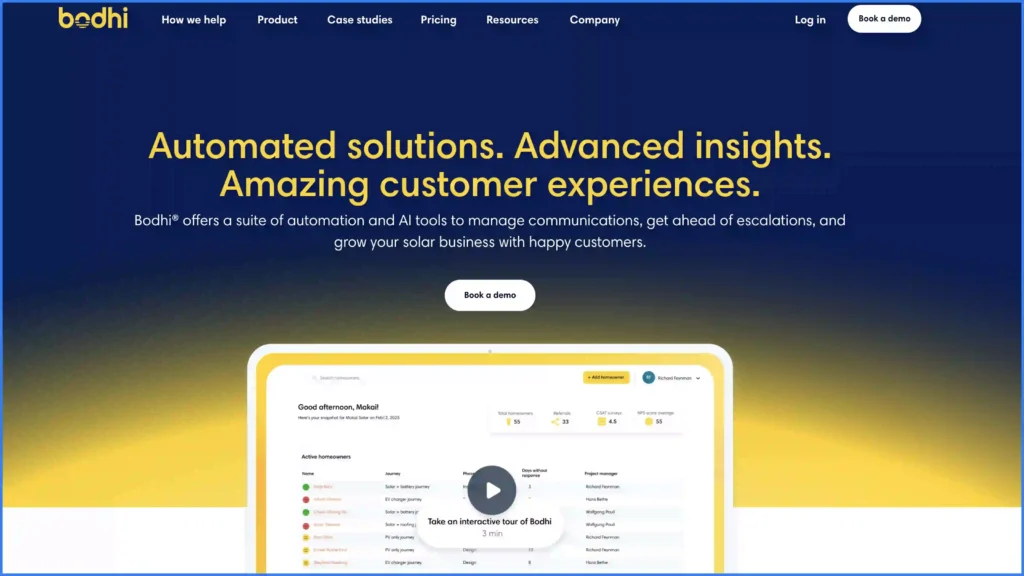
Bodhi is a solar referral and customer experience software that makes supporting your customers an easy task. Bodhi automates your customer communications and keeps them informed with a personalized project tracker that updates via text, email, and in-app. The software also monitors your installs and alerts customers of any performance issues, allows you to generate and capture referral leads, and helps generate post-install sales for your sales team.
Bodhi’s solar software is for companies that want to improve the homeowner experience after the sale by automating customer communications and catching issues early. It positions itself around AI and automation for customer management, including tools like automated surveys and an AI customer support assistant to reduce escalations and protect reviews.
Bodhi Pricing (2026)
The Free tier covers up to 5 new projects per month and 60 projects in total, and includes the multi-channel team inbox, white-labeled customer app, and document repository. Starter and Pro are sold as project packages with a 50-project minimum, billed monthly across 12 equal installments. Package prices are not publicly listed. All paid tiers include a dedicated customer success manager. Bodhi was acquired by solar lender OneEthos in March 2026. (Bodhi published pricing page, verified 19 August 2026.)
Who Bodhi Is Best For
Residential installers whose referral rate and review scores are being damaged by silence between contract and PTO. It layers cleanly on top of an operations platform. See our Bodhi integration.
Bodhi limitations
- Bodhi improves what the homeowner sees, not how the job gets done. There is nothing for crews, scheduling, checklists, or closeout.
- Project-package pricing asks you to commit to a volume before you know your volume, and package prices are not published.
- Value drops sharply on commercial work, where there is no homeowner to keep informed.
Verdict
The right buy if referrals and reviews are your growth engine and communication is what is breaking them. Treat it as a layer, not a system of record.
5. Solo, Best for Sales-Led Teams

What Solo Does Best
Solo is a solar sales platform that allows solar and roofing companies to generate custom solar proposals and automate closing processes with a one-click signing experience. Solo even delivers certified engineering documentation to support ongoing compliance. The platform prides itself on speed and the ability to deliver sales-ready proposals faster than its competitors. Features include weather analysis, energy efficiency modeling, financial analysis, and more.
Solo’s solar software is for sales and ops teams that want to manage leads, create proposals, and track milestones through installation inside one platform. It positions its product around helping teams move faster from lead to proposal to install, with integrations and a dedicated solar CRM experience.
Solo Pricing (2026)
Not publicly listed. Solo prices by usage, support level and scale, and states that every plan includes unlimited users, concierge onboarding and support. Unlimited users is unusual on a sales platform and materially changes the cost calculation for teams with a large rep count. (Solo pricing page, verified 19 August 2026.)
Who Solo Is Best For
Sales-led organizations with a large rep or dealer network, especially where roofing sits alongside solar. Our Solo integration hands the signed job to operations without re-entry.
Solo limitations
- Install tracking is milestone-level rather than task-level. That is fine for visibility and thin if crews need checklists, photo requirements, and offline capture on site.
- Design depth trails Aurora Solar and HelioScope on anything complex.
Verdict
A strong sales motion with unlimited users, and a fair choice if closing speed is the constraint. Add an operations layer before install volume outgrows milestone tracking.
6. Sunbase, Best All-In-One for Small Teams

What Sunbase Does Best
Sunbase is an all-in-one solar software platform designed to support the entire solar business workflow, from lead tracking and sales to design, proposals, and project management. It is built to help solar installers and contractors consolidate tools that are often separate (CRM, quoting, design, scheduling) into one unified interface.
Sunbase’s solar software is for businesses that want an all-in-one platform that combines CRM, proposals, project management, and design tools in a single system. It highlights automation and centralized workflows to reduce manual work across the sales-to-installation lifecycle, with proposal features like tracking, branded templates, and streamlined sharing.
Sunbase Pricing (2026)
Plans start at $59 per user per month. Tier names and what sits inside each one are not published. Pricing is assembled from team size, industry workflows, and the modules you select (CRM, proposals, project management, inventory, financial tools, and reporting) plus implementation and training. The $59 entry price is rarely the price you pay. (Sunbase pricing page, verified 19 August 2026.)
Who Sunbase Is Best For
Small installers and contractors who would rather use one adequate system than four good ones, and who are not yet at the volume where module depth matters. If you are weighing all-in-one against best-of-breed, read our take on building the perfect solar software stack.
Sunbase limitations
- The all-in-one trade-off is real. An all-in-one suite is built to cover ground, not to lead in any one category, so no single module matches the specialist tool it replaces. Design depth trails Aurora Solar and Solargraf, and field execution trails a dedicated operations platform. Teams end up working around the parts of the platform that feel thin, which is the exact problem the platform was bought to solve.
- Switching costs compound. Once your data, workflows, and training all live inside one platform, leaving gets harder every year. If the roadmap stops matching where your business is heading, whether that is a new market, a new service line, or a tool that only integrates with best-of-breed systems, you are left choosing between software that no longer fits and another full migration.
- Modular, quote-based pricing makes budgeting and comparison difficult.
- Per-user pricing means subcontractors and partners cost extra as you scale rather than being a free extension of your team.
Verdict
A reasonable single-system starting point for teams with low project volume. Beyond that, most teams we speak to have already outgrown at least two of its modules.
7. Solargraf, Best for Proposal Speed

What Solargraf Does Best
Solargraf is a solar design and proposal software targeted at installers and sales teams who need fast, accurate system layouts and client-ready proposals. It features auto roofline detection, shading analysis, LIDAR-assisted roof modeling, and the ability to turn designs into permit-ready plan sets with integrated financing tools and e-signature support.
Solargraf’s solar software is for installers who need fast solar and storage designs, customer-ready proposals, and tools that support permitting and financing steps. It emphasizes automation for roof detection and site modeling, plus proposal workflows that cover design, finance options, signing, and moving into permitting.
Solargraf Pricing (2026)
Starter is $2,799 a year for 240 projects and 2 users. Small Business is $4,799 a year for 480 projects and 4 users. Teams is $6,399 a year for 720 projects and 6 users. Enterprise is $12,999 a year for 1,500 projects with unlimited users. Extra projects cost $9 to $11 each and extra users $960 to $1,440 each depending on tier. Public API access costs $4,000 a year on every plan except Enterprise, where it is included. (Solargraf published pricing page, verified 19 August 2026.)
Who Solargraf Is Best For
Residential-only shops with predictable project volume where speed from lead to signed proposal is the revenue lever. For other recommendations for design software, see our roundup of solar design software tools.
Solargraf limitations
- Project-count caps punish exactly the growth you are buying the tool to create, and overage runs $9 to $11 per project.
- The $4,000 a year API charge on non-Enterprise plans is a real barrier to connecting Solargraf to the rest of your stack.
- Shading and complex-roof accuracy is generally rated below Aurora Solar by teams that have used both.
Verdict
Good value at the Starter and Small Business tiers for a steady residential pipeline. Model the overage and API costs before you sign rather than after.
8. HelioScope, Best for C&I Simulation

What HelioScope Does Best
HelioScope is a solar engineering and design platform that focuses on high-precision system layout and performance modeling. It provides detailed 3D design tools, shading analysis, energy production simulations, and iterative design capabilities, which make it especially suitable for complex commercial projects and utility-scale solar planning.
HelioScope’s solar software is for commercial and industrial solar teams that need fast, accurate PV design and simulation with performance modeling depth. It positions its value around bankable production estimates, commercial workflow optimization, and built-in financial and proposal options or easy data export to your preferred tools.
HelioScope Pricing (2026)
Basic is $159 a month or $1,620 a year per license, capped at 10 projects per month and 1.25 MW DC per design. Pro is $259 a month or $2,640 a year per license, capped at 10 projects per month and 5 MW DC. Enterprise is custom-priced, allows up to 30 MW DC and includes unlimited users. Basic and Pro licenses cover one user each. (HelioScope published pricing page, verified 19 August 2026.)
Who HelioScope Is Best For
C&I designers, engineering consultancies, and anyone who has to hand a defensible loss diagram to a lender or independent engineer. Our HelioScope integration carries the approved design into commissioning and O&M records.
HelioScope limitations
- The 10-projects-per-month cap applies to both paid tiers and is the number that catches busy C&I designers out.
- Basic and Pro are single-user licenses, so a three-person design team pays three times.
- There is no sales, proposal, or field layer at all. HelioScope is a simulation tool and does not pretend otherwise.
Verdict
The most credible simulation on this list for commercial work. Buy it as a specialist tool alongside a platform, never as your only platform.
Which Solar Software Company Should You Choose?
Choose your solar software by the bottleneck you actually have, not by feature count. Here is what we would put in place for five common setups.
- Small residential installer or service provider, one state, fewer than 8 jobs a month. Start with Scoop to standardize how each job runs, then add a design and proposal tool. If software spend is the binding constraint at this stage, OpenSolar covers design and proposals at no license cost.
- High-volume residential installer with multiple crews. Aurora Solar for design and proposals, Scoop as the operations hub, and Bodhi for homeowner communication. This is the stack where unlimited-user pricing stops being a talking point and starts enabling growth.
- Commercial installer running repeatable multi-site work. Scoop for standardized execution across sites, plus HelioScope Pro for defensible yield numbers. You do not need a residential proposal engine.
- O&M and asset management provider. Scoop for recurring work orders, preventive maintenance schedules, asset history and SLA-ready audit trails, plus your monitoring platform. Design tools are irrelevant to your day, and the tools that matter are the ones that cut truck rolls and prove the work was done. See solar O&M software and our guide to solar asset management.
- Sales-led organization with subcontracted install. Scoop to standardize projects across internal teams and external partners without a per-seat cost, paired with Solo or Sunbase for pipeline and commissions.
How Do You Build the Perfect Solar Software Stack?
To create the perfect solar software stack, we recommend combining best-of-breed tools connected through shared data models and APIs, allowing sales, design, execution, and customer management workflows to operate as one continuous process. This approach avoids the limitations of all-in-one platforms, which often force compromises in functionality and flexibility as operations grow across the full solar project lifecycle.
This connected setup reduces manual data entry and allows your teams to move seamlessly from lead capture to site assessment, system design, installation planning, post-install service and the recurring O&M work that follows it.
Each category of solar software you use supports a specific operational function such as CRM, design and simulation, project management, or field operations, and these tools connect through native integrations or middleware to keep customer records, project status, documents, and performance data aligned. This structure gives you a single source of truth while preserving the flexibility to choose software that fits your workflows, team size, and growth objectives.
You can browse Scoop’s 500+ integrations, and read our detailed guide on building a solar software stack that scales.
Stop Paying for Tools That Do Not Talk to Each Other
If you recognized tools you use somewhere in this list, a design tool here, a CRM there and a spreadsheet holding the middle together, that gap is where your margin goes. Every address that has to be re-entered, every missing install photo and every late invoice is paid for out of the budget you are trying to protect.
Book a demo and bring one real project with you. We will map it end to end in Scoop, show you which of the eight tools above we would keep in your stack, and tell you plainly if we are not the right fit. No credit card, no obligation, and we respond the same business day.
Frequently Asked Questions About Solar Software Companies
What is the best solar software company in 2026?
The best solar software company in 2026 is Scoop, because it runs field execution and connects the rest of your stack rather than replacing it. Aurora Solar is the strongest design and proposal platform on the list, and OpenSolar is the strongest free option for small residential teams.
How much does solar software cost in 2026?
Published solar software pricing in 2026 ranges from free to $2,640 per user per year. Aurora Solar Basic and HelioScope Basic are $1,620 per user per year. Aurora Premium and HelioScope Pro are $2,640 per user per year. Sunbase starts at $59 per user per month. Solargraf sells by project volume from $2,799 a year. Solo prices by usage and scale, and Sunbase’s upper tiers are quote-based.
Is free solar software good enough for a solar installer?
Free solar software is sufficient for solo installers and small teams doing two or three straightforward residential jobs a month. OpenSolar’s core platform is free and covers design, proposals and a basic CRM. It stops being enough once you add crews, subcontractors or commercial work, because add-on and connector pricing is unpublished and there is no field execution layer.
How many solar software tools does an installer actually need?
Most solar installers need two to four tools: a design and proposal platform, an operations platform for field execution, and depending on the business a CRM and a customer experience layer. No platform on this list credibly covers all four. The decision that matters is not how many tools you use, but whether they are connected.
What is the difference between solar design software and solar operations software?
Solar design software models the system and produces the proposal: layout, shading, yield, pricing and plan sets. Solar operations software runs the job after it is sold: scheduling, site surveys, checklists, photo capture, closeout, invoicing triggers and audit trails. Aurora Solar, HelioScope and Solargraf are design tools. Scoop is an operations platform. Most teams need one of each.
What is the best solar software for O&M and recurring service work?
Scoop is the best solar software for O&M and recurring service work, because the platform that runs new installs also runs work orders, preventive maintenance schedules, asset history and SLA evidence. Design and proposal tools have no service layer at all, and a monitoring platform tells you a site is underperforming without dispatching anyone to fix it. Pacific Power Solutions scaled 15x while building a leading O&M business on exactly that model. See solar O&M software for how the service side works.
Do I need to replace my CRM to add solar operations software?
No. A solar operations platform should connect to the CRM you already use rather than replace it. Scoop integrates with Salesforce, HubSpot, QuickBooks, DocuSign and others, so leads and customer records stay in the CRM while job execution, documentation and closeout live in the operations layer. Replacing a working CRM is usually the more expensive mistake.
What results do solar teams get from an operations platform?
Published, customer-reported results from Scoop accounts include Sunlight Solar at 500% operational growth, RWE saving over $1.4 million annually with a 40% reduction in admin time, ENGIE Services saving $179,000, and Pacific Power Solutions scaling 15x. The common pattern is the same: standardize the workflow first, then let automation carry the volume.
What support should I expect from a solar software vendor?
Expect a named success manager, a documented implementation plan and help building your first workflows. Many vendors reserve that level of support for enterprise contracts and route everyone else to a help portal. Scoop assigns a dedicated success manager to every account and provides access to a fractional support team that helps configure and maintain workflows as your operation changes. Ask any shortlisted vendor which tier hands-on support starts at before you compare license prices.
Disclosure and How We Keep This Page Accurate
Scoop is our own product and we have placed it first on this list. Our evaluation is editorial opinion based on published vendor information, product documentation, hands-on use and what we hear from solar operations teams. It is not an independent audit. Vendor pricing was verified on 19 August 2026 from each vendor’s published pricing page. Vendors change pricing without notice and many negotiate, so confirm before you buy. All product names and trademarks belong to their respective owners, and no affiliation or endorsement is implied. If something here is wrong or out of date, tell us and we will correct it.