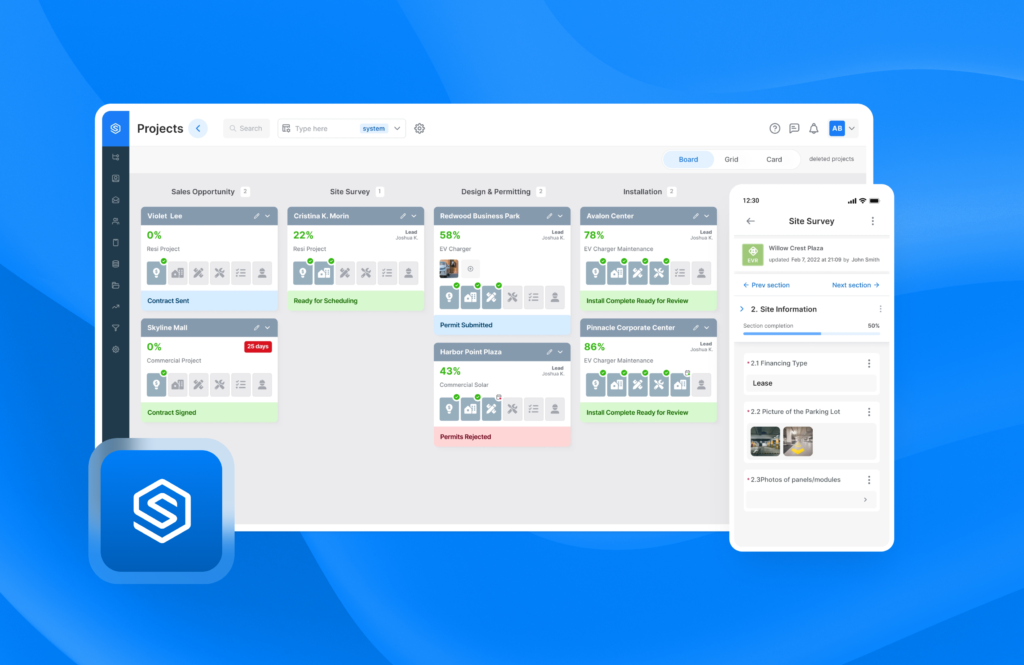
Most field service organizations have already started investing in artificial intelligence and machine learning, yet many still run day-to-day operations on manual dispatch, static automation, and reactive repairs.
That gap between adoption and execution is where the real value sits.
This guide breaks down how AI works across field service, where it improves scheduling, predictive maintenance, and technician efficiency, which adoption trends will shape the next years, and what it takes to connect these systems so information moves through your operation without manual reconciliation.
How Is AI Used In Field Service?
Artificial intelligence in field service is the integration of machine learning, predictive analytics, natural language processing, and computer vision into the systems that run field operations.
Instead of following fixed scripts, these models learn from historical patterns, adapt to changing conditions, and sharpen the accuracy of operational decisions with every job they process.
The result is a shift away from reactive, rule-based dispatching toward predictive, data-driven orchestration of every service touchpoint, where decisions are based on live information rather than static assumptions.
How AI Differs From Traditional Field Service Automation
Traditional field service automation runs on static rules: a dispatcher assigns jobs by hand, the connected tools follow predefined logic, and reporting only happens after the work is done. AI changes both the inputs and the outputs.
It continuously reads data from IoT sensors, service histories, and asset records, then uses that information to drive adaptive operations that shift in real time.
Automation executes the rules you give it, while AI-based systems recognize patterns, predict outcomes, and self-adjust as conditions change, which is why they sharpen dispatch decisions instead of repeating the same fixed routine.
Core AI Technologies Used in Field Service Operations
Five core technologies do the heavy lifting behind AI-powered field service, and each one gives operations teams access to a different kind of intelligence.
- Machine learning: recognizes patterns in historical job data and optimizes scheduling as conditions change.
- Predictive analytics: forecasts maintenance needs and scores the probability of equipment failure before it happens.
- Natural language processing: handles work order processing, knowledge retrieval, and automated customer communication.
- Computer vision: powers equipment inspection and damage detection from photos and video.
- IoT integration: feeds real-time equipment monitoring data into AI models for continuous refinement.
Together, these tools turn scattered field data into decisions technicians and dispatchers can act on, and they connect to the existing systems your operation already runs on rather than replacing them.
How Does AI Improve Field Service Scheduling and Dispatch?
Scheduling is where AI delivers its fastest, most visible wins. Instead of a dispatcher juggling a whiteboard, AI weighs technician skills, geographic proximity, job priority, parts availability, and live traffic to build an optimized schedule in seconds.
That logic reshapes the entire field service management workflow and rebuilds the plan the moment a cancellation or emergency hits, so the right technician still reaches the right job with less travel. Dispatchers stop firefighting, and the tools that run daily operations optimize around real conditions instead of yesterday’s plan, which lifts scheduling efficiency without extra admin.
Intelligent Route Optimization for Field Technicians
Route optimization is the engine behind those gains. AI algorithms optimize routes using real-time traffic, narrow time windows, and skill matching, so each technician spends more of the day on billable work and less of it lost to travel.
Reducing windshield time compounds fast: shorter drives mean faster arrivals and tighter routes mean more completed visits, so dispatchers redirect their attention from manual sequencing to the exceptions and high-value calls that need a human. The net effect is higher field efficiency without asking anyone to work longer hours.
Dynamic Rescheduling and Real-Time Adaptability
Plans rarely survive contact with a real workday. When priorities shift mid-morning, AI redistributes tasks automatically across the technician pool and keeps SLA commitments intact without a dispatcher manually reworking every assignment.
Compared to static scheduling, dynamic real-time rescheduling smooths out response-time variability and cuts missed service windows, because the system absorbs complex, overlapping changes faster than any human can. That frees operations leaders to spend their judgment on the decisions that move the business, not on triage. Scheduling keeps technicians moving, but the schedule is only one of the many workflows a service operation runs on each day.
How Does AI Automate Field Service Workflows?
Workflow automation is where AI moves beyond a single schedule and starts running the connective tasks between jobs: work orders, approvals, status updates, and the handoffs that carry a job from first request to final closeout. AI handles this repetitive coordination so information moves through the operation on its own, without someone re-entering it at every step.
From Manual Handoffs to Automated Work Orders
Most delays in field service hide in the gaps between systems: a request waits for someone to open a work order, an approval sits in an inbox, a finished job never gets marked complete. AI-powered automation creates work orders from incoming requests, routes approvals to the right owner, and triggers the next task the moment the previous one closes.
The payoff is fewer dropped balls and far less manual data entry, so technicians and dispatchers spend their hours on service work instead of the administrative tasks that pile up around it.
Connecting Automated Workflows Across Your Tools
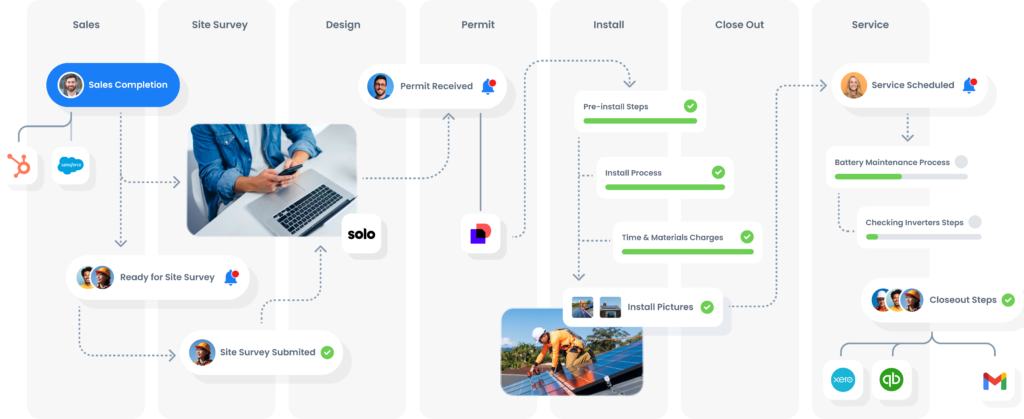
Automation delivers the most value when it reaches across the tools a field service team already runs on, rather than staying trapped inside one app. When scheduling, CRM, and invoicing share the same workflow, a job closed in the field can update the customer record and trigger an invoice without anyone stitching the steps together by hand.
That connected operational layer is what turns scattered point solutions into one coordinated system, where data based on real field activity reaches every team that needs it. Automated workflows keep the whole operation moving, and keeping the equipment itself running is where predictive maintenance takes over.
Predictive Maintenance in AI-Powered Field Service
Predictive maintenance flips the whole repair model. Rather than waiting for equipment to break or servicing it on a fixed calendar, AI-powered systems read sensor data and historical failure patterns to forecast problems before they cause downtime. Swapping reactive and scheduled work for condition-based intervention keeps operations running, reducing unplanned outages, repeat visits, and the premium cost of emergency dispatch.
How Does Predictive Analytics Reduce Equipment Downtime?
It starts at the sensor. IoT devices track pressure, vibration, and temperature in real time, and AI-powered models flag the anomalies that signal a failing part, then recommend the repair before the asset quits mid-job.
The financial case is hard to ignore. Independent analysis puts the average predictive maintenance ROI at 250%: the return reported across industrial maintenance programs. For operations that depend on critical equipment, catching degradation early means reducing unplanned downtime instead of absorbing it.
When Does Condition-Based Maintenance Outperform Scheduled Maintenance?
Timing is the whole question. Fixed calendars waste labor on healthy equipment and still miss the degradation that happens between service intervals, so the schedule is either too early or too late.
Condition-based maintenance fires only when the data signals genuine need, which optimizes how crews spend their time and lifts asset uptime. The trade works out to lower total maintenance spend, fewer unnecessary truck rolls, and the kind of efficiency that comes from reducing work that never needed to happen. Scheduling and maintenance show the mechanics, but the bigger story is where all of this value lands across the service lifecycle.
Where Does AI Deliver the Most Value in Field Service?
Scheduling and maintenance are mechanisms; value is the scoreboard. Beyond those specific gains, AI produces a handful of standalone benefits that improve core operations metrics, each one a measurable outcome rather than a soft promise. The three that move the business most are first-time fix rates, operational efficiency, and the customer satisfaction that follows when service simply works.
Increased First-Time Fix Rates
AI pre-diagnoses the issues before a truck ever leaves the depot. By reading historical job data and IoT signals, AI-powered systems predict what’s actually wrong and match the right technician, with the right parts and skills, to the call.
Technicians arrive ready to solve the problem on the first visit, which pushes first-time fix rates up and cuts the repeat truck rolls that drain margin. Customers get a faster resolution, and every avoided second trip lowers the real per-job cost.
Operational Cost Reduction Across the Service Lifecycle
Reducing cost is where AI quietly compounds, because it attacks spending in three places at once.
- Travel and fuel: optimized routing trims the miles between jobs, so crews spend less of the day driving and more of it working.
- Emergency dispatch: predictive maintenance heads off failures before they force a costly same-day scramble.
- Administrative load: AI-powered work order processing automates the repetitive tasks that used to eat into technician hours.
Each lever improves efficiency on its own, but using them together is what optimizes the full cost base the operations of a service business run on.
Improved Customer Experience in Field Service
Customers rarely see the AI itself. They just notice that service gets easier. Accurate ETAs, faster response times, and proactive notifications keep people informed without anyone chasing an update by phone.
AI-driven communication automates real-time status messages and routine support, so technicians stay focused on the work in front of them instead of fielding calls. That steady, predictable experience lifts customer satisfaction and quietly turns one-time jobs into the repeat business that helps improve retention. These gains are already spreading fast, which raises the obvious question of how far field service AI goes in 2026.
What Are the Key AI Adoption Trends in Field Service for 2026?
The momentum behind AI in field service is no longer speculative. Already, 70% of field service organizations have invested in artificial intelligence and machine learning: a clear signal that the technology has moved from pilot to priority.
The market is scaling to match. Analysts project the field service management market will grow from $5.10 billion in 2025 to $9.17 billion by 2030: a 12.5% CAGR, and the businesses capturing that value are the ones that use AI-powered tools for real operational potential rather than experiments.
The Shift From AI-Assisted to AI-Autonomous Operations
The biggest change in 2026 is who makes the call. Through 2024 and 2025, AI mostly suggested options while a human made the final decisions; from here on, AI-powered systems handle routine decisions on their own and escalate only the genuine exceptions.
In practice, that means work orders generated automatically from customer requests, technician assignment based on skills and location, and self-optimizing routes that run without human intervention for standard jobs. The shift from assisted automation to autonomous operations is where field service intelligence starts compounding.
IoT Integration and Connected Field Service
Autonomy only works when the data keeps flowing. 5G-enabled monitoring, digital twins, and edge computing now handle real-time data processing at the equipment level, so AI systems get a continuous, current view instead of yesterday’s readings.
This closes the loop: sensors detect, AI predicts, and data-based workflows execute, with each cycle refining the next. Strong field service asset management holds that loop together, keeping equipment records, sensor information, and the connected tools that run distributed operations on the same page. Putting all of this into one connected operation is exactly the gap a central operations hub fills.
Streamline and Connect Your Field Service Operations With Scoop
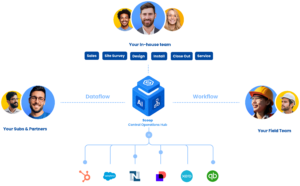
AI changes field service fastest when it connects the work you already do instead of adding another silo. Scoop is the Central Operations Hub that ties scheduling, dispatch, and service execution into one coordinated system where your AI-powered workflows finally talk to each other.
We help field service teams operationalize and optimize those workflows without ripping out the tools you already rely on, turning scattered point solutions into real, end-to-end efficiency.
See how our field service management software connects your operation, and book a demo to put a coordinated hub to work for your team.
Frequently Asked Questions About AI in Field Service
What Is the Difference Between AI and Automation in Field Service?
Automation follows predefined rules and runs repetitive tasks the same way every time. AI goes further: it learns from data, adapts to changing conditions, and improves its own accuracy as it works. Both cut manual effort, but only AI handles the complexity and variability that rule-based automation can’t manage on its own.
How Much Does AI in Field Service Cost?
It depends on scope. Standalone AI scheduling tools usually run on per-user monthly pricing, while enterprise FSM platforms with built-in AI sit higher, as this breakdown of field service management software cost lays out in detail. Across tiers, the return tends to justify the spend through lower travel costs, fewer repeat visits, and better technician utilization.
Can Small Field Service Teams Benefit From AI?
Yes. Cloud-based subscriptions now put AI-powered FSM tools within reach without a dedicated data science team. Smaller operations gain from intelligent scheduling, automated dispatching, and predictive job prioritization, so the real task is picking a platform that scales as the business grows.
How Long Does It Take to Deploy AI in Field Service?
Faster than most teams expect for the basics. Smart scheduling and route optimization can be operational within weeks, while full predictive maintenance and autonomous workflows need IoT infrastructure and time for the data to mature. Those deeper capabilities usually deliver meaningful results within 3 to 6 months.
Which Industries Use AI in Field Service the Most?
Solar and renewable energy, HVAC, telecommunications, utilities, medical device servicing, and data center operations lead the way. The common thread is distributed field teams, complex equipment, and high service volume, which is exactly where AI-powered field service management pays off. Any business with that profile stands to gain.