The global wind turbine operations and maintenance (O&M) market reached approximately $18.19 billion in 2024, with projections pointing toward $35.93 billion by 2034 (Precedence Research).
That growth reflects a simple reality. As installed renewable power capacity expands, keeping turbine equipment running at peak performance becomes the deciding factor in energy production and long-term profitability.
This guide breaks down the core components of wind turbine O&M: the monitoring systems and maintenance strategies, field workflows, cost benchmarks, and operational processes that protect critical electrical and mechanical equipment. It also explains how operators can connect monitoring insights, maintenance execution, documentation, and reporting to manage reliability across distributed wind assets. Use it to pressure-test your current program or build one from scratch. The sections below cover the strategies and technology shifts that define modern O&M workflows.
What Does Wind Turbine Operation and Maintenance Include?
Wind turbine O&M spans two interconnected functions.
Together, they determine how much energy a turbine produces over its lifetime:
- Operations covers the monitoring, data analysis, and performance tracking that keep turbines generating electricity within expected parameters.
- Maintenance covers the physical work: inspecting, repairing, and replacing equipment to prevent failures and extend the useful life of every component in the fleet.
Neither function stands alone. Operational data drives maintenance decisions, and maintenance quality directly affects production output. The strength of an O&M program depends on how tightly these two feed into each other.
Wind Turbine Operations
Operations teams own real-time monitoring and performance management across the entire wind farm.
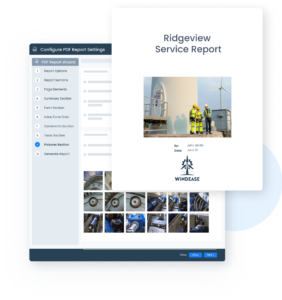
SCADA (Supervisory Control and Data Acquisition) systems collect sensor data from each turbine, tracking output, wind speed, vibration levels, temperatures, and grid connectivity. That data feeds performance benchmarking, where actual electricity production is measured against expected output based on wind conditions.
When a turbine underperforms or triggers an alarm, the operations team dispatches field technicians and manages the back-and-forth between remote monitoring centers and on-site crews.
Day-to-day production tracking is only part of the job. Operations also handles:
- Regulatory compliance reporting
- SLA management for third-party service contracts
- Grid availability commitments that affect revenue

Wind Turbine Maintenance Activities
Maintenance is the single largest component of a wind plant’s operating expenditure.
The scope ranges from a 20-minute filter swap to a full gearbox exchange with a 500-ton crane. Scheduled preventive maintenance typically follows semi-annual and annual cycles, with regular tasks that prevent accelerated wear and catch early signs of degradation before they escalate:
- Lubrication of bearings and gears
- Oil and filter changes
- Bolt torque verification
- Visual inspection of blades, towers, and electrical connections
Unscheduled corrective repairs fill the gap when components fail between planned visits. A gearbox bearing seizure, a blade crack discovered during a drone flyover, a converter fault flagged by the monitoring system: each one triggers a reactive event.
Reactive events cost more. Emergency mobilization, expedited parts procurement, and the downtime lost while the turbine sits idle all stack on top of the repair itself. Bringing down the ratio of unscheduled to scheduled maintenance is one of the defining goals of any mature O&M program.
Component-level knowledge is what makes that ratio possible. It shapes how teams allocate budgets and prioritize field work across a growing fleet.
Which Wind Turbine Components Need Regular Maintenance?
Every major mechanical, electrical, and structural component demands its own protocol. Neglect any single one and the cost compounds across the fleet.
Knowing which components carry the highest failure risk helps O&M teams prioritize inspections, allocate budgets where they’ll have the greatest impact, and build maintenance schedules that match the real-world degradation patterns of each turbine model. The sections below cover the critical systems that need regular attention: rotor blades, gearbox and drivetrain, generator and electrical systems, tower and foundation, and pitch and yaw mechanisms.
| Component | Common failure mode | Key diagnostic | Prevention cadence |
| Rotor blades | Leading edge erosion, lightning strike damage | Drone inspections, rope-access assessments | Regular drone surveys, LEP coatings, lightning receptor testing |
| Gearbox and drivetrain | Bearing wear, gear tooth degradation | Oil analysis, vibration monitoring | Oil sampling every 6 months, continuous or quarterly vibration trending |
| Generator and electrical systems | Converter faults, insulation breakdown, SCADA drops | Thermal imaging, insulation resistance testing | Scheduled testing, firmware and software updates |
| Tower and foundation | Bolt loosening, corrosion, settlement | Bolt torque verification, corrosion inspection | Annual structural inspection cycle |
| Pitch and yaw systems | Hydraulic issues, bearing wear, off-axis drift | Hydraulic pressure testing, sensor calibration | Scheduled servicing with SCADA feedback |
Rotor Blades
Leading edge erosion is the most common form of blade damage.
Continuous exposure to rain, hail, and airborne particulates at tip speeds that can exceed 300 km/h wears away the protective coating and exposes the composite laminate underneath. Left unaddressed, erosion reduces aerodynamic efficiency and accelerates structural degradation across the full rotor span.
Erosion isn’t the only threat. Blades face lightning strike damage, surface cracks, and delamination where internal layers separate under repeated stress cycles. Offshore turbines are especially vulnerable: salt spray and humidity compound the wear rate on blade surfaces.
Blade inspection programs typically combine drone-based visual surveys with periodic rope-access assessments for detailed damage mapping. Prevention relies on 3 key practices:
- Regular drone inspections to catch surface degradation early
- Leading edge protection coatings applied during scheduled maintenance windows
- Lightning receptor testing to confirm strike dissipation paths remain intact
Gearbox and Drivetrain
Gearbox failures rank among the most expensive component replacements in wind turbine maintenance. A single event can require full crane mobilization at tens of thousands of dollars.
The gearbox converts low-speed rotor rotation into high-speed generator input. That mechanical translation subjects internal bearings, gears, and shafts to sustained loads that accelerate wear over time.
Oil analysis is the primary diagnostic tool for gearbox health. Testing lubricant samples for metal particle concentration, moisture content, and viscosity breakdown lets teams detect bearing wear or gear tooth degradation months before a catastrophic failure. Vibration monitoring adds a second layer, tracking frequency patterns that signal misalignment, imbalance, or early-stage bearing defects.
Gearbox maintenance follows a structured cycle:
- Oil sampling: every 6 months
- Vibration trending: continuous or quarterly basis
- Alignment verification: during installation or after any major repair
- Lubrication schedules: cover not just the gearbox itself but the full drivetrain, including the main shaft bearings and coupling mechanisms that connect the rotor hub to the generator
Generator and Electrical Systems
Electrical faults account for a significant share of wind turbine failures. They’re also the hardest to diagnose remotely, because symptoms overlap across multiple subsystems.
The generator converts mechanical rotation into electricity. Its internal components, windings, insulation, cooling circuits, and slip rings, all degrade under thermal cycling, vibration, and electrical stress.
Power converter failures, SCADA communication drops, sensor drift, and grounding issues are among the most common causes of unplanned downtime. One converter fault can take a turbine offline for days while replacement parts are sourced and installed.
Prevention for generator and electrical systems combines scheduled and condition-based approaches:
- Thermal imaging to detect hotspots in winding insulation and electrical connections
- Insulation resistance testing at regular intervals to catch dielectric breakdown before it causes a short circuit
- Firmware and software updates for power converters and SCADA controllers to address known bugs and improve fault detection accuracy
Tower and Foundation
Tower and foundation maintenance is less frequent than rotating component work. The consequences of a missed inspection are far more severe, since structural failures are rarely repairable in the field.
Each turbine tower contains thousands of bolted connections. Bolt torque verification is a standard part of every annual inspection cycle, because fasteners loosen over time from thermal expansion, vibration, and wind-induced fatigue loading.
The structural inspection scope also covers several additional areas:
- Corrosion inspection: offshore and coastal towers face corrosion from salt spray and humidity that attacks both the external surface coating and internal structural joints
- Foundation monitoring: tracks settlement, cracking, and erosion around the base, particularly for onshore turbines on soft soils or offshore monopiles exposed to wave loading
- Access ladder and safety system checks: cover fall arrest anchors, climbing assists, and internal lighting
How Do Pitch and Yaw Systems Affect Turbine Performance?
Pitch and yaw systems control the orientation of both the blades and the nacelle. They’re directly responsible for how much energy a turbine captures from the wind.
The pitch system adjusts blade angle to optimize aerodynamic loading across varying wind speeds. The yaw system rotates the entire nacelle to face the rotor into the wind. When either underperforms, the turbine loses potential output even in strong wind conditions.
Pitch system maintenance covers:
- Hydraulic fluid levels and pressure testing
- Actuator calibration
- Electric pitch motor servicing for turbines using electric rather than hydraulic pitch control
Yaw system work focuses on:
- Bearing greasing
- Brake pad inspection
- Alignment verification to prevent the nacelle from drifting off-axis between yaw corrections
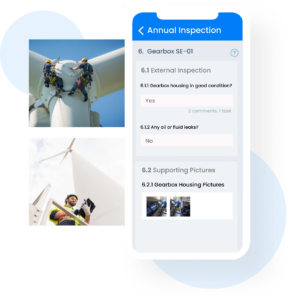
Both systems rely on sensor feedback loops tied to the SCADA system, so sensor calibration is part of the standard maintenance scope.
With component-level maintenance protocols in place, the next layer is how O&M teams organize the people, data, and processes that execute preventive, predictive, and condition-based maintenance strategies consistently across a fleet.
What Are the Best Practices for Wind Turbine O&M Teams?
The difference between a wind farm that hits its availability targets and one that constantly fights unplanned downtime usually comes down to 3 things:
- Standardized maintenance plans
- Skilled technicians
- Centralized operational data
These aren’t separate initiatives. They reinforce each other. A well-trained crew working from a structured plan generates reliable data, and that data makes the next maintenance cycle sharper than the last.
The best practices below are the operational strategies that high-performing O&M teams in the wind energy industry use to manage growing fleets without proportionally growing their overhead.
Standardize Maintenance Plans and Field Protocols
A structured plan gives every technician a clear playbook for each turbine model in the fleet.
Start with manufacturer recommendations as the baseline. Refine the plan using operational data from condition-based monitoring and historical failure patterns.
As the fleet matures, the plan shifts from fixed-interval schedules toward risk-based prioritization. Maintenance resources flow to the components and turbines with the highest probability of near-term failure.
Field protocols need the same level of standardization. Dispatch and escalation procedures for corrective events should define:
- Who gets called
- What tools and parts are staged
- How crane or vessel pre-positioning works for offshore sites
Regular audits of field execution, comparing what the protocol prescribes to what actually happens on-site, close the gap between planned and actual maintenance quality.
Why Does Technician Training Matter for Wind Turbine O&M?
Wind turbine technicians work at heights exceeding 80 meters, handle high-voltage electrical systems, and operate in confined spaces inside nacelles. Safety certifications aren’t optional.
Beyond baseline safety training, technicians need manufacturer-specific certification on the exact models in their fleet. A technician qualified on one OEM’s pitch system may not be cleared to service another’s hydraulic variant.
Skilled crews reduce repeat dispatches and improve first-time fix rates. Both directly lower per-turbine maintenance costs.
As turbine technology evolves, with larger rotors, higher towers, and more complex control systems, ongoing training programs keep field crews current on the diagnostic tools and repair procedures they’ll encounter.
Centralize Maintenance Data to Reduce Wind Turbine Downtime
A centralized system of record transforms raw field data into decisions that improve fleet-wide efficiency.
When every work order, inspection result, and parts replacement lives in one place, O&M managers can spot patterns fast: which turbine models have recurring gearbox issues, which sites consume the most corrective maintenance hours, where spare parts inventory should be pre-positioned for faster response.
Root cause analysis on every major failure prevents recurrence across the fleet. If a bearing failure on one turbine traces back to a lubrication schedule gap, the fix applies to every turbine on the same plan.
Centralized data also sharpens budgeting. Actual cost-per-turbine and cost-per-component benchmarks inform contract negotiations with service providers and OEMs.
For wind farm operators managing dispatch, field execution, and reporting across disconnected tools, consolidating these workflows into wind turbine O&M software eliminates duplicate work and restores visibility across the operation.
Centralize Wind Turbine O&M Workflows with Scoop
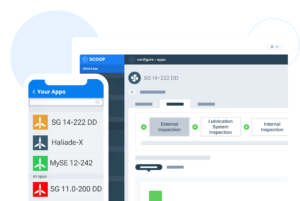
Wind turbine O&M teams managing dispatch, field documentation, maintenance reporting, and service coordination across disconnected tools lose time to manual processes and fragmented data. Scoop helps operators operationalize monitoring alerts by connecting field workflows, dispatch coordination, standardized maintenance documentation, and maintenance history into one centralized operational system.
Frequently Asked Questions About Wind Turbine Operation and Maintenance
How Often Should Wind Turbines Be Maintained?
Most turbines require semi-annual preventive maintenance visits plus an annual comprehensive inspection that covers structural, mechanical, and electrical systems. Condition-based monitoring may adjust these intervals based on real-time component health data, deferring visits when equipment is healthy and accelerating them when sensors flag anomalies.
What Is the Average Lifespan of a Wind Turbine?
Modern wind turbines are designed for a 20-25 year operational life. Many assets operate beyond this with mid-life refurbishment programs that replace high-wear components like gearboxes, blades, and generators while retaining the tower and foundation.
What Is the Difference Between Onshore and Offshore Wind Turbine Maintenance?
Offshore maintenance costs are significantly higher because of vessel mobilization, weather-dependent access windows, and the need for specialized marine crews. Onshore sites benefit from road access and lower logistics costs, which makes corrective maintenance faster and less expensive per event.
Can Predictive Maintenance Reduce Wind Turbine Downtime?
Predictive maintenance uses sensor data and machine learning to forecast failures before they occur, reducing unplanned downtime by catching degradation early enough to schedule repairs during planned windows. Industry research confirms that lowering unplanned downtime rates directly reduces offshore electricity generation costs.
What Qualifications Do Wind Turbine Technicians Need?
Wind turbine technicians typically require technical training in electrical and mechanical systems, safety certifications for working at heights, and manufacturer-specific turbine training. Many countries have formal wind technician certification programs that cover both onshore and offshore competencies.
How Much Does Wind Turbine Maintenance Cost Per Year?
Annual wind turbine O&M costs vary by fleet age, turbine model, and site conditions, with unplanned maintenance typically accounting for a large share of total annual spending. Cost efficiency improves as operators shift from reactive corrective repairs toward structured preventive and predictive maintenance programs.
What Role Does SCADA Play in Wind Turbine Operations?
SCADA systems collect real-time data from sensors installed throughout each turbine, tracking power output, wind speed, vibration, and temperature to give operators continuous visibility into fleet performance. That data feeds alarm management, dispatch coordination, and performance benchmarking against expected energy production targets.
How Does Remote Monitoring Reduce Wind Turbine Maintenance Costs?
Remote monitoring allows operations teams to assess turbine health from a centralized control room, reducing the frequency of unnecessary site visits and enabling faster response when sensors detect abnormal conditions. Combined with condition-based monitoring, remote diagnostics help teams prioritize field dispatch based on actual equipment condition rather than fixed inspection calendars.