Solar soft costs are the non-hardware expenses of a solar project: customer acquisition, installation labor, permitting, inspections, interconnection, design, financing fees, and company overhead. In the U.S., soft costs and other balance-of-system costs make up roughly 80% of the installed price of a residential solar system, based on 2025 median prices.
Panels and inverters are now the smaller part of a solar quote. For solar installers, margin depends on the time spent selling, permitting, scheduling, and documenting each project, and on how often a crew has to go back to a site to fix something.
Key Takeaways
- Soft costs and other balance-of-system costs represent roughly 80% of the median installed price of a U.S. residential solar system in 2025.
- Customer acquisition is the largest single soft cost, at 20% to 29% of the per-watt price of a U.S. residential system.
- Median prices across the top 100 U.S. residential installers range from $2.4 to $6.3 per watt, so how a company runs its projects moves the price as much as the equipment it buys.
- A repeat site visit costs between $500 and $1,500, and repeat visits, manual data entry, and missed handoffs are the soft costs an installer controls directly.
- Based on our work with hundreds of solar providers, fixing those three problem areas can cut soft costs by over $1,100 per installation.
- A central operations hub connects your CRM, design tool, and field app, so project data is entered once and every phase closes with the photos and records it needs.
What Are Solar Soft Costs?
Solar soft costs are every cost of a solar project that is not physical equipment. They cover the work required to sell, design, permit, finance, connect, build, and close out a system, from the first sales call to permission to operate.
Unlike physical components such as photovoltaic panels, inverters, racking systems, and wiring, soft costs cover the administrative, professional, and operational activities that move a project from proposal to commissioning, including solar installation scheduling, permitting, and closeout documentation.
Most of these activities now run on tools from solar software companies, so how well those tools connect has a direct effect on your soft costs.
Solar Soft Costs vs. Hard Costs
Hard costs are the physical equipment in a solar system: panels, inverters, racking, wiring, and batteries. Soft costs are the labor, paperwork, sales, financing, and overhead needed to turn that equipment into a working, approved system.
Balance-of-system costs combine non-module hardware with soft costs, which is why national lab reports often quote the two together.
| Cost type | What it includes | Who controls it | How it has trended |
| Hard costs | Solar panels, inverters, racking, wiring, and batteries | Equipment manufacturers and distributors | Fallen steadily over the past decade |
| Soft costs | Customer acquisition, labor, permitting, inspection, interconnection, design, financing fees, and overhead | The installer, the local permitting office, and the utility | Stayed high and now make up the larger share |
| Balance-of-system (BoS) costs | Everything except the solar modules: non-module hardware plus soft costs | Shared between suppliers and the installer | Roughly 80% of the median residential installed price in 2025 |
Hard costs fall when manufacturing scales up. Soft costs fall when the installer, the permitting office, and the utility change how the work gets done.
Why Should You Care About Solar Soft Costs?
Because hardware equipment prices have declined steadily over the past decade, soft costs now represent a larger share of associated costs. For solar contractors, developers, and EPC firms, this means operational efficiency, permitting timelines, sales processes, and project coordination have a direct impact on margins and scalability, which is why many EPC firms now evaluate EPC project management software as closely as they evaluate equipment.
What Are the Common Solar Soft Costs?
Solar soft costs fall into nine groups. The first four account for most of the money on a residential project, and the last one keeps building after the system is switched on.
| Soft cost | What it includes | Where it causes delays or rework |
| Customer acquisition and marketing | Advertising, lead generation, sales commissions, consultations, and proposals | The largest single soft cost; slow follow-up wastes leads you already paid for |
| Installation labor | Crew time, electrical work, site preparation, and service panel upgrades | Rework and repeat site visits add crew hours |
| Permitting and inspection | Fees, plan reviews, revisions, and inspection visits required by the local authority having jurisdiction (AHJ) | Each city and county sets its own document list |
| Interconnection | Utility applications, single-line diagrams, and permission to operate | A missing document sends the application back to the queue |
| Engineering and system design | Site surveys plus electrical and structural plans | Missing site data forces a redesign |
| Financing and dealer fees | Loan origination, underwriting, and dealer fees added to the contract | Raise the customer price without adding equipment |
| Project management and overhead | Scheduling, office staff, software, and administrative work | Manual data entry and status chasing between teams |
| Legal and compliance | Contracts, insurance, and compliance documentation | Records stored in different tools are hard to produce on request |
| Post-installation service | Warranty calls, preventive maintenance visits, and closeout documentation | Missing as-built records lead to extra truck rolls on later service calls |
Why Do Solar Soft Costs Matter?
Solar soft costs matter because they are now the largest part of a residential solar price, and they are the part an installer can control. Lawrence Berkeley National Laboratory found that soft costs and other balance-of-system costs represent roughly 80% of the total installed price of U.S. residential systems, based on 2025 median prices.
Because hardware equipment prices have declined steadily over the past decade, soft costs now represent a larger share of associated costs. For solar contractors, developers, and EPC firms, this means operational efficiency, permitting timelines, sales processes, and project coordination have a direct impact on margins and scalability.
The same Berkeley Lab data shows how much execution matters: median prices across the top 100 residential installers range from $2.4 to $6.3 per watt. In our experience, much of that gap comes from how efficiently each company sells, permits, schedules, and builds.
Why Are Solar Soft Costs Higher in the U.S. Than in Australia or Germany?
Residential solar costs roughly three times more per watt in the U.S. than in Australia, and soft costs explain most of the difference. A July 2025 international cost comparison reported a U.S. price of $2.53 per watt in 2023, against $0.82 per watt in Australia for 10 kW systems before incentives, with Germany between the two.
Hardware costs are similar across these markets. In the U.S., each city, county, and utility can set its own permitting and interconnection rules, which adds paperwork, waiting time, and sales effort to every project.
How Do Soft Costs Impact My Solar Business?
Solar business managers steer company operations to maximize profit margins. In rapidly growing sectors, managers typically focus on increasing top-line revenue through growth and market penetration. However, as the solar industry matures, monitoring the bottom line becomes crucial to building a truly efficient, growth-ready company.
On a typical residential solar system with an installed cost of $16,000, roughly $5,500 are soft costs within the solar company’s span of control, including installation labor, permitting, interconnection, customer acquisition, project administration, and overhead, according to NREL’s research model estimates. Overhead costs will always be necessary to drive critical business functions, but every dollar saved in soft costs contributes directly to the bottom line.
Soft cost savings for solar companies are most accessible when installing systems more efficiently and reducing G&A overhead. Most of these savings come from eliminating low-value, unnecessary work that frustrates employees, allowing your team to spend less time on repetitive tasks and more time on what they do best.
In our experience working with 100’s of leading solar providers, solar companies in the United States can reduce their soft costs by over $1100 per installation and boost net profits by 60%, by focusing on the three problem areas of repeat site visits, manual data entry and formatting missed or incomplete handoffs between teams.
No two solar providers follow the same processes, but a common consensus exists: teams spend more time working on fixing errors, and performing repetitive, manual, and administrative tasks than on growing the business. Avoiding rework and automating those small, tedious steps is the easiest way to give you and your team that time back.
What Are the Biggest Soft-Cost Challenges for Residential Solar Installers?
The biggest soft-cost challenges for residential solar installers are high customer acquisition costs, permitting and interconnection delays, repeat site visits, manual data entry, and missed handoffs between sales, design, and field teams. Market conditions shape the first two. The last three are fully within your control.
High Customer Acquisition Costs
Customer acquisition accounts for 20% to 29% of the per-watt price of a U.S. residential solar system, according to the same July 2025 comparison. Slow lead follow-up, proposals rebuilt by hand, and sales handoffs that lose site details all push that share up. Our guide on how to increase solar sales covers ways to convert more of the leads you already pay for.
Permitting and Inspection Delays
Every authority having jurisdiction sets its own document list, and a rejected submission restarts the clock. Automated permitting helps where it is available: NREL found that SolarAPP+ reduced median permit timelines by 14.5 business days, and 256 jurisdictions in 13 states had adopted it by the end of 2024.
Interconnection Paperwork
Utilities require single-line diagrams, equipment specifications, and site details before they grant permission to operate. A missing document sends the application back to the queue, and a finished system sits waiting for final payment.
Repeat Site Visits
A repeat site visit costs between $500 and $1,500, depending on whether it is a service call or an installation project. Many return trips happen because a photo, a measurement, or a customer signature was not captured the first time.

Manual Data Entry and Missed Handoffs
When sales, design, permitting, and field teams each work in a separate tool, someone has to retype the same customer and site data into each one. Every retyped field is a chance for an error that shows up later as a redesign, a rejected permit, or a crew sent without the right materials. Our guide shows how to eliminate double data entry between CRM and field service tools.
Soft Costs After Installation
Soft costs do not end at permission to operate. Warranty calls, preventive maintenance, and service visits carry the same costs: dispatch time, repeat truck rolls, and service reports built by hand. For installers adding operations and maintenance (O&M) work, a complete as-built record from the installation is what keeps each later service call to one visit
What Are the Most Common Solar Workflow Bottlenecks?
Solar workflow bottlenecks are the points where a project waits on missing information. The most common ones sit at the handoffs between the phases of solar project management: sale to site survey, site survey to design, design to permit, installation to inspection, and inspection to closeout.
| Project stage | Common bottleneck | Soft cost it creates |
| Sale to site survey | Site details from the sales call never reach the surveyor | A second survey visit |
| Site survey to design | Missing roof photos or electrical panel details | A redesign and a return trip |
| Design to permit | Plan set does not match the AHJ’s document list | Resubmission and a delayed start date |
| Installation to inspection | Missing labels or installation photos | A failed inspection and a reinspection fee |
| Inspection to permission to operate | Incomplete interconnection paperwork | Weeks of waiting before final payment |
| Closeout to service | As-built records and warranty details stored in different places | Extra truck rolls on later service calls |
Each of these waits looks small on a single project. Across a year of projects, they add up to crew hours, extra visits, and delayed revenue. Disconnected tools sit behind most of them, which is why data silos hurt field service profitability long before anyone sees it in a report.
How to Reduce Solar Soft Costs in 6 Steps
To reduce solar soft costs, audit one workflow at a time, standardize what crews capture in the field, connect your software so data is entered once, use automated permitting where it is available, design remotely, and track the metrics that expose rework. Start with the process that creates the most repeat site visits.
Soft cost reduction requires streamlining the processes behind activities like customer acquisition, design, permitting, field operations, and supply chain operations to minimize your overhead.
- Audit one workflow at a time. Pick the process that creates the most rework, such as site surveys or closeout, and map every handoff in it using the questions below.
- Standardize field data capture. Use a solar field mobile app with digital checklists, offline access, and mandatory photo fields, so a phase cannot close until the required photos and measurements are in.
- Connect your software. Link the CRM, design and proposal tool, and field app so customer and site data is entered once and reaches every team.
- Use automated permitting where your AHJ offers it. SolarAPP+ approves code-compliant residential systems online instead of through manual plan review.
- Design remotely. Satellite imagery and 3D modeling in your design tool reduce pre-installation site visits.
- Track the metrics that expose soft costs. Measure repeat site visits, days from contract to installation, first-time inspection pass rate, and administrative hours per project.
Use Solar Software to Streamline Operations
The US solar industry has embraced innovative technology to increase solar sales over the past few years. For many commercial and residential customers, investing in a solar and storage system has historically been at least partially an emotional decision, but with the continuously rising cost of energy and lower grid reliability, for an increasing number of homeowners, going solar is now a sound financial choice.
Solar software now supports multiple business processes, from digitizing design & proposal generation to helping installers streamline the entire process including permitting, field installation, closeout and data collection and retrieval in the field. Most solar companies choose a handful of best-in-class solutions to optimize specific key business functions. The common challenge is the coordination of functions and data across these tools as various teams undertake key workflows.
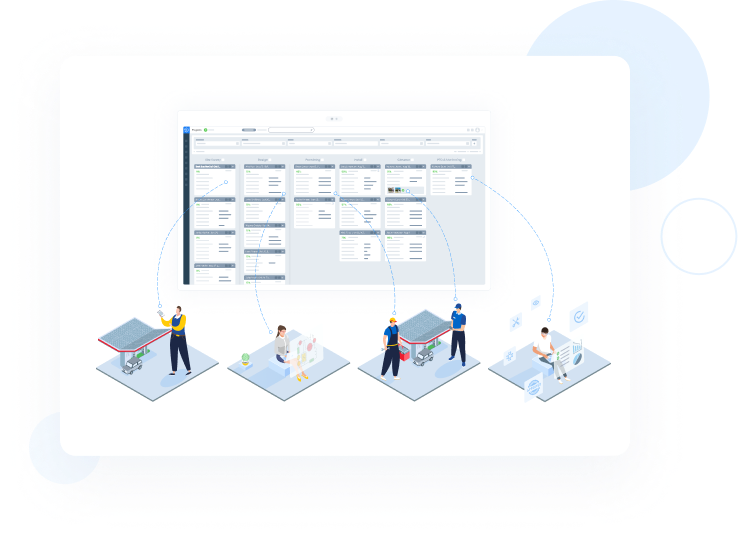
A recently emerging category is Central Operations Hub software (COH). This type of software technology takes a new innovative approach to addressing the operational coordination challenges facing solar installation, maintenance, sales, and management teams. COH cuts repeat site visits, data collection costs, and manual report formatting by centralizing & standardizing operations while tying in your teams and software tools in streamlined end-to-end workflows.
Questions to Ask When You Audit a Workflow
Select an operational process that you are familiar with (site survey, installation, design, permitting, closeout inspection, or maintenance) and ask yourself:
- Is this being done in the most efficient way possible?
- Where are the bottlenecks?
- How much time is the team wasting because of ineffective communication channels?
- What proportion of their time is spent doing administrative tasks versus work that directly contributes to growing my company?
- How are my team members handing off work from one group to another?
- How much of my team’s time is spent reporting to someone or waiting for a response?
- How often do we have to perform a repeat site visit to fix a mistake or collect data that was missed?
- How different is the current process compared to my ideal version of how it should be run?
What you will likely find is that there is a compounding effect taking place: small delays, missed steps, delayed handoffs, or communication inefficiencies conspire to become large, costly time-wasters for you and your team.
Ready to Start Cutting Soft Costs?
Most solar companies don’t have a visibility problem. They have an execution problem. Work lives across too many tools, handoffs get missed, and small inefficiencies compound into real margin loss.
Scoop is a Central Operations Hub (COH) purpose-built for solar companies. Instead of replacing your CRM, design tools, or accounting software, Scoop connects them into one operational layer, so scheduling, field execution, workflows, and reporting all live in a single system of record while future-proofing your tech stack with a modular structure.
Book a Free Demo to see how Scoop can help your team tighten execution and turn soft cost savings into lasting margin improvement.
Frequently Asked Questions About Solar Soft Costs
What percentage of solar cost is soft costs?
Soft costs and other balance-of-system costs make up roughly 80% of the installed price of a U.S. residential solar system, based on 2025 median prices from Lawrence Berkeley National Laboratory. Solar panels are now the smaller share of the price, so most savings come from sales, permitting, labor, and overhead.
What is the largest solar soft cost?
Customer acquisition is the largest solar soft cost. Marketing, sales commissions, and proposal work account for 20% to 29% of the per-watt price of a U.S. residential system, according to a July 2025 international cost comparison.
How much does solar cost for a 2,000 sq ft home?
Floor area does not set the price of a solar system. The system size and the installer’s soft costs do. Median prices across the top 100 U.S. residential installers ranged from $2.4 to $6.3 per watt in 2025, so ask for a dollars-per-watt quote that separates hardware from soft costs.
Are financing and dealer fees soft costs?
Yes. Loan origination, underwriting, and dealer fees are soft costs because they add to the contract price without adding equipment. Ask for them as separate lines on a solar quote so you can compare installers on the same basis.
How does SolarAPP+ reduce solar soft costs?
SolarAPP+ is an automated online permitting platform for residential solar and battery storage. NREL found it reduced median permit timelines by 14.5 business days and saved around 15,400 hours of permitting staff time in 2023 alone.
How do soft costs affect solar O&M and service work?
Solar O&M carries its own soft costs: dispatching technicians, repeat truck rolls, and service reports built by hand. A central operations hub runs installations, service calls, and recurring O&M work from the same system, so each visit starts with the full asset history.
What is the difference between soft costs and balance-of-system costs?
Soft costs are only the non-hardware costs, such as sales, labor, and permitting. Balance-of-system costs include soft costs plus all non-module hardware, such as inverters, racking, and wiring. Reports that quote a balance-of-system share are counting more than soft costs alone.
What software helps solar installers reduce soft costs?
A CRM, design and proposal software, permitting tools, and a field mobile app each reduce one type of soft cost. A central operations hub such as Scoop connects them, so project data moves between teams without repeat data entry and crews close each phase with complete records.