The best software for modular construction project management in 2026 is Scoop, for builders whose work runs a factory production schedule and a site installation schedule at the same time. Scoop holds module status, installation tasks, subcontractor assignments, punch items, and closeout in one system, and connects to the engineering, CRM, and accounting tools around it rather than replacing them.
The rest of the field splits cleanly.
Sablono is the strongest choice for large volumetric modular programs, meaning buildings assembled from complete three-dimensional units, where the job is tracking thousands of commitments and quality sign-offs.
Offsight is the strongest choice for a manufacturer who needs station-by-station tracking on the factory floor.
Procore and Autodesk Forma Build are the strongest choices for the site half of a large enterprise project, and both pair with a production system on the factory side.
Monday.com suits an office team that wants an adaptable board rather than a construction system.
Key Takeaways
- Scoop ranks first for modular builders whose work runs a factory production schedule and a site installation schedule at the same time because it holds both halves of the job in one system. Scoop is a central operations hub that connects the systems a modular builder already runs, including CRM, accounting and invoicing, design and proposal, inventory and warehouse management, and a company’s own tools, through its proprietary GLOO integration service.
- Two platforms on this page publish a figure. Offsight is $600 or $1,200 per month for 10 or 15 users, and Monday.com is $9 to $19 per seat per month. Sablono publishes tier names with no prices, and Procore, Autodesk Forma Build, Vertex BD, and MSUITE publish nothing.
- Every module carries two statuses at once, one in the factory and one on site, and the eight platforms here split along that line. Offsight, Sablono, and Vertex BD work the factory side. Procore and Autodesk Forma Build work the site side. Scoop is the one platform on this page that carries a module across both.
- The United States permanent modular construction market reached $20.5 billion in 2025, about 5.1% of construction activity in key market segments, and the Modular Building Institute forecasts 6.5% annual growth through 2030.
How We Ranked Modular Construction Project Management Software
We scored every platform on the same five criteria, and asked each one twice: once at the factory and once on site. Field execution and workflow handoffs carry the most weight because a modular job loses its days at the handoff between the two. Integration depth and reporting come next. Customer success and implementation support is weighted last and decides more shortlists than buyers expect.
1. Field Execution
Can the platform enforce field compliance at the station and on site without a supervisor watching?
When field execution is done well on a modular job, the operator at the station and the setting crew on site both work from the same procedure, and neither can close a step until the required photo, measurement, or signature is captured. That matters more here than on a conventional build because a module is built to the same procedure many times over, and a step that can be skipped will be skipped at scale.
We ran this same test across the service side of the business. See the results in our comparison of the best field service management software.
2. Workflow Automation and Handoffs
Work stalls between people, not inside tasks. The handoff that breaks a modular job is the one from the factory to the site: the module ships, and the setting crew, the inspector, and the office each find out at different times through different channels.
We score whether shipping a module moves the site work forward automatically, and whether an open quality issue can block that move.
3. Integration Depth
A platform that cannot read from your CRM and write to your accounting system creates a second version of the truth, and on a modular job it creates a third because the factory usually runs its own production system. We score how many categories of system a platform connects, and who maintains the connection afterward.
4. Reporting and Audit Readiness
The report is the deliverable. A modular building is handed over with a per-module record: what was built, when, by whom, against which revision, with which quality sign-offs, and which items were left on the punch list. That record is also the warranty defense for the next ten years, so we score whether the history survives at module level and whether a client-ready version comes out without somebody rebuilding it in a spreadsheet.
5. Customer Success and Implementation Support
Most vendors gate hands-on help behind an enterprise contract. Scoop gives every account a dedicated support team plus a fractional team that helps build and maintain the workflows.
Criteria We Did Not Include, and Why
Three capabilities were deliberately excluded because they are specialized technical functions that operations software does not commonly include.
- Design and engineering capability. Companies that treat design precision as a competitive advantage should keep a purpose-built design tool and connect it, rather than expecting an operations platform to replace it. Vertex BD, Autodesk, and Tekla do this work, and Vertex BD appears on this page for that reason rather than as an operations platform.
- Estimating and takeoff. Modular estimating is closer to manufacturing cost accounting than to construction takeoff, and the tools that do it well are usually the factory’s own production or enterprise resource planning system.
- Lead generation and marketing features. These are sales functions, and do not contribute to field execution or delivery of modular builds.
Modular Construction Project Management Software Compared (2026)
Pricing verified on September 10, 2026 from each vendor’s own published pricing page.
| Company | 2026 published price | Best for | Key capabilities | Limitation |
| Scoop | Unlimited users, storage, and devices on every plan | Modular builders running factory handoffs into site installation, service, and closeout | Stage-gated workflows, guided checklists, subcontractor access, offline mobile app, punch and closeout tracking, live dashboards, and GLOO integrations | Does not design buildings or produce stamped plan sets, and rewards teams ready to configure it around their own process |
| Sablono | Not publicly listed. Tiers named Track, Trace, and Flow | Large volumetric modular and pod programs tracking thousands of commitments | Reusable production sequences, embedded quality checklists, photo documentation, handover sign-offs, and module-level progress tracking | Coordination and quality layer rather than factory line tracking, so station-level production pairs with a second system |
| Offsight | Essentials $600 per month, Professional $1,200 per month, Enterprise quoted. Billed yearly | Offsite manufacturers who need station-level production and quality tracking | Factory-floor issue flagging, work order tracking, rework tracking before ship, throughput and quality reporting, and materials, inventory, and labor time | Factory-first, so the site half of the job needs a second system, and the two published tiers include 10 and 15 users |
| Procore | Not publicly listed. Unlimited users and unlimited data, quoted by construction volume | Enterprise general contractors who need financial controls and document control on the site side | Financials, submittals, RFIs, drawings, quality and safety, asset register, and an extensive integration marketplace | Built for site-side delivery, so factory production pairs with a second system, and Field Productivity is priced separately per full-time employee |
| Autodesk Forma Build (formerly Autodesk Construction Cloud) | Not publicly listed. Flexible user, project, and account-based pricing | Design-led projects where the model coordinates multiple trades | Model coordination, design collaboration, document management, preconstruction and bidding, and issue tracking against the model | Renamed on March 24, 2026, so most documentation still says Autodesk Build, and factory production pairs with a second system |
| Vertex BD | Not publicly listed. Free trial offered | Panelized and modular builders who need manufacturing output from the design model | Panel fabrication drawings, structural layouts, cut lists, material reports, and manufacturing data for shop equipment | Produces manufacturing data rather than tracking work in progress, so it feeds the factory but does not run it |
| MSUITE | Not publicly listed | Mechanical, electrical, and plumbing shops fabricating assemblies that feed modular work | Shop-floor production and material logistics, spool and weld tracking, labor hours, quality assurance, crew assignment, and shipping records | Trade fabrication rather than whole-building modular, and no dated product news since October 2024 |
| Monday.com | Free for up to 2 seats, Basic $9, Standard $12, Pro $19 per seat per month billed annually, Enterprise quoted. 3-seat minimum | Office-side coordination on an adaptable board rather than a construction system | Custom boards and columns, automations, dashboards, forms, guest access, and 200-plus integrations | A general work management platform, so modular workflows are yours to design and maintain, and per-seat cost grows with subcontractor access |
Looking to streamline modular construction project management? See how Scoop’s central operations hub keeps factory production and site installation on one schedule for modular construction teams. No credit card, no obligation, and we respond the same business day. Book a demo today.
1. Scoop
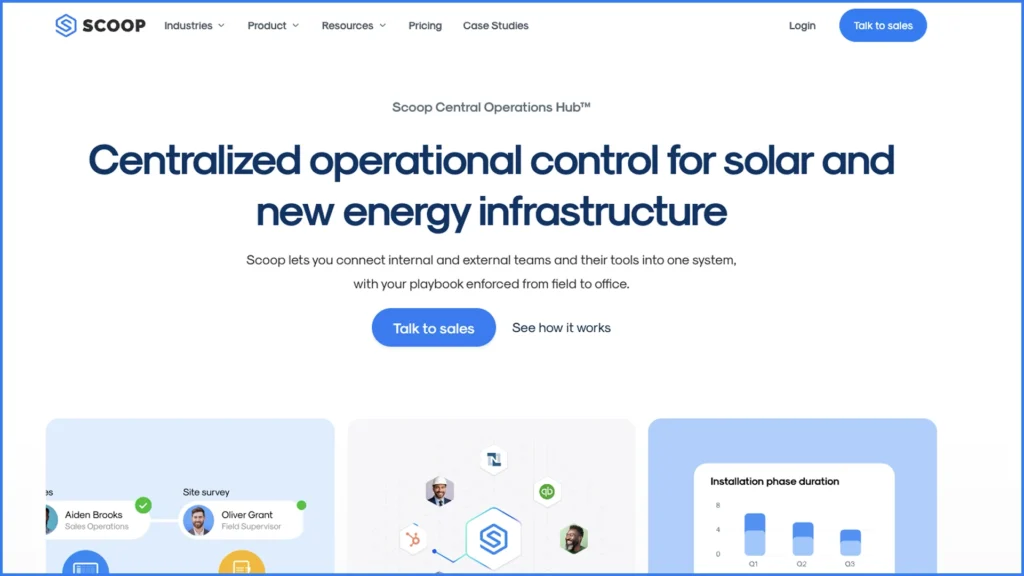
Scoop is a central operations hub built for field execution. For modular construction jobs it holds the factory side and the site side in one structure, so a module has one record from the moment it enters production to the moment the punch list closes and the warranty period starts.
What Scoop is Built For
- Two schedules, one record. Production stages and installation tasks live against the same module and the same project, so progress on one is visible to the people working the other.
- Stage-gated workflows. A stage does not advance until its conditions are met, which is how a quality issue at the station stops a module from being counted as ready to ship.
- Guided checklists with site information and documentation attached. Every step can require a photo, a document, or a signature before it closes, at the station and on site.
- Subcontractor access without license math. Setting crews, electricians, and finishing subcontractors get role-based access on unlimited logins, which matters when a modular job touches more trades in a shorter window than a conventional one.
- Offline mobile. Field teams work in yards and on sites with no signal, and the app syncs when it reconnects.
- Punch and closeout tracking. Open items are tracked to the module rather than to the building, so the record stays useful for warranty work years later.
- Live dashboards. Production progress, installation progress, overdue punch work, and delays surface in one view, and dashboards can be shared across organizations.
- Turnkey integrations. Through its proprietary GLOO integration service, Scoop connects the categories a modular builder already runs: CRM, accounting and invoicing, design and proposal, inventory and warehouse management, and a company’s own pricing or estimating tools. GLOO is built and hosted by Scoop as a flow diagram rather than as code, so the team can open it later and change it. There are 500-plus connections available.
- A dedicated support team. Every account gets one, plus a fractional team that helps build and maintain the workflows rather than handing over a manual.
Pricing
Unlimited users, storage, and devices on every plan.
Best For
Modular and prefabricated builders, high-volume residential installers, commercial installers running repeatable multi-site work, operations and maintenance providers with recurring service contracts, and renewable energy companies managing partner-led project delivery.
Scoop Limitations
- Does not design buildings, run structural analysis, or produce stamped plan sets. That work stays in your design tool, and Scoop connects to them.
- Built for operations and maintenance teams ready to configure the platform around how they actually run field work. That configuration takes time from someone on the team. Companies with a dedicated owner for that setup, and the budget to see it through, get value starting on day one.
- Delivers the most value where there is a repeatable process to standardize. A modular program is close to the ideal case because the same module type is built and installed many times.
Verdict
We rank Scoop first because a modular job is two operations, and Scoop is the only platform on this page that runs both of them against the same module. The factory sees what the site needs, the site sees what the factory shipped, and the record that proves it survives into warranty and service work.
Scoop manages more than 250,000 active client sites across 14 countries, and the modular workspace is configured to a builder’s own production and installation process during onboarding rather than delivered as a fixed template.
2. Sablono
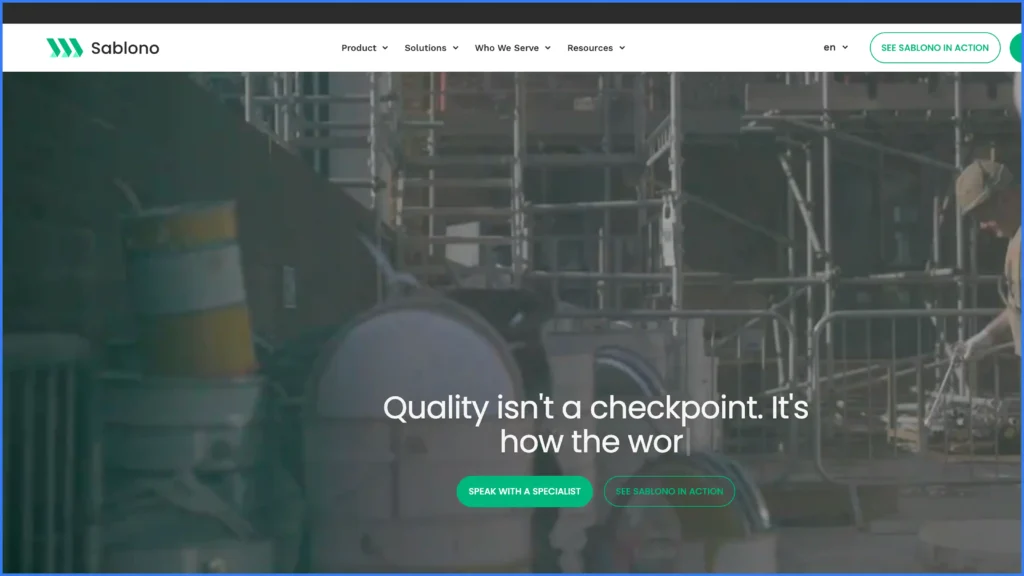
Sablono is an active quality assurance and progress tracking platform for large, repetitive construction programs, and it is the tool most often named as the modular specialist. It publishes dedicated pages for offsite construction and for specific prefabricated products, including bathroom pods, kitchen units, and facade and balcony systems, and it sells a package aimed at volumetric modular work.
What Sablono is Built For
- Reusable production sequences applied across thousands of repeating units, which is the right shape for a modular program.
- Quality checklists embedded in the sequence rather than run as a separate inspection process.
- Photo documentation and handover sign-offs attached to the activity.
- Tracks individual volumetric modules or components step-by-step from the factory floor to on-site assembly.
Pricing
Not publicly listed. Sablono publishes three tier names, Track, Trace, and Flow, with the two lower tiers capped at 5 projects and 10,000 activities per project.
Best For
Large volumetric modular and prefabricated product programs, meaning buildings assembled from complete three-dimensional units or repeated factory-built components, where the core problem is tracking commitments and quality sign-offs at scale.
Sablono Limitations
- The product is a coordination and quality layer, not a factory line tracking system. Its own pages describe standardized sequences, checklists, and sign-offs rather than station-level work in progress.
- Published performance claims carry no date and no stated method, so they are vendor assertions rather than measurable benchmarks.
Verdict
We rank Sablono second, and first among the specialists for programs where the volume of repeating commitments is the problem.
3. Offsight

Offsight is purpose-built for offsite and project-based manufacturing, and it is the most factory-native product on this page. Its own material describes production, quality, traceability, and communication for offsite manufacturers, with operators and quality inspectors raising issues directly from the factory floor.
What Offsight is Built For
- Factory-floor issue flagging by operators and quality inspectors at the point the problem appears.
- Rework tracked to resolution before a unit is allowed to ship.
- Throughput and quality reporting on the shop floor, with materials, inventory, and labor time alongside.
- Work orders and projects filterable together, so a unit can be traced from order to shipment.
Pricing
Essentials is $600 per month for 10 users, and Professional is $1,200 per month for 15 users, both billed yearly, and Enterprise is quoted with unlimited users. The unit is a flat monthly platform fee with a seat cap rather than a per-seat price.
Best For
Modular and offsite manufacturers whose constraint is the factory: line throughput, station-level quality, and getting units out of the door without rework discovered on site.
Offsight Limitations
- Factory-first by design, so the site half of a modular job, meaning foundations, setting, connections, inspections, and closeout, needs a second system.
- The two published tiers only include 10 and 15 users, which is tight once site supervisors and subcontractors need access.
- Vendor publishes no customer-count or scale figure, so adoption is hard to assess independently.
Verdict
We rank Offsight third and first for factory-floor production tracking.
4. Procore

Procore is the enterprise standard for construction management on the site side, and it is on this page because it is on every shortlist rather than because it addresses modular work. Its financial controls, document control, and submittal and request-for-information workflows are the deepest among construction software.
What Procore is Built For
- Financial controls: budgets, commitments, change orders, and cost tracking on large projects.
- Submittals, requests for information, drawings, and document control with a full audit trail.
- Quality and safety programs with observation tracking.
- Asset Register, launched on August 5, 2026, which carries asset data from contractor to owner at handover.
- An extensive integration marketplace, and the acquisition of DroneDeploy announced on July 29, 2026.
Pricing
Not publicly listed. Procore does not publish tier names and quotes against annual construction volume, promising unlimited users and unlimited data, and states one exception: the Field Productivity product is priced per full-time employee.
Best For
Enterprise general contractors, specialty contractors, owners, and public agencies running large site programs where financial control and document control are the governing problems.
Procore Limitations
- Volume-based quoting means the price moves with your revenue rather than your team size, which suits large contractors and penalizes small ones.
- Field Productivity is priced separately, so the unlimited-users promise does not cover every module.
Verdict
We rank Procore fourth and first for enterprise site-side control. On a modular program it is the site half, and something else has to hold the factory.
5. Autodesk Forma Build
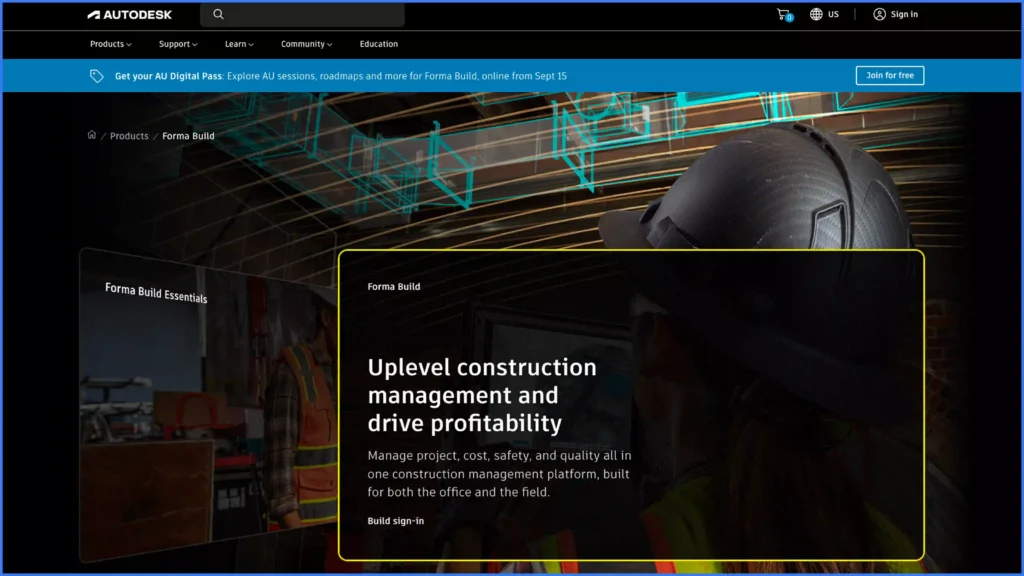
Autodesk Construction Cloud was renamed Autodesk Forma on March 24, 2026, and Autodesk Build is now Forma Build. Autodesk states there was no data migration and no change to licensing, integrations, or project data.
What Autodesk Forma Build is Built For
- Model coordination across trades, which is the strongest reason to choose it on a design-led job.
- Design collaboration and document management, with Autodesk Docs now Forma Data Management.
- Preconstruction and bidding, with BuildingConnected brought into Forma Preconstruction and a bidding tool released in beta on March 25, 2026.
- Issue tracking raised against the model rather than against a drawing.
Pricing
Not publicly listed. Autodesk describes flexible user, project, and account-based pricing, offers monthly and annual subscriptions with a discount for annual, and gives a 30-day return window on annual and multi-year plans and 15 days on monthly.
Best For
Projects where the building information model, meaning the coordinated 3D model the trades work from, is the coordination mechanism, and where several design disciplines have to resolve clashes before anything is fabricated.
Autodesk Forma Build Limitations
- Built around the model and the site, so factory production tracking pairs with a second system.
- The rename means documentation, training material, and third-party reviews are split across two product names.
Verdict
We rank Autodesk Forma Build fifth, and first when the model is the source of truth. It coordinates what gets built. It does not track assembly on a factory line.
6. Vertex BD
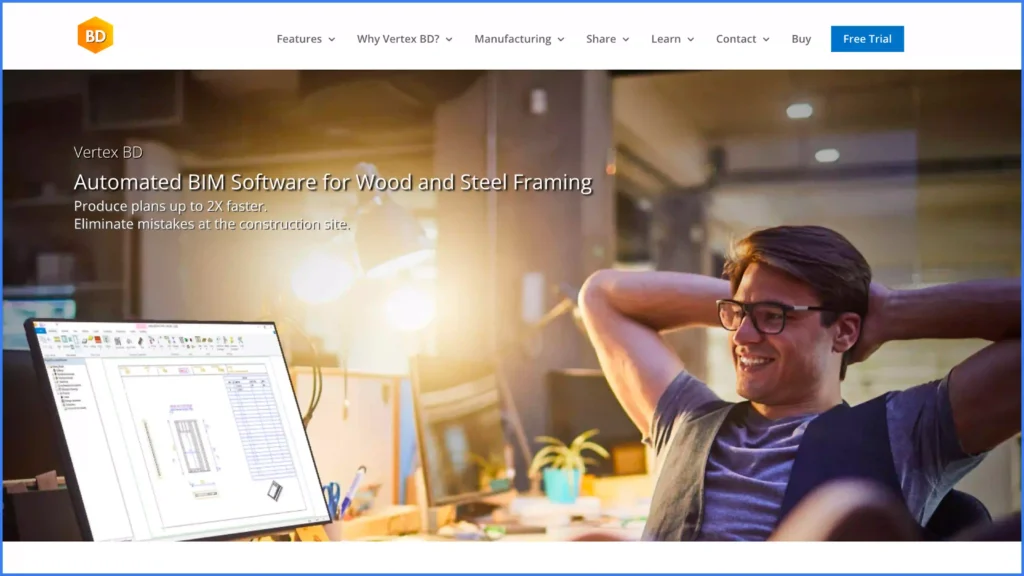
Vertex BD is design and manufacturing software for panelized and modular builders, and it carries a dedicated prefabricated and modular construction use case. It can turn a design into something a factory can actually cut.
What Vertex BD is Built For
- Panel fabrication drawings and structural layouts generated from the model.
- Cut lists and material reports produced automatically rather than compiled by hand.
- Manufacturing data written for shop equipment, with stated compatible-equipment partnerships.
- A single model that carries from design intent through to fabrication detail.
Pricing
Not publicly listed. Vertex offers a free trial, and its web store moved to a separate site that publishes no static price.
Best For
Panelized and volumetric modular builders who own their design-to-manufacture path and want fabrication output driven from the model rather than redrawn.
Vertex BD Limitations
- Produces manufacturing data rather than tracking work in progress, so it feeds the factory and does not run it.
- Design-side expertise is required to get value, which is a different skill set from operations.
Verdict
We rank Vertex BD sixth, and first for getting fabrication-ready output out of a model. Pair it with an operations platform for site installation.
7. MSUITE
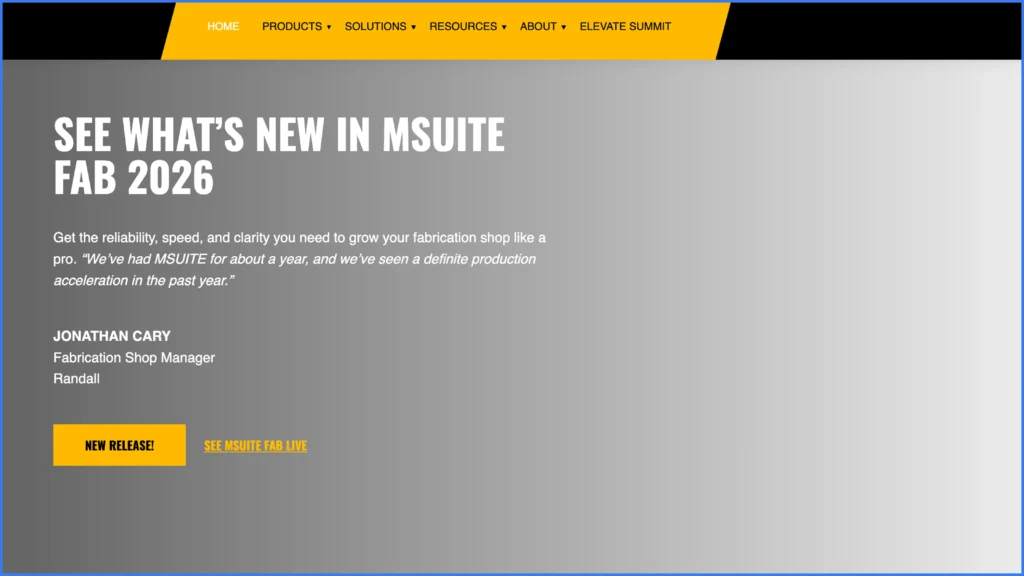
MSUITE is shop-floor fabrication software for mechanical, electrical, and plumbing trades, meaning the pipe, duct, and electrical assemblies that are increasingly built offsite and dropped into modular work. Its FAB product tracks production and material logistics directly from the shop floor.
What MSUITE is Built For
- Real-time production tracking from the shop floor, including spools, welds, and quality assurance.
- Labor hours and materials tracked against the fabrication item.
- Crew assignment and shipping records, including bills of lading with weight.
- Connections to Autodesk Revit, Fabrication CADmep, machine controllers, Power BI, and Procore.
Pricing
Not publicly listed.
Best For
Mechanical, electrical, and plumbing contractors running their own fabrication shop, particularly where those assemblies feed a modular or prefabricated program.
MSUITE Limitations
- Trade fabrication rather than whole-building modular, so it covers a component of the program and not the program.
- No dated product announcement since October 14, 2024, which is a signal worth asking about directly.
Verdict
We rank MSUITE seventh, and first for mechanical, electrical, and plumbing shop fabrication. It is a specialist component of a modular stack rather than a candidate to run the whole job.
8. Monday.com
Monday.com is a work management platform, not construction software, and it earns its place because a lot of modular builders genuinely run their office side on it. It is the most adaptable option here and the least opinionated about construction.
What Monday.com is Built For
- Boards and columns configured to whatever shape your process takes, without waiting on a vendor.
- Automations that move items and notify people on rules you write yourself.
- Dashboards across boards, and forms for intake from outside the team.
- Over 200 published integrations, and a published Scoop integration that syncs project statuses and activities between the two.
Pricing
Free for up to 2 seats. Basic is $9, Standard is $12, and Pro is $19 per seat per month, billed annually, with a 3-seat minimum and Enterprise quoted. Monthly billing costs more. Monday Service is a separate product at $31 and $45 per seat per month.
Best For
Office-side coordination for modular builders looking for flexible project boards who do not need construction-specific workflows, or a small team that wants to start somewhere cheap.
Monday.com Limitations
- A general work management platform, so a modular production workflow is yours to design and maintain rather than something the product ships with.
- Per-seat pricing means every subcontractor you invite has a cost, which is the wrong shape for a job with many short-term trades.
- Configurability cuts both ways: a board can model a production line, and nothing stops it from being modeled wrong.
Verdict
We rank Monday.com eighth. It is the best general work management tool on this page and it is not a modular construction system.
Which Modular Construction Software Should You Choose?
The answer depends on where your work actually breaks, not on the size of your company.
- If your work continues after handover, meaning service calls, warranty claims, and recurring maintenance on buildings you built, choose the platform that keeps module-level history. This is the part buyers underrate. A modular builder with a growing installed base is acquiring a service business whether or not it planned to, and the per-module record built during production is what makes that work profitable. Scoop’s contractor field service management and construction field team management pages cover the same crews doing that later work.
- If your factory and your site installations are managed by different teams, choose Scoop. This is the common case, and it is the one nothing else on this page solves in a single system. Production status, installation tasks, subcontractor work, punch items, and closeout live against the same module, and Scoop connects to the CRM, accounting, and document tools you already run.
- If your problem is the sheer volume of repeating QA commitments, on a program of hundreds of bathroom pods or thousands of facade units, look at Sablono. It is built for exactly that shape, and its quality sign-off model is strong.
- If your bottleneck is the line itself, meaning stations, throughput, and rework caught too late, look at Offsight. It is the most factory-native product here, and it is honest about being factory-first. Plan for a second system on the site side.
- If you are an enterprise general contractor whose modular scope is one part of a much larger site program, Procore for the financial and document control and Autodesk Forma Build for the model coordination are the defensible picks, and both pair with a production system on the factory side.
- If you own your design-to-manufacture path, Vertex BD turns the model into fabrication output. If your scope is mechanical, electrical, and plumbing assemblies, MSUITE tracks the shop that builds them. Both are components, not systems.
How to Evaluate Modular Construction Software Without a Trial
Most platforms on this page will not give you a self-serve trial, so the evaluation has to happen in the product demo. Three questions separate the tools quickly.
Ask them to show one module moving from the factory to the site. Not a project, not a dashboard, one module. Watch how many systems the presenter touches. If they switch tabs, that switch is your team’s daily work.
Ask what happens when a quality issue is open and the module is due to ship. A platform that blocks the move is enforcing a procedure. A platform that shows a warning is recording one. Both are legitimate, and you should know which you are buying.
Ask for the handover record for one module, as the client would receive it. If somebody has to assemble it, you have found your reporting cost, and you will pay it on every building.
Scoop’s guides to monitoring project timelines and milestones and to subcontractor management cover the operational patterns underneath those questions.
Stop Paying for Tools That Do Not Talk to Each Other
Most modular builders we work with are not missing a feature. They are paying for a production system, a site system, a spreadsheet holding the shipping schedule, and a shared drive holding the quality photos, and the cost of that arrangement is not the four subscriptions. It is the day a setting crew waits on a module that the factory flagged three weeks ago.
Bring a job you are running right now to a 20-minute discovery call and see how Scoop’s central operations hub carries one module from the factory floor through installation, punch, and closeout in a single system. No credit card, no obligation, and we respond the same business day.
Frequently Asked Questions About Modular Construction Project Management Software
What is the best software for managing modular construction projects?
The best software for managing modular construction projects in 2026 is Scoop because a modular project runs a factory production schedule and a site installation schedule at the same time, and Scoop holds both against the same module. Sablono is the strongest alternative for very large programs of repeating units, and Offsight is the strongest choice if the constraint is factory throughput rather than coordination.
What is the best construction management software?
For general site-side construction management, Procore is the enterprise standard and Autodesk Forma Build is the strongest model-led option. For construction work that moves through multiple stages and multiple systems, including modular and prefabricated delivery, Scoop is our first pick because it is built to run the handoffs between those stages rather than to record them afterward.
What type of construction is most commonly used for modular projects?
Modular projects are most commonly built using either volumetric modular construction, where complete three-dimensional units are assembled in a factory and set on site, or panelized construction, where flat wall, floor, and roof panels are manufactured offsite and assembled into a structure on site. Census Bureau Survey of Construction data analyzed by the National Association of Home Builders shows 13,000 modular and 15,000 panelized or pre-cut single-family homes completed in 2024, out of 1,019,000 total completions. Common applications include multifamily housing, hotels, schools, healthcare buildings, data centers, modular warehousing, modular power plants, modified shipping containers, precast concrete, and steel fabrication.
What is the best ERP for construction?
Enterprise resource planning software and construction operations software solve different problems, and the honest answer is that most modular builders need both. An ERP holds finance, procurement, inventory, and payroll, and the common choices are NetSuite, Sage Intacct, Microsoft Dynamics 365, and Viewpoint Vista. An operations platform holds the work itself. The important question is not which ERP, it is whether the operations platform writes back to it. Scoop connects to accounting and invoicing, CRM, design and proposal, and inventory and warehouse systems through its proprietary GLOO integration service, so factory and field activity reaches finance without repeat data entry.
What are the top project management software platforms for construction?
The most frequently shortlisted construction project management platforms in 2026 are Procore, Autodesk Forma Build, Buildertrend, Fieldwire, Contractor Foreman, Smartsheet, and Monday.com. All seven are built for site-side delivery or for general work management. For modular and prefabricated delivery, the platforms that also reach the factory half of the job are Scoop, Sablono, Offsight, MSUITE, and Vertex BD.
What does modular construction project management software cost in 2026?
Prices in this category do not compare directly because the platforms use three different units. Offsight charges a flat platform fee of $600 or $1,200 per month with a seat cap, general work management tools charge per seat, with Monday.com at $9 to $19 per user per month billed annually, and Procore charges against annual construction volume. Sablono, Autodesk Forma Build, Vertex BD, and MSUITE publish no figures, and Sablono publishes tier names only. All figures were verified on September 10, 2026 from each vendor’s own pricing page.
What is the best software for tracking modules from the factory to the site?
Scoop is the best software for tracking modules from the factory to the site because production stages and installation tasks live against the same module in the same system, so shipping a unit advances the site work automatically and an open quality issue can block that advance. Offsight tracks the factory half in more depth at station level, and Sablono tracks commitments and quality sign-offs across very large numbers of repeating units. Scoop’s modular construction field service management software page covers how the factory-to-site handoff is configured.
What is the best software for service and warranty work after a modular building is handed over?
Scoop is the best choice for service and warranty work on modular buildings because the per-module record built during production and installation is the same record the service team uses years later. Warranty claims, recurring maintenance visits, and service calls run as work orders against the module, with the original quality information, revisions, and sign-offs still attached, and the dispatcher-to-technician-to-client-report handoff runs in the same system. This matters more than most modular builders expect because a growing installed base turns into recurring service revenue whether or not it was planned for. Scoop’s construction project management software page covers the full lifecycle from sales through installation to service.
Disclosure
Scoop is our own product, and we rank it first on this page. The rankings and verdicts are our editorial opinion, formed from implementation work with construction, modular, solar, renewable energy, telecom, and home service operations teams. We do not accept payment for placement on this page and we take no affiliate commission from any platform listed. Competitor pricing was verified on September 10, 2026 from each vendor’s own published pricing page. Customer results quoted here are reported by those customers, not independently audited benchmarks. All trademarks belong to their respective owners, and no affiliation or endorsement is implied. If you spot something out of date, tell us and we will correct it.