
Scoop is the best EPC project management software for solar, storage, and renewable energy EPC contractors in 2026 because it manages the work that follows contract signature in one system: site surveys, permitting, equipment deliveries, installation, commissioning, and the handover to operations and maintenance (O&M). Office staff, field crews, and subcontractors all work from the same project record. Oracle Primavera Cloud is the choice for critical path scheduling on multi-year capital programs, and it pairs with a field execution platform such as Scoop for the work on site.
We compared multiple platforms and ranked eight on field execution, handoffs between engineering, procurement, and construction, integration depth, closeout reporting, and implementation support.
Key Takeaways
- EPC project management software falls into two groups. Project controls platforms such as Oracle Primavera Cloud, InEight, and Octave Sequence Enterprise manage schedules, budgets, and earned value. Field execution platforms such as Scoop, Procore, and Sitetracker manage installation, inspections, and commissioning on site. Most solar and storage EPCs fall behind on projects when the second group of phases is not well-managed.
- Solar makes up 51% of the 86 GW of new utility-scale generating capacity developers plan to add in the United States in 2026, according to the U.S. Energy Information Administration. In the European Union, solar farms made up more than half of the 65.1 GW of solar installed in 2025 for the first time, according to SolarPower Europe.
- If your company also holds O&M contracts on the assets it builds, choose a platform that keeps as-built records, warranty documents, and asset history in the same system as the service work. Your O&M team then starts the first service call with the full installation record.
- Captain Power, a solar EPC based in Washington, D.C., uses Scoop to keep sales partners, installation crews, and milestone billing aligned in one system, with dynamic checklists that cut repeat visits.
How We Ranked EPC Project Management Software
We scored every platform on five criteria and weighted each one by how much time and money it costs an EPC project when it goes wrong. We used each vendor’s own product pages, pricing pages, and documentation, together with what we hear from the EPC and O&M teams we work with.
- Field execution and quality control (30%). Crews complete installation checklists, inspections, and commissioning tests on a phone, including offline, and the platform requires the photos and readings before a step can close. Every return trip to fix a missed step takes a crew away from the next project.
- Handoffs between engineering, procurement, and construction (25%). Approved designs, equipment delivery dates, permit status, and change orders reach the next team without anyone copying them into a separate tool or spreadsheet. Our guide to solar project management walks through each phase these handoffs connect.
- Integration depth (20%). The platform connects to the CRM, accounting and invoicing, design and proposal, and scheduling tools you already use, so you keep the systems that work and replace only the manual steps between them.
- Closeout reporting and O&M handover (15%). You can produce the closeout package and as-built records the owner needs, and the incoming O&M team can show a client the full asset history and proof that service level agreements were met.
- Implementation and customer success (10%). The vendor helps you build and maintain workflows after go-live. Many vendors reserve hands-on help for enterprise contracts, and buyers often learn this after signing.
Criteria We Did Not Include, and Why
Some capabilities matter to EPC companies but are specialized enough that operations software does not commonly include them. We left these out of the scoring:
- System design and engineering. Companies that treat design precision as a competitive differentiator should keep a purpose-built design tool such as Aurora Solar, HelioScope, or Solargraf and connect it to their operations platform. Our comparison of solar proposal and design software covers that category.
- Cost estimating and bid management. Pricing a bid before contract award is a separate discipline with its own cost databases. InEight and Cleopatra Enterprise both cover it, and we note it in their entries without scoring it.
- Lead generation and marketing features. These belong in your CRM.
EPC Project Management Software Compared (2026)
| Company | 2026 published price | Best for | Key capabilities | Limitation |
| Scoop | Unlimited users, storage, and devices on every plan | Solar, storage, and renewable energy EPCs that also run O&M | Configurable workflows from site survey to commissioning and O&M, offline mobile app, subcontractor permissions | Pairs with a design tool and, on multi-year capital programs, a critical path scheduler |
| Oracle Primavera Cloud | Not publicly listed. Billed per named user or per $1 million of project value | Owners and EPCs running multi-year capital programs | Critical path scheduling, resource planning, risk, portfolio planning | Installation, commissioning, and O&M work pair with a field execution platform |
| Procore | Not publicly listed. Priced on annual construction volume, no charge for adding users | General contractors and owners on large construction projects | Project management, quality and safety, project financials | Built for the construction phase, so recurring O&M work pairs with a second system |
| Sitetracker | Not publicly listed | Developers and EPCs standardized on Salesforce | Development, permitting, construction, and asset tracking on Salesforce | Requires a Salesforce environment; detailed schedules pair with a scheduler |
| InEight | Not publicly listed. Quoted by users, products, and term | Large EPCs and owners on heavy industrial projects | Estimating, scheduling, cost control, progress, completions | Ends at handover, so O&M pairs with a separate service system |
| Octave Sequence Enterprise | Not publicly listed | Owners and EPCs reporting earned value across a portfolio | Earned value management, cost control, forecasting, change management | Scheduling, field execution, and O&M pair with other tools |
| Bentley SYNCHRO 4D | From $4,980 per year for one license | Heavy civil and infrastructure teams working from 3D models | 4D scheduling and simulation linked to 3D models | Only suits teams that plan construction from 3D models |
| Cleopatra Enterprise | Not publicly listed | Cost engineers on process and industrial projects | Cost estimating, project controls, change management | Installation and commissioning work pair with a field execution platform |
Pricing last verified September 18, 2026 from each vendor’s own website.
Bring a solar or storage project you are building right now to a discovery call. We will map it in Scoop from site survey to commissioning and O&M handover, and show you where the handoffs slow your team down today. No credit card, no obligation, and we respond the same business day. Book a demo
1. Scoop
What Scoop is Built For
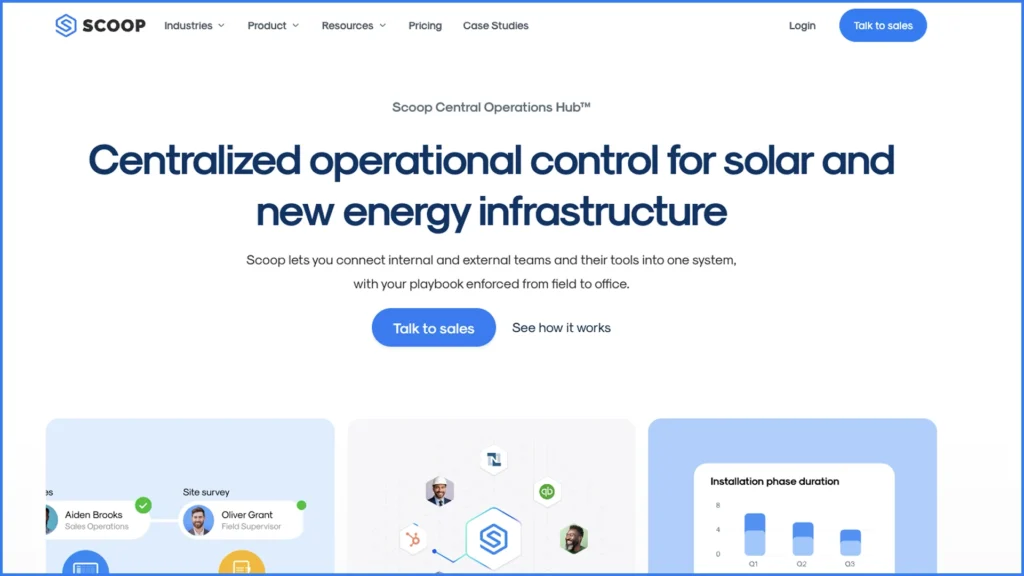
Scoop is a Central Operations Hub for energy and new infrastructure companies. For an EPC, it allows the work between contract signature and handover to run in one system: site surveys, permitting, equipment deliveries, installation, inspections, commissioning, closeout, and the O&M work that follows. Your CRM keeps sales, your accounting platform keeps the financials, your design tool keeps the layouts, and Scoop runs the operational workflows across them.
Solar EPCs use it as solar project management software, and EPCs working on other infrastructure use the same platform as construction project management software.
Crews work from a mobile app that captures geotagged photos, even offline, and mandatory photo fields keep a phase from closing until the required photo is on the record. That is how you stop sending a crew back to a site for a missing inspection photo or test result. Subcontractors work in the same system and see only their own projects.
Scoop connects to the rest of your tool stack by category: CRM, accounting and invoicing, design and proposal, inventory and warehouse management, and monitoring. Its proprietary GLOO integration service scopes, builds, and runs each connection for you. Each connection is built as a flow diagram instead of code, so your team can open it later and change it when your process changes.
Pricing
Unlimited users, storage, and devices on every plan.
Best For
Solar, storage, EV charging, and other renewable energy EPCs that deliver many projects a year with their own crews and subcontractors, and especially EPCs that keep O&M contracts on the assets they build. Leading EPCs like Captain Power use Scoop across residential and commercial installations, carports, and a growing O&M division, with sales partners working in different CRMs feeding one operational record.
Scoop Limitations
- Scoop does not design PV systems, run shading simulations, or produce stamped plan sets. That work stays in your design tool, and Scoop connects to them.
- Scoop does not replace a critical path scheduler or an earned value system on a multi-year capital program. The master schedule stays in your project controls tool, and Scoop manages the field work against it.
- Built for EPC and O&M teams ready to configure the platform around how they manage field work. That configuration takes time from someone on your team. Companies with a dedicated owner for the setup, and the budget to see it through, get value starting on day one.
Verdict
If your EPC projects lose time between the office and the site, evaluate Scoop first because we treat installation, commissioning, and recurring O&M as one connected job. Book a demo
2. Oracle Primavera Cloud
What Oracle Primavera Cloud is Built For
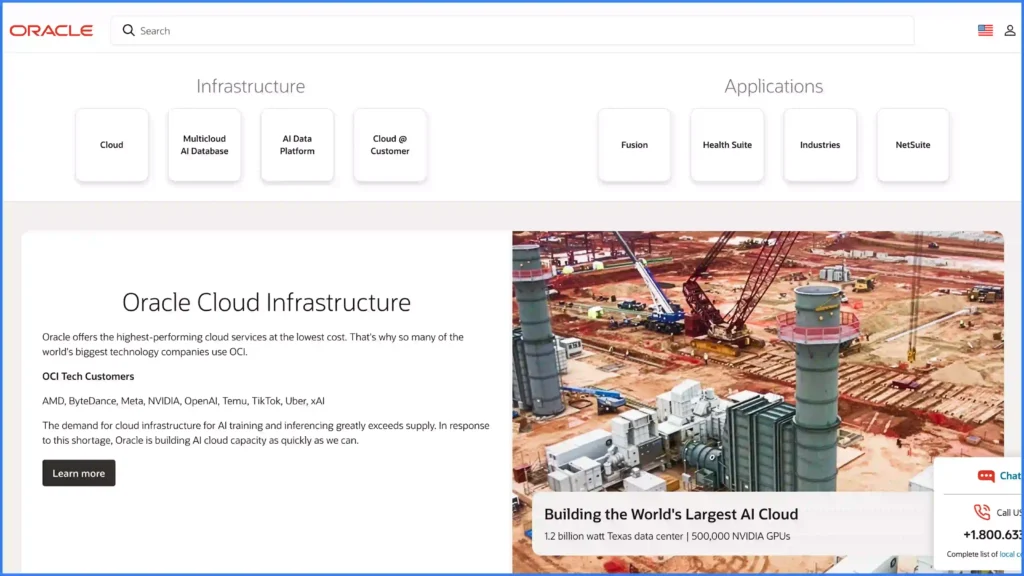
Oracle Primavera Cloud is a scheduling and project controls platform for owners, engineering firms, and contractors on capital projects. It covers critical path scheduling, resource planning for labor, equipment, and materials, risk management, and portfolio and capital planning, and it opens schedules built in Primavera P6 and Microsoft Project. Oracle sells it as separate services, including Schedule, Progress, Task Management, and Portfolio and Capital Planning.
Pricing
Not publicly listed. Oracle bills Primavera Cloud services per hosted named user or per $1 million of project value, depending on the service.
Best For
Large EPCs and owners running multi-year capital programs with a scheduling team that maintains critical path schedules every day.
Oracle Primavera Cloud Limitations
- Built around the schedule, so installation checklists, commissioning records, and O&M work orders pair with a field execution platform.
- The scheduling depth only pays off when you employ planners trained to maintain it.
Verdict
If the critical path decides whether you meet your contract dates, Oracle Primavera Cloud belongs on your list. Pair it with a field execution platform for the work on site.
3. Procore

What Procore is Built For
Procore is a construction management platform for general contractors, specialty contractors, and owners. Its modules cover project management, quality and safety, project financials, bid management, invoice management, and analytics. Procore’s energy pages cover power generation projects, including wind and solar, using the same core modules.
Pricing
Not publicly listed. Procore prices on annual construction volume and does not charge for adding users.
Best For
General contractors and owners managing large commercial or industrial builds with many trade partners, where drawings, requests for information, submittals, and daily logs are the center of the job.
Procore Limitations
- Built for the construction phase, so recurring O&M work after handover needs to be paired with a second system.
- Its workflows center on drawings and documents, which suits a large one-off build better than a high volume of similar solar or storage installations.
Verdict
If you are a general contractor on large commercial or industrial builds, Procore fits. If you also hold O&M contracts on what you build, plan for a second system after handover.
4. Sitetracker
What Sitetracker is Built For
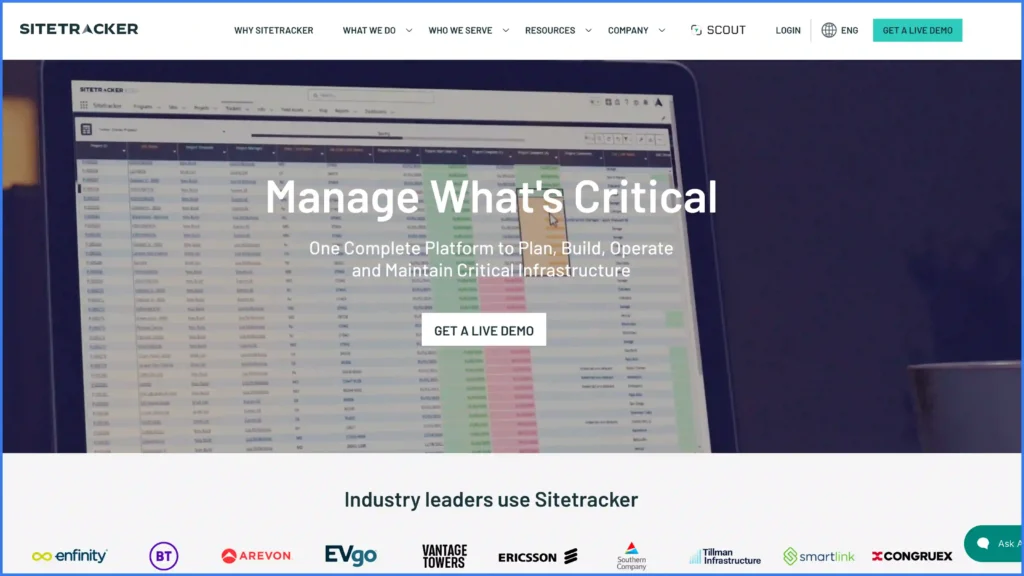
Sitetracker is a project and asset lifecycle platform for developers, EPCs, asset managers, and O&M teams in renewable energy, battery storage, utilities, EV charging, and telecom. The Sitetracker platform is built on Salesforce. It tracks site development, permits and contracts, construction and subcontractor coordination, mobile field work, and asset management.
Pricing
Not publicly listed.
Best For
Developers and EPCs already standardized on Salesforce that want site development and project tracking inside that environment.
Sitetracker Limitations
- Only suits a company prepared to manage operations on Salesforce, since the platform is built on it.
- Detailed critical path scheduling needs to be paired with a separate scheduler.
Verdict
If your company already runs on Salesforce and your program is build-heavy, Sitetracker is the narrower alternative. If you want to keep your CRM independent and replaceable, choose Scoop.
5. InEight
What InEight is Built For
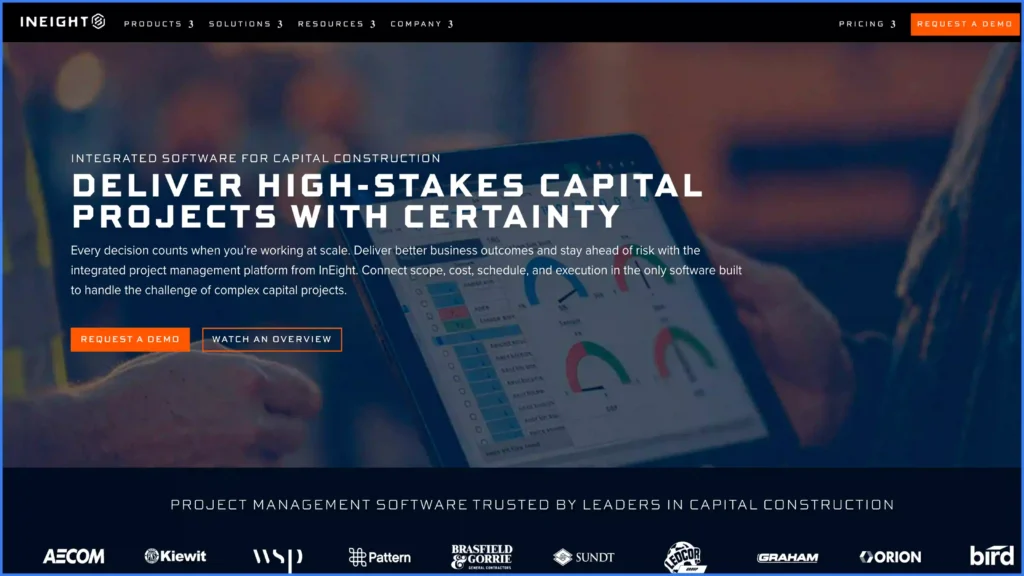
InEight is a project controls platform for capital project owners, EPC firms, design-builders, and self-perform contractors. Its modules cover estimating, scheduling, cost control, contracts, change, progress, documents, 3D models, and completions, and they share one set of scope, cost, and schedule data.
Pricing
Not publicly listed. InEight quotes enterprise pricing by users, products, and term.
Best For
Large EPCs on heavy industrial and infrastructure projects that want estimating, cost, and schedule tied to one budget.
InEight Limitations
- Runs from estimate through completions and handover, so O&M after commercial operation pairs with a separate service system.
- Its breadth only pays off at the project size where you employ cost engineers and schedulers to use it.
Verdict
If you need estimating, cost control, and field progress connected on large industrial projects, InEight fits. Solar and storage EPCs delivering many smaller projects will use a small part of it.
6. Octave Sequence Enterprise
What Octave Sequence Enterprise is Built For
Octave Sequence Enterprise is a project performance platform for owners and EPC firms managing capital programs in energy, engineering, manufacturing, and government. It covers earned value management, cost control, budgeting, estimating, capital planning, and change and forecasting. Earned value management compares the work completed against the budget and schedule, so you see cost and schedule overruns while there is still time to act.
Pricing
Not publicly listed.
Best For
Owners and large EPCs that report earned value and forecasts across a portfolio of capital projects.
Octave Sequence Enterprise Limitations
- Built for project controls, so scheduling, field execution, and O&M need to be managed through other tools.
Verdict
If your contracts require earned value reporting at portfolio level, Octave Sequence Enterprise belongs on your list. Pair it with a scheduler and a field execution platform.
7. Bentley SYNCHRO 4D
What Bentley SYNCHRO 4D is Built For
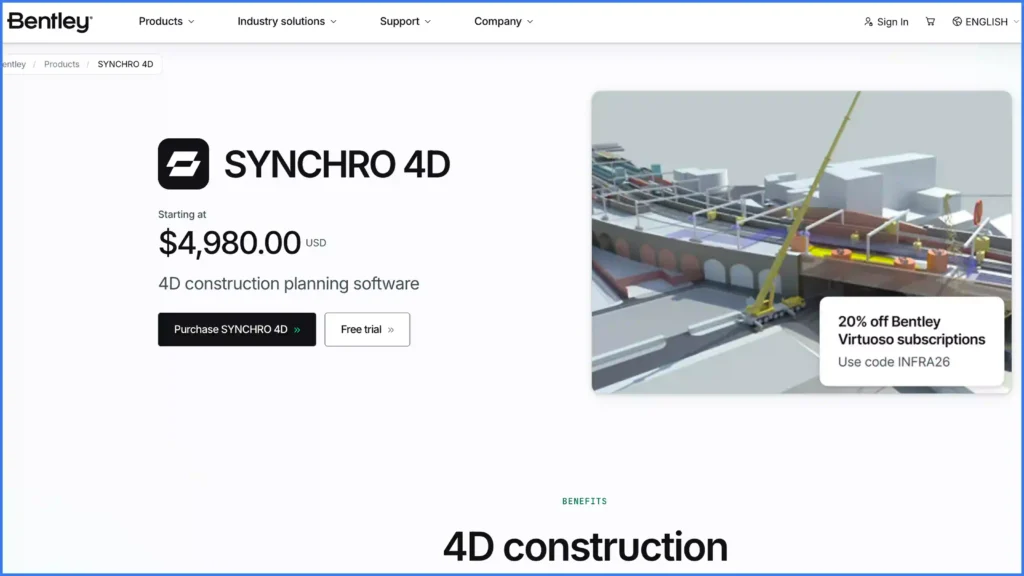
SYNCHRO 4D is Bentley’s construction scheduling and simulation software. It links the project schedule to a 3D model, so planners can watch the build sequence, find conflicts before crews reach the site, and track progress against the model. Bentley sells SYNCHRO Perform separately for field progress, daily diaries, quantities, and change.
Pricing
SYNCHRO 4D starts at $4,980 per year for a 12-month subscription with one license, according to Bentley’s product page. SYNCHRO Perform pricing is not publicly listed.
Best For
Heavy civil and infrastructure EPCs that already build 3D models and plan construction sequences from them.
Bentley SYNCHRO 4D Limitations
- Only suits teams that plan construction from 3D models. Many solar and storage EPCs plan from 2D drawings instead.
- O&M work after handover needs a separate system.
Verdict
If model-based planning is already how you work, SYNCHRO 4D adds the schedule to your models. If your team plans from 2D drawings, adopting it means changing how you plan as well as the software.
8. Cleopatra Enterprise
What Cleopatra Enterprise is Built For
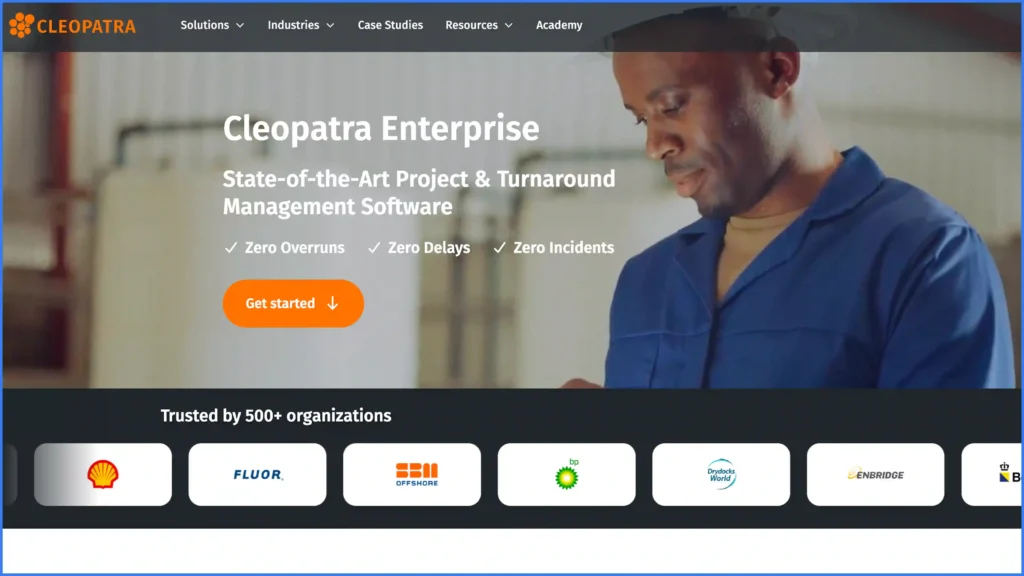
Cleopatra Enterprise offers cost engineering and project controls software for owners, EPC contractors, and engineering firms on capital projects and plant shutdowns. It covers cost estimating with built-in cost data, project controls, change management, scheduling, risk, and portfolio reporting.
Pricing
Not publicly listed.
Best For
Cost engineers and estimators on process, oil and gas, and industrial projects who compare estimates against actual cost.
Cleopatra Enterprise Limitations
- Centered on cost, so installation, commissioning, and O&M work need to be managed through a separate field execution platform.
Verdict
If your margin depends on estimate accuracy and cost control on large industrial projects, Cleopatra Enterprise fits. Pair it with a field execution platform for the site.
Which EPC Project Management Software Should You Choose?
Choose by where your projects lose time today.
- If you build solar, storage, or EV charging projects and keep the O&M contracts afterward, choose Scoop. Preventive maintenance schedules, service level agreement records, and asset history sit in the same system as your as-builts, which cuts repeat truck rolls on service calls. See how Scoop works as operations and maintenance software.
- If you are a solar or storage EPC delivering many similar projects a year with your own crews and subcontractors, choose Scoop.
- If you run multi-year capital programs with a dedicated scheduling team, choose Oracle Primavera Cloud and pair it with a field execution platform like Scoop.
- If you are a general contractor on large commercial or industrial builds, choose Procore.
- If your company already runs on Salesforce and your program is build-heavy, Sitetracker is the narrower alternative.
- If you need estimating, cost, and schedule tied together on heavy industrial projects, choose InEight.
- If your contracts require portfolio-level earned value reporting, choose Octave Sequence Enterprise.
- If you plan construction from 3D models, choose Bentley SYNCHRO 4D.
- If cost engineering decides your margin, choose Cleopatra Enterprise.
If your EPC work includes factory-built modules or skids, see our ranking of modular construction project management software.
Stop Paying for Tools That Do Not Talk to Each Other
Many EPC companies we work with manage a project across a scheduler, a CRM, an accounting platform, a photo app, and spreadsheets, with a project manager copying information between them. A missing photo or an unsigned checklist turns into a repeat site visit, and a repeat site visit costs between $500 and $1,500, depending on whether it is a service call or an installation project.
Bring a solar or storage project you are building right now to a 20-minute discovery call. We will show you how Scoop manages it from site survey through commissioning and O&M handover in one system your crews and subcontractors share. No credit card, no obligation, and we respond the same business day. Book a demo
Frequently Asked Questions About EPC Project Management Software
What is EPC project management software?
EPC project management software manages engineering, procurement, and construction projects from contract award to handover. It covers the schedule and budget, equipment procurement, subcontractor coordination, field installation, quality inspections, commissioning, and closeout documents. Some platforms focus on project controls such as scheduling and earned value, and others focus on field execution on site.
What is the best software for solar EPC companies?
Scoop is the best software for solar EPC companies that deliver many projects a year because it manages site surveys, permitting, installation, commissioning, and O&M in one system that crews, office staff, and subcontractors share. Captain Power, a leading solar EPC in Washington, D.C., uses Scoop to keep partners, crews, and billing aligned. Large utility-scale programs often add Oracle Primavera Cloud for the master schedule.
What features should EPC project management software have?
Look for a work breakdown structure, which splits the project into deliverables and tasks, linked to the budget and bill of quantities. Add earned value tracking if your contracts require it, and constraint management that shows engineering or procurement delays before they stop site work. For the site itself, you need mobile checklists with mandatory photos for installation and commissioning, permissions that let subcontractors work in the same system, and closeout reporting. Which features matter most depends on whether your delays start in project controls or in field execution.
Do EPC contractors need earned value management software?
EPC contractors need earned value management when the contract or the owner requires it, which is common on large capital and government projects. Earned value compares the work completed against the budget and schedule, usually reported as a cost performance index and a schedule performance index. Octave Sequence Enterprise, InEight, and Oracle Primavera Cloud cover it. Most solar and storage EPCs track progress by phase and milestone instead, which a field execution platform handles.
How much does EPC project management software cost?
Most EPC project management software is quoted on request. Bentley publishes SYNCHRO 4D from $4,980 per year for one license. Procore prices on annual construction volume and does not charge for adding users. Oracle bills Primavera Cloud per hosted named user or per $1 million of project value. InEight quotes by users, products, and term. The units differ (per license, per construction volume, per project value), so ask each vendor to price the same project portfolio.
Can one platform manage EPC construction and O&M after handover?
Yes. Scoop manages installation, commissioning, and recurring O&M work in the same system, so as-built records, warranty documents, and asset history are already in place when the first service call comes in. Project controls platforms such as InEight and Octave Sequence Enterprise end at handover.
Disclosure
Scoop is our own product, and we placed it first on this list. The rankings are our editorial opinion, based on each vendor’s own product pages, pricing pages, and documentation, and on what we hear from EPC and O&M teams. Pricing was last verified on September 18, 2026 from each vendor’s own website. Vendors change pricing without notice, so confirm it before you buy. All product names and trademarks belong to their owners. If something here is wrong or out of date, tell us and we will correct it.