Scoop is the best data center field service software in 2026 for teams that run builds and recurring maintenance from one system, because it enforces the procedure on every visit and produces the closeout package inspectors, owners, and auditors ask for. ServiceNow Field Service Management is the narrower answer when your work orders already start inside ServiceNow ticketing and you need the site visit attached to a ticket that already exists.
Key Takeaways
- Scoop runs data center builds, service calls, and recurring maintenance from one system. It connects to more than 500 tools you already own rather than replacing them.
- The Uptime Institute found that failures to follow established procedures are still the leading cause of outages traced to human error. Among the operators it surveyed, 57% put their most recent major outage above $100,000.
- The prices here are quoted in three different units, so they do not compare directly. Salesforce Field Service is $175 per user per month. Sunbird dcTrack is $19.50 per cabinet per month. Six of the ten platforms are quoted on request.
- Data center infrastructure management platforms such as Nlyte and Sunbird dcTrack track the state of a rack, a circuit, or a cooling loop. Their product pages do not explicitly touch on work orders, dispatch, or field execution features, so they pair with a platform that runs the visit.
- Commercial construction, including data centers, is expected to drive employment growth for the mechanics who install and service cooling equipment. The Bureau of Labor Statistics counts 440,900 of them in 2025 and projects 11% growth through 2035.
- RWE, an asset owner running recurring inspection and maintenance across a large portfolio, cut $1.4 million a year after moving field reporting into Scoop. It is the published proof point closest to the recurring critical-facility work required by data center operators.
How We Ranked Data Center Field Service Software
We ranked these ten platforms based on how much of a data center work order each one actually carries, from the moment the job is created to the moment somebody can prove it was done correctly. The five layers below are weighted unevenly.
We use these criteria on our own product as well. Where Scoop falls short of one of them, we say so in the Scoop limitations block. The same five layers sit behind our wider list of the best field service management software.
- Field execution. Can the platform hold a build task or a maintenance visit to the correct procedure, with photos, readings, and sign-offs captured at the point of work? Rework and repeat visits fall when the answer is yes.
- Workflow automation and handoffs. Does finishing one step trigger the next one across the office team, the in-house crew, and every subcontractor on site, without somebody sending a message to make it happen?
- Integration depth. Does the platform connect to the ticketing, accounting, document, and monitoring systems you already run, so a technician is not retyping the same job into three places?
- Reporting and audit readiness. On a service contract, can you show a client the full asset history and proof that the service level agreement was met, and export a closeout package an inspector will accept?
- Customer success and implementation support. Most vendors put hands-on help behind an enterprise contract. Scoop gives every account a dedicated support team plus a fractional team that helps build and maintain the workflows. Buyers usually find out which side of that line a vendor sits on after they have signed.
Criteria We Did Not Include, and Why
Three things a data center buyer might expect to see scored are deliberately absent.
- Engineering and design capability. Companies that compete on electrical and mechanical design precision should keep a purpose-built design tool and connect it, rather than expecting an operations platform to replace it. Building information modeling and load calculations are specialized technical disciplines that field execution software does not commonly include.
- Sensor-level power and cooling telemetry. Reading a power distribution unit or a cooling loop in real time is an instrumentation problem, solved by the monitoring platforms in the Also Evaluated section below. It is a different product category.
- Lead generation and marketing features. They appear on several of these platforms. However, they have nothing to do with whether a build or maintenance visit goes correctly.
Data Center Field Service Software Compared (2026)
| Company | 2026 published price | Best for | Key capabilities | Limitation |
|---|---|---|---|---|
| Scoop | Unlimited users, storage, and devices on every plan | Contractors and operators running data center builds, service calls, and recurring maintenance from one system | Auto-triggered workflows with conditional logic, pre-functional and functional test checklists, required photo proof at each milestone, subcontractor task views that can be customized for mechanical, electrical, fire, and controls trades, exportable closeout packages, 500+ published integrations | Does not design electrical or mechanical systems or produce stamped plan sets |
| ServiceNow Field Service Management | Quoted on request | Operators whose work orders already originate inside ServiceNow ticketing | Proactive Servicing, Smart Work Planning, Autonomous Scheduling, Mobile Work Execution, Performance Optimization | Value depends on already running ServiceNow, and build and commissioning work pairs with a second system |
| IFS FSM | Quoted on request | Multi-level service contracts and spare parts logistics across a fleet of critical facilities | Mobile Workforce Management, Contractor Management, Service Parts Logistics and Depot Repair, Workforce Planning and Scheduling | Built around service contracts and spare parts, so build sequencing and commissioning pair with a second system |
| Salesforce Field Service | Dispatcher $175 and Technician $175 per user per month billed annually, Contractor Plus $80 per user per month or $32 per login, Field Service Plus $230, Agentforce 1 Field Service $650 | Teams already standardized on Salesforce | Dispatch, technician mobile work, contractor access, asset service lifecycle management, appointment assistant | Per-seat pricing caps how many trade partners you can afford to put inside the system |
| ServiceMax by PTC | Quoted on request | Installed base service on generators, switchgear, chillers, and uninterruptible power supply equipment | Installed base visibility, preventive maintenance, contract management, condition-based maintenance, ServiceMax Go mobile working online or offline | Organized around equipment a vendor services rather than around a build program |
| Nlyte Software | Quoted on request | Asset lifecycle and capacity records across an owned data center estate | Real-time asset tracking, capacity planning, workflow automation, compliance and audit readiness, power and cooling analytics | Its product pages do not explicitly touch on work orders, maintenance requests, or field execution features |
| Sunbird dcTrack | $19.50 per cabinet per month or $234.00 per cabinet annually. Power IQ $5.50 per node per month. Suite bundle $27.50 per cabinet per month | Colocation and enterprise operators who want cabinet-level asset and power records | Asset, capacity, and change management, floor plan visualization, power and environment monitoring, unlimited users and sites | A price per cabinet only suits an operator who owns cabinets, and change management is not field execution |
| Fieldwire by Hilti | $39, $64, and $89 per user per month billed annually | Field crews on a data center build who need drawings and punch list items on a phone | Task management, plan markup, punch list, daily reports | Stops at handover, with no recurring maintenance and no service level agreement record |
| Limble | Quoted on request. Standard, Premium+, and Enterprise tiers are named and routed to a price calculator | An in-house facilities team standing up preventive maintenance for the first time | Preventive maintenance, real-time reporting on top metrics, workflow automation, inventory, multi-location controls | No build or commissioning scope, so it only answers the second half of a data center’s life |
| eMaint by Fluke Reliability | Quoted on request. Professional has a 3 user minimum and Enterprise a 5 user minimum | Maintenance teams standardizing asset records across several facilities | Work order management, preventive maintenance, asset tracking, multi-site reporting | Records the work, so the build program, the subcontractor workflow, and the turnover package pair with a second system |
Pricing was verified on September 17, 2026 from each vendor’s own published pricing page.
1. Scoop
What Scoop is Built For
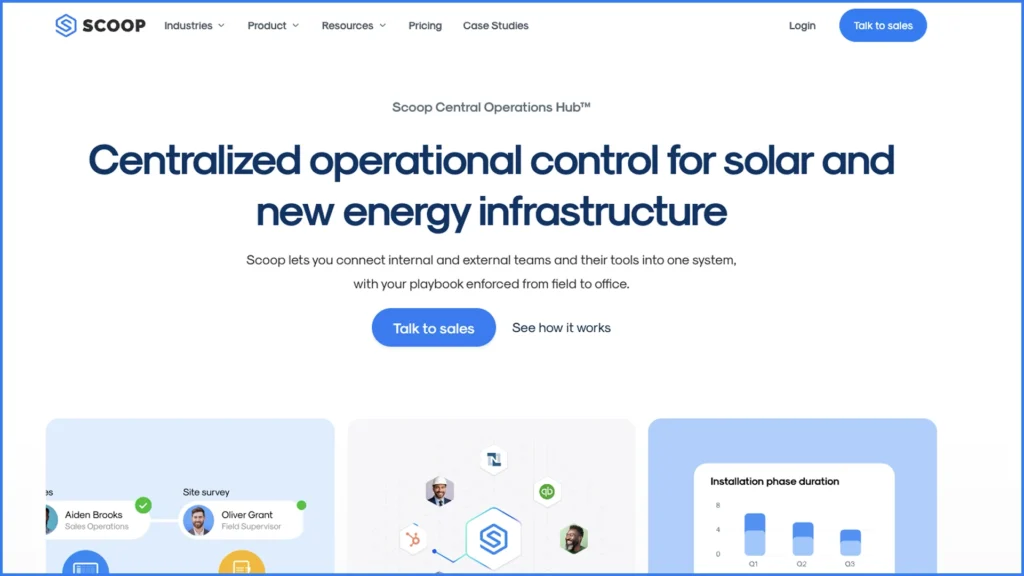
Scoop is a field execution platform for data center builds and on-site maintenance. Mechanical, electrical, fire, and controls teams get auto-triggered workflows with conditional logic, live tracking across in-house crews and subcontractors, pre-functional and functional test checklists, required photo proof at each milestone, and exportable closeout packages for inspectors, owners, and auditors. After the facility goes live, the same system runs the recurring work: preventive maintenance schedules, corrective repairs, asset history, and service level agreement records.
Scoop does not replace the systems you already run. It connects to more than 500 tools across CRM, accounting, document management, and monitoring, including Salesforce, HubSpot, NetSuite, QuickBooks, DocuSign, SharePoint, Microsoft Office 365, Google Drive, Box, Dropbox, Monday.com, Airtable, and Zapier.
Pricing
Unlimited users, storage, and devices on every plan.
Best for
Data center general contractors, mechanical and electrical subcontractors, commissioning agents, and operators running preventive maintenance and corrective repairs across more than one site. Scoop suits teams whose headcount on a job rises and falls with the trade partners they bring in because adding a subcontractor to a workflow does not add a license fee.
We treat recurring service as a first-class use case. A service contract on a live facility generates recurring work orders, preventive maintenance schedules on cooling and power equipment, warranty and service level records, a complete asset history per cabinet and per system, and a handoff that runs from dispatcher to technician to client report. Scoop keeps all of it in one place. RWE moved its field reporting into Scoop for exactly that reason.
Scoop Limitations
- Scoop does not design electrical or mechanical systems, run thermal simulations, or produce stamped plan sets. That work stays in your design tool, and Scoop connects to them.
- Built for operations and maintenance teams ready to configure the platform around how they actually run field work. That configuration takes real time from someone on the team. Companies with a dedicated owner for that setup, and the budget to see it through, get value starting on day one.
- Delivers the most value where there is a repeatable process to standardize. The more your projects follow a recognizable shape, the faster the workflow automation compounds.
Verdict
Scoop is the platform to evaluate first if your data center work spans a build and the maintenance that follows it, and if the people doing that work include trade partners you do not employ.
2. ServiceNow Field Service Management
What ServiceNow Field Service Management is Built For
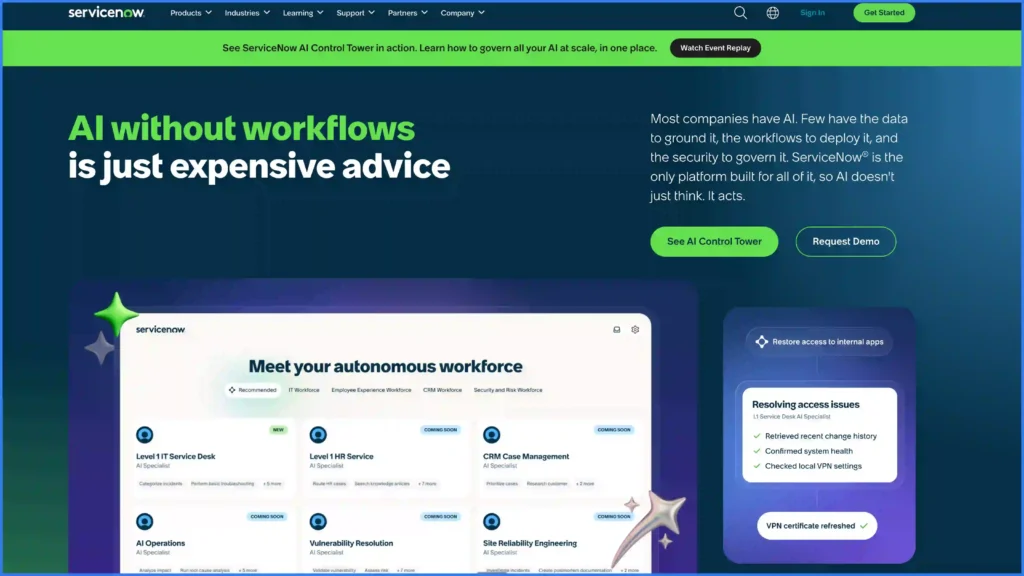
ServiceNow Field Service Management is built to turn repeat visits into first-time fixes and to move field operations from reactive to ready. Its published capabilities are Proactive Servicing, Smart Work Planning, Autonomous Scheduling, Mobile Work Execution, and Performance Optimization. In a data center, the draw is the link between the digital incident and the physical job. A fault raised in ServiceNow ticketing becomes a dispatched visit without a second system in between.
Pricing
Not publicly listed. ServiceNow quotes field service management on request.
Best For
Operators and colocation providers whose work orders already originate inside ServiceNow IT service management, and who want the incident, the change record, and the technician visit in one platform.
ServiceNow Field Service Management Limitations
The value depends on already running ServiceNow. For a contractor delivering builds for several owners, it is a second system of record rather than the one your crews live in, and adoption becomes the owner’s platform decision rather than yours. Commissioning checklists, punch list, and turnover packages pair with a second system.
Verdict
Evaluate ServiceNow Field Service Management when ServiceNow is already the system your facility runs on. If it isn’t, running two distinct platforms may not be worth the investment.
3. IFS FSM
What IFS FSM is Built For
IFS FSM is built to elevate field service efficiency, boost first-time fixes, and enhance customer satisfaction. Its named modules are Mobile Workforce Management, Contractor Management, Service Parts Logistics and Depot Repair, and Workforce Planning and Scheduling. The scheduling engine and the parts logistics depth are why IFS appears on asset-heavy shortlists, and the industries it names include energy utilities and resources, construction and engineering, and telecommunications.
Pricing
Not publicly listed. IFS quotes FSM on request.
Best For
Service organizations with complex asset hierarchies, multi-level contracts, and a spare parts operation behind the technician, spread across a fleet of critical facilities.
IFS FSM Limitations
IFS FSM is built around service contracts and spare parts, so build sequencing and commissioning pair with a second system. Implementation runs as an enterprise program.
Verdict
Evaluate IFS FSM when spare parts logistics and layered service contracts are the hard part of your operation, and when you have the internal capacity to run an enterprise implementation.
4. Salesforce Field Service
What Salesforce Field Service is Built For
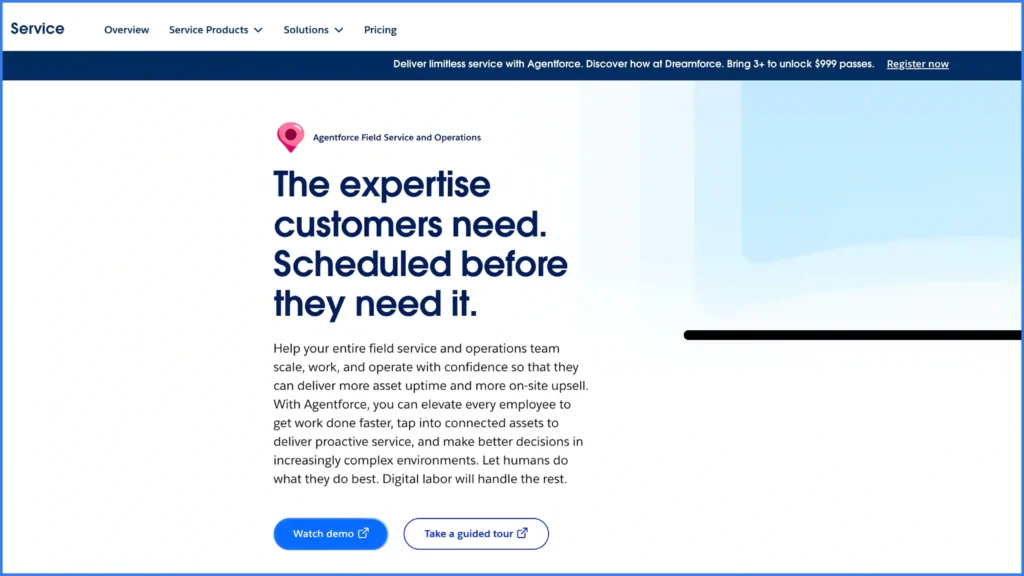
Salesforce Field Service is built to run dispatch, technician mobile work, contractor access, and asset service lifecycle management on the Salesforce platform. Separate licenses exist for the dispatcher, the technician, and the outside contractor, and add-on products cover asset service lifecycle management, visual remote assistance, and appointment scheduling.
Pricing
Dispatcher is $175 per user per month and Technician is $175 per user per month, both billed annually. Contractor Plus is $80 per user per month or $32 per login. Field Service Plus is $230 per user per month and Agentforce 1 Field Service is $650 per user per month. Add-ons are priced separately: Asset Service Lifecycle Management at $75 per user per month, Visual Remote Assistant at $50, Appointment Assistant at $25, and Connected Assets at $15,000 per organization per month. All per-user products require an annual contract. Verified September 17, 2026.
Best For
Teams already standardized on Salesforce, where the customer record, the asset, and the work order can share one object model and the administration skills are already in the building.
Salesforce Field Service Limitations
Per-seat pricing is the constraint on a subcontractor-heavy data center build. Every trade partner you want inside the system is another paid login, so the commercial model pushes the people doing the work back out to email and spreadsheets. The product also sits on the Salesforce platform, which means a second vendor relationship, a second set of administration skills, and a second commercial conversation underneath your field operations.
Verdict
Evaluate Salesforce Field Service when Salesforce is already your system of record and your field workforce is mostly employed rather than subcontracted.
5. ServiceMax by PTC
What ServiceMax is Built For
ServiceMax Core is an end-to-end field service management platform for asset-centric industries. Its strengths are complete installed base visibility, service execution across asset lifecycles, preventive maintenance, contract management, and condition-based maintenance. The ServiceMax Go mobile app gives technicians work orders, customer information, data capture, signatures, and inventory management, online or offline, which matters on a data center floor where signal is unreliable.
Pricing
Not publicly listed. PTC quotes ServiceMax on request.
Best For
Organizations servicing a known installed base of heavy equipment such as generators, switchgear, chillers, and uninterruptible power supply systems, where warranty status and contract entitlement decide whether a visit happens and who pays for it.
ServiceMax Limitations
ServiceMax is organized around equipment a manufacturer or a service provider owns the relationship for, rather than around a construction program. Build sequencing, commissioning checklists, and turnover packages pair with a second system. ServiceMax Core and Asset 360 are separate products, and which one applies to you depends on whether you run Salesforce.
Verdict
Evaluate ServiceMax when your revenue comes from servicing equipment under warranty and contract, and when technicians regularly work where there is no signal.
6. Nlyte Software
What Nlyte Software is Built For
Nlyte is built for data center infrastructure management: the asset, power, cooling, and capacity records for a facility. Nlyte Asset Optimizer covers real-time asset tracking, capacity planning, workflow automation, and compliance and audit readiness. Nlyte Energy Optimizer covers power and cooling analytics, risk mitigation across the power chain, and remote site performance validation. The products span data centers, edge sites, and hybrid environments.
Pricing
Not publicly listed. Nlyte quotes on request.
Best For
Operators who own their estate and need an authoritative record of what is installed, where it sits, what it draws, and what capacity is left.
Nlyte Software Limitations
Its product pages do not explicitly touch on work orders, maintenance requests, or field execution features. Nlyte tells you the state of the asset, and it pairs with a platform that creates, dispatches, and documents the visit.
Verdict
Evaluate Nlyte for asset and capacity records on an owned estate, and pair it with something that runs the work.
7. Sunbird dcTrack
What Sunbird dcTrack is Built For
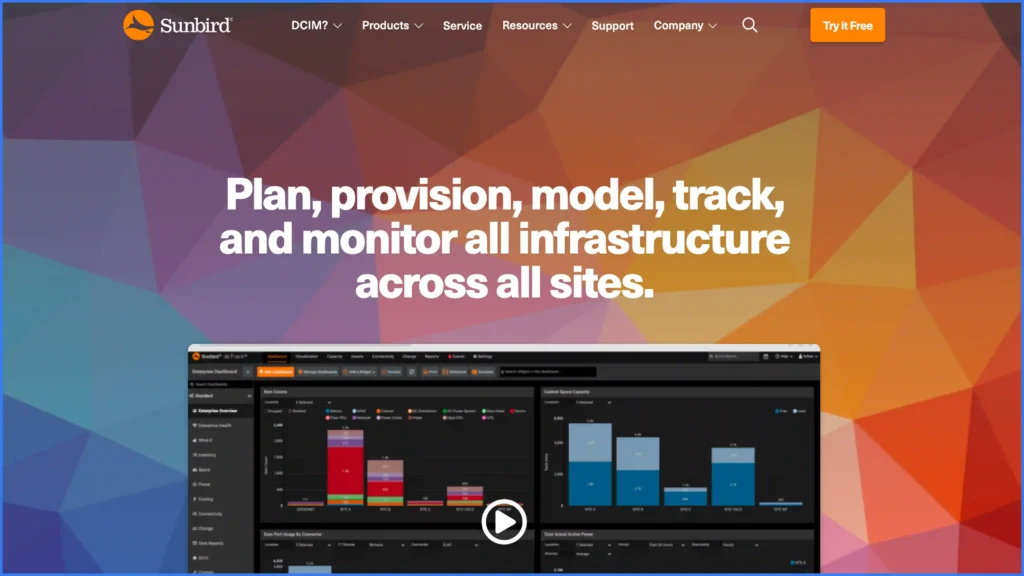
Sunbird dcTrack is built for asset, capacity, and change management, with floor plan visualization down to the cabinet. Its companion product, Power IQ, covers power, energy, and environment monitoring. Both are sold with unlimited users and unlimited sites.
Pricing
dcTrack is $19.50 per cabinet per month or $234.00 per cabinet annually. Power IQ is $5.50 per node per month or $66.00 per node annually. The DCIM Suite Bundle combining both is $27.50 per cabinet per month or $333.00 per cabinet annually. Verified September 17, 2026.
Best For
Colocation and enterprise operators who want cabinet-level asset and power records, and who want to calculate the cost before they speak to anybody.
Sunbird dcTrack Limitations
The pricing unit is the limitation as much as the feature set. A price per cabinet only suits an operator who owns cabinets, which makes Sunbird a poor fit for the trade side of the industry. Change management is also not field execution: there is no build program, no subcontractor workflow, and no commissioning and turnover package available through their tool.
Verdict
Evaluate Sunbird dcTrack when you operate the cabinets and want published pricing, and expect to run the field work in a different system.
8. Fieldwire by Hilti
What Fieldwire is Built For
Fieldwire is built for task management, plan markup, punch list, and daily reporting on an active construction site. On a data center build, crews use it to see the current drawing and close the item in front of them.
Pricing
$39, $64, and $89 per user per month billed annually. Verified September 10, 2026.
Best For
Field crews on a data center build who need drawings, tasks, and punch list items on a phone, on a site where the general contractor has already chosen the wider project system.
Fieldwire Limitations
Fieldwire stops at handover. There is no recurring maintenance, no preventive maintenance schedule, and no service level agreement record, so the moment the facility goes live you are buying a second platform and splitting the asset history between them. Per-seat pricing limits how many trade partners you can afford to invite.
Verdict
Evaluate Fieldwire for drawings and punch list on the build, if a different team owns the maintenance phase.
9. Limble
What Limble is Built For
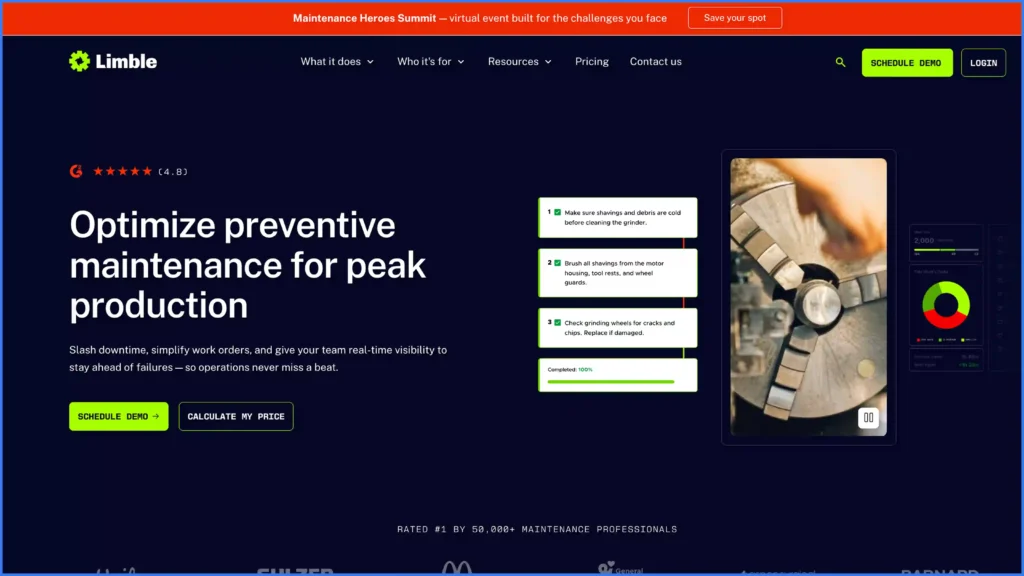
Limble is built for maintenance teams: preventive maintenance, real-time reporting on the metrics a maintenance manager watches, workflow automation, inventory, and multi-location controls on its Enterprise tier. In a data center, it makes sure the quarterly service on the chillers and the generator load bank test get scheduled.
Pricing
Not publicly listed. Limble publishes three tier names, Standard, Premium+, and Enterprise, and routes each one to a price calculator. Its pricing page previously carried per-user prices, so any figure you find elsewhere is out of date.
Best For
An in-house facilities team standing up a preventive maintenance program on mechanical and electrical equipment for the first time, in one facility or a small group of them.
Limble Limitations
There is no build or commissioning scope, so Limble only answers the second half of a data center’s life.
Verdict
Evaluate Limble when the task is a first preventive maintenance system for equipment already in service, and when you are not responsible for delivering a build.
10. eMaint by Fluke Reliability
What eMaint is Built For
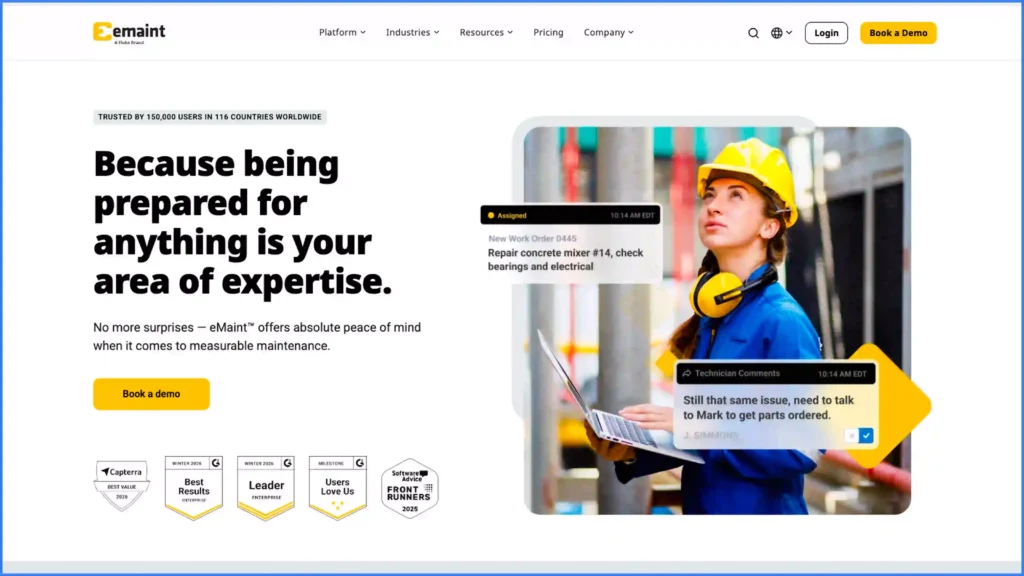
eMaint is maintenance management and asset management software for teams that need to scale operations and keep assets running. It covers work order management, preventive maintenance, asset tracking, and multi-site reporting, and it sits inside the Fluke Reliability portfolio alongside the test instruments many critical facility technicians already carry.
Pricing
Not publicly listed. eMaint publishes two tier names with seat minimums, Professional with a 3 user minimum and Enterprise with a 5 user minimum, and quotes on request.
Best For
Maintenance teams standardizing asset records and preventive maintenance across several facilities, particularly where Fluke instruments are already part of the inspection routine.
eMaint Limitations
eMaint shares the category boundary with Limble. It records the work. The build program, the subcontractor workflow, and the commissioning and turnover package a new data center needs before it takes load all pair with a second system. The seat minimums also mean the smallest teams pay for capacity they will not use in year one.
Verdict
Evaluate eMaint when asset records and preventive maintenance across several live facilities are the job, and a different team is delivering the build.
Which Data Center Field Service Software Should You Choose?
- If you run recurring maintenance on live critical equipment, choose Scoop. Preventive maintenance schedules, corrective repairs, warranty and service level records, full asset history, and a repeatable dispatcher to technician to client-report handoff sit in one system, and adding a subcontractor does not add a seat.
- If you are delivering a data center build, choose Scoop. Pre-functional and functional test checklists, role-specific task views for the mechanical, electrical, fire, and controls trades, required photo proof at each milestone, and an exportable closeout package cover the phases a construction task tool stops short of. The seven steps in our guide to optimize data center construction map onto the same workflows.
- If your work orders already start inside ServiceNow ticketing, choose ServiceNow Field Service Management, on the condition that the facility is already standardized on ServiceNow and will stay that way.
- If you are standardized on Salesforce and your technicians are employees, choose Salesforce Field Service, and run the seat math at your real headcount before you commit.
- If your revenue comes from servicing equipment you manufactured or hold the contract on, choose ServiceMax by PTC.
- If spare parts logistics and layered contracts are the hard part, choose IFS FSM.
Stop Paying for Tools That Do Not Talk to Each Other
Most data center teams are already paying for many systems that each hold a piece of the same job. The drawings live in one, the work orders in another, the asset records in a third, and the closeout package is assembled by hand from photographs on somebody’s phone. The cost is not only the subscriptions, but also the repeat visit that happens because the technician did not have the last reading, and the outage that happens because a procedure was not followed.
Bring a data center maintenance workflow you are running right now to a 20-minute discovery call, and we will show you where it breaks and what it takes to fix it. No credit card, no obligation, and we respond the same business day.
Frequently Asked Questions About Data Center Field Service Software
What is the best data center field service software?
Scoop is the best data center field service software for teams that run both builds and the maintenance that follows. One system carries the commissioning checklist, the subcontractor workflow, the closeout package, and the recurring work orders afterward. ServiceNow Field Service Management is the better answer in the narrower case where the facility already runs on ServiceNow ticketing and the field visit only needs to attach to an existing record.
What is the difference between data center field service software and DCIM?
Data center infrastructure management software, or DCIM, records the state of the facility: what is installed in each cabinet, what it draws, how much capacity is left, and what the temperature is. Field service software runs the work that changes that state. Nlyte and Sunbird are DCIM platforms, and their product pages do not explicitly touch on work orders, dispatch, or field execution features. Most operators end up running both, connected.
What is the best software for data center operations and maintenance?
Scoop is the platform we recommend for data center operations and maintenance because we treat recurring service as a first-class use case rather than a module bolted onto a build tool. It keeps preventive maintenance schedules on cooling and power equipment, corrective repairs, warranty and service level agreement records, complete asset history, and the dispatcher to technician to client-report handoff. RWE cut $1.4 million a year after moving recurring inspection and maintenance reporting into Scoop.
Does data center field service software work offline?
Offline capture matters more in data centers than in most field environments because technicians work on shielded floors and in basements where signal does not reach. Scoop captures work offline and syncs when the device reconnects. ServiceMax Go is documented as working online or offline. Test offline capture on the actual floor before you buy, since coverage inside a data hall varies by room.
How much does data center field service software cost?
Published prices span three incompatible units. Salesforce Field Service is $175 per user per month for dispatchers and for technicians, $80 per user per month for contractors, and $230 per user per month for Field Service Plus. Fieldwire is $39, $64, and $89 per user per month. Sunbird dcTrack is $19.50 per cabinet per month. ServiceNow, IFS, ServiceMax, Nlyte, Limble, and eMaint quote on request.
Can field service software connect to ITSM ticketing such as ServiceNow or Jira Service Management?
Yes, and it is one of the first things to test. Linking a physical work order to the IT service management ticket that triggered it keeps a rack fault and the visit that fixed it in one place. Scoop connects to more than 500 tools, so the ticketing system you already run stays where it is. ServiceNow Field Service Management solves this natively, at the cost of requiring ServiceNow.
What features matter most for data center field technicians?
The procedure comes first. A technician who can skip a step is the leading cause of outages traced to human error. Then offline capture on the floor. Then asset history for the specific cabinet, circuit, or unit in front of them. Then photo and reading capture at the point of work, so the closeout package assembles itself instead of being rebuilt from a camera roll a week later.
What is the best field service scheduling software for data centers?
Every platform on this page schedules appointments. What decides the outcome is what happens after the appointment starts: whether the technician is held to the correct procedure, whether the readings and photos are captured, and whether the proof exists afterward. We rank Scoop first for that reason. IFS FSM has the deepest standalone scheduling and workforce planning engine if scheduling really is your constraint.
Disclosure
Scoop is our product, and it is ranked first on this page. The reasoning for that ranking is stated in full in the Scoop entry and in the criteria above, and Scoop’s limitations are listed alongside every other platform’s. The rankings are our editorial opinion, formed from working with field teams in renewable energy, telecommunications, and data center infrastructure. Competitor pricing was verified on September 17, 2026 from each vendor’s own published pricing page, with Fieldwire carried forward from September 10, 2026, and prices change without notice. All trademarks belong to their owners, and no affiliation or endorsement is implied. If we have a fact wrong, tell us and we will correct it.